

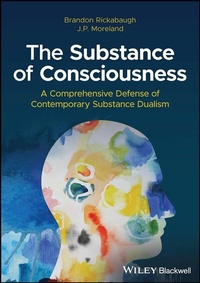
The Substance of Consciousness
Description

In The Substance of Consciousness: A Comprehensive Defense of Contemporary Substance Dualism, two distinguished philosophers deliver a unique and powerful defense of contemporary substance dualism, which makes the claim that the human person is an embodied fundamental, immaterial, and unifying substance. Multidisciplinary in scope, the book explores areas of philosophy, cognitive science, neuroscience, and the sociology of mind-body beliefs.
The authors present the most comprehensive, up-to-date, and rigorous non-edited work on substance dualism in the field, as well as a detailed history of how property and substance dualism have been presented and evaluated over the last 150 years. Alongside developing new and updated positive arguments for substance dualism, they also discuss key metaphysical notions and distinctions that inform the examination of substance dualism and its alternatives.
Readers will also find:
* A thorough examination of the recent shift away from standard physicalism and the renaissance of substance dualism
* Comprehensive explorations of the likely future of substance dualism in the twenty-first century, including an exhaustive list of proposed research projects for substance dualists
* Practical discussion of new and rigorous critiques of significant physicality alternatives, including emergentism and panpsychism.
* Extensive treatments of philosophy of mind debates about the roles played by staunch/faint-hearted naturalism and theism in establishing or presuming methodology, epistemic priorities, and prior metaphysical commitments
Perfect for professional philosophers, The Substance of Consciousness will also earn a place in the libraries of consciousness researchers, philosophical theologians, and religious studies scholars.
More details
Other editions
Additional editions
Persons
Brandon Rickabaugh is Assistant Professor of Philosophy and Research Scholar of Philosophy of Technology and Culture at Palm Beach Atlantic University. He is a fellow of the Cultura Initiative at The Martin Institute in Santa Barbara, California.
J.P. Moreland is Distinguished Professor of Philosophy at Talbot School of Theology, Biola University. He has authored or contributed to 95 books, including Does God Exist?, Universals, Consciousness and the Existence of God, and The Blackwell Companion to Natural Theology. Moreland was selected by The Best Schools as one of the 50 most influential living philosophers in the world.
Content
Acknowledgments xxii
Part I Ontologically Serious Philosophy of Mind 1
1 Substance Dualism in the 21st Century 3
2 How Staunch Naturalism Shapes the Dialectic in Philosophy of Mind 16
3 A Brief Ontological Detour: Subjects, Parts, Wholes, and Unity 43
Part II Arguments from Introspection, Self-Awareness, and Intentionality 57
4 The Real Nature of Introspection Arguments for Substance Dualism 59
5 From Self-Awareness and Intentionality to the Self as Soul 74
Part III On the Fundamental Unity of Conscious Beings 117
6 From Phenomenal Unity to the Synchronic Unity of the Immaterial Self 119
7 Mereological Essentialism and the Diachronic Endurance of the Soul 144
Part IV Updated and Novel Arguments from Modality and Libertarian Freedom 189
8 Upgrading Modal Arguments for Substance Dualism 191
9 Staunch Libertarian Agency and the Simple, Enduring Soul 234
Part V New and Neglected Responses to Common Defeaters Against Substance Dualism 273
10 Important Frequently Raised Defeaters Against Substance Dualism 275
Part VI Charting a Future for Substance Dualism 309
11 New Research Programs for 21st Century Substance Dualism 311
APPENDIX: The Soul, Mental Action, and the Conservation Laws 344
Mihretu P. Guta
Bibliography 361
Index 392
CHAPTER 1
Substance Dualism in the 21st Century
1.1 THE RETURN OF SUBSTANCE DUALISM
1.1.1 The Great Revolt Against Dualism
At the end of the 19th century, substance dualism-roughly, the thesis that the human person is comprised of a substantial immaterial soul and a physical body-was widespread. Materialism was not a live option. As U.T. Place observed,
[Ever] since the debate between Hobbes and Descartes ended in apparent victory for the latter, it was taken more or less for granted that whatever answer to the mind-body problem is true, materialism must be false.1
This sociological fact changed quickly, bringing about what William James described as "the evaporation of the definite soul-substance."2 Arthur O. Lovejoy deemed the 20th century as "the Age of the Great Revolt against Dualism."3 The inevitable defeat of substance dualism was assumed to be a foregone conclusion. Gilbert Ryle had, in the words of Daniel Dennett, "danced quite a jig on the corpse of Cartesian dualism."4
Rebellious defenders of substance dualism remained (e.g., C. J. Ducasse (1881-1969), William McDougall (1871-1938), G. F. Stout (1860-1944), Karl Popper (1902-1994), John Eccles (1903-1997)). Physicalist William Lyon goes so far as to announce
. there is no doubt at all, that by the last decades of the nineteenth century and during the first [three] decades of the twentieth century, the new scientific psychologist's view of the correct way of finding out about minds, and implicitly of the nature of minds, was deeply Cartesian.5
Yet, despite a remarkable rise in apt defenders in the latter 20th century, novel and sophisticated defenses of substance dualism were largely ignored. In the words of D. M. Armstrong, dualism was seen as "curiously formal and empty."6 Daniel Dennett incites the overall acceptance of "the dogmatic rule that dualism is to be avoided at all costs."7
Denunciations of substance dualism are often expressed quite dramatically. Here is a representative sample:
"Few ideas are as unsupported, ridiculous and even downright harmful as that of the 'human soul'."8
. dualism is akin to explaining lightning in terms of Thor's anger, and hence is fundamentally primitive and pre-scientific.9
. the concept of a non-physical soul looks increasingly like an outdated theoretical curiosity.10
To defend dualism is to close one's eyes to the enormous and ongoing scientific developments in the mind and brain sciences in the past few centuries-and to wallow in mystery.11
"Immaterial mind" or "soul," like "élan vital," "elf," or "chupacabras," are ghostly expressions that come from mistaken frameworks or conceptions and do not refer to anything.12
There is no spirit-driven life force, no throbbing, heaving, pullulating, protoplasmic, mystic jelly. Life is just bytes and bytes and bytes of digital information.13
Notice that these quotations employ mere rhetorical devices. John Searle has pointed out at least four rhetorical devices used in the philosophy of mind to either ridicule opposing views or hide the implausibility of one's view.14 Searle's observations apply equally to so many dismissals of substance dualism.
- The use of technical jargon to cover up the implausibility of one's view.15
- The stylistic use of prose to evade clearly stating one's argument.16
- Naming an opposing view (e.g., "the Cartesian intuition"), to which one then denies by name and not by content.17
- The covering up of one's troubling view by means of an analogy with a scientific discovery of the past that also seemed silly or ignorant.18
To Searle's list, we add a fifth device.
- The practice of associating substance (and, sometimes, property) dualists with accepting the existence of spooks or spooky stuff, ghosts, or other paranormal entities is best left to the pages of The National Enquirer. These labels function as a way of associating dualism with astrology, the occult, or other superstitious views contrasting with physicalism, which is the clear implication of tough-minded progress in the hard sciences.19
One would hope that such unabashed ridicule would reflect the great strength of anti-dualist arguments. But, as we will demonstrate in the chapters to come, that hope is questionable if not outright ungrounded.
1.1.2 The Resurgence of Substance Dualism
Fast forward to the late 20th and early 21st centuries. Things are changing. We are witnessing a resurgence of substance dualism. Physicalism remains the dominant view in the philosophy of mind. Yet, it is no exaggeration to say that substance dualism is undergoing an unforeseen revival and is poised to make a strong return in the 21st century. These reasons are not mere sociological reflections but expressions of the rapid growth in sophisticated new work on substance dualism. A large number of recently published book-length defenses of substance dualism evidence this, along with collections of new pro-substance dualism papers. The number of journal articles defending substance dualism is too long to list.20 Conspicuous by their absence are substantive engagements with these works.
1.2 THE CASE AGAINST SUBSTANCE DUALISM WEAKENS
1.2.1 Admissions to the Weakness of Standard Objections to Substance Dualism
In addition to the resurgence of substance dualism, some non-dualists argue that standard objections to substance dualism are less triumphant than previously thought. After working through standard arguments against substance dualism, Jose´ Gusma~o Rodrigues, himself a Russellian monist, concludes,
A significant part of current literature on the mind-body problem, personal identity and other general metaphysical questions seems to me rife with anti-dualistic assumptions without good arguments to back it [sic] up. Such an attitude is dogmatic and contrary to good philosophical spirit.21
Likewise, materialism William Lycan admits,
Being a philosopher, of course I would like to think that my stance is rational, held not just instinctively and scientistically and in the main-stream but because the arguments do indeed favor materialism over dualism. But I do not think that, though I used to. My position may be rational, broadly speaking, but not because the arguments favor it: Though the arguments for dualism do (indeed) fail, so do the arguments for materialism. And the standard objections to dualism are not very convincing; if one really manages to be a dualist in the first place, one should not be much impressed by them.22
In Chapter 10, we will argue in detail that the standard objections to substance dualism fail in ways even staunch anti-dualists must acknowledge.
1.2.2 Admitting the Faith of Anti-Dualism
Another striking phenomenon is the growing recognition that eschewing substance dualism is essentially the expression of faith in naturalism, faith in what Karl Popper referred to as promissory materialism: that in the not-too-distant future, science will provide an in-principle explanation of all phenomena in the world, including consciousness.23
David Chalmers observes, "The main residual motivation to reject substance dualism may simply lie in the term's negative connotations."24 If Chalmers is correct, then the rejection of substance dualism is most likely driven primarily by mere ideological allegiance-by faith-rather than rigorous argument. John Searle expresses this posture well.
[We] have a terror of falling into Cartesian dualism. The bankruptcy of the Cartesian tradition and the absurdity of supposing that there are two kinds of substances or properties in the world, "mental" and "physical," is so threatening to us and has had such a sordid history that we are reluctant to concede anything that might smack of Cartesianism.25
As a result, substance dualism has not been tried and found wanting so much as it has been judged unacceptable and left untried.
1.2.3 Proposals of Naturalistic Substance Dualism
Indeed, the presumption of naturalism and atheism fuels most rejections of substance dualism. Why else would the guilt by religious association objection be relevant? This habit is not well thought out; some naturalists acknowledge as much. As Michael Martin, perhaps one of the leading atheists of the past 100 years, states, "atheism is not materialism . atheism is compatible with various forms of mind-body dualism."26 Graham Oppy makes the same observation.27 Atheist Evan Fales observes,
A naturalist who is not sanguine about the reducibility of the mental to the physical has several options. These include token-token identity theories such as functionalism, property dualism, and-more daringly-substance dualism.28
Naturalism, according to Fales, plausibly commits one to reject the existence of disembodied minds. But substance dualism does not entail disembodied minds, nor is naturalism incompatible with substance dualism.29 Likewise, naturalist Eric Steinhart explains,
While many...
