

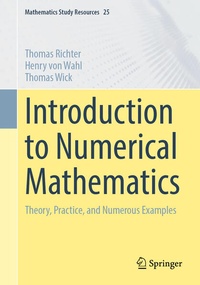
Introduction to Numerical Mathematics
Description

This textbook presents the theoretical foundations of numerical mathematics in a modern, application-oriented, and comprehensive way. In addition to the standard content, it includes numerous examples and practical excursions to sustainably enhance understanding. Proofs are presented in a very detailed, step-by-step manner. The recurring core concepts of numerical mathematics like accuracy, efficiency, robustness and stability are explicitly addressed and clearly distinguished from one another. Specific example calculations for the described algorithms are carried out using provided Python codes. Numerical modeling for aspects of machine learning and neural networks are taken into consideration. Furthermore, numerical methods from linear algebra and analysis are presented separately, which significantly facilitates students' access to numerical mathematics - based on the two main lectures within undergraduate studies in mathematics. Therefore, the book is ideally suited for students of mathematics, physics, computer science, or engineering.
This book is a translation of the original German 2nd edition of "Einführung in die Numerische Mathematik" (Springer, 2024). The translation was done with the help of artificial intelligence. A subsequent revision was performed by the authors to further refine the work and to ensure that the translation is appropriate concerning content and scientific correctness.
More details
Other editions
Additional editions
Persons
Thomas Richter is a professor for Numerical Mathematics at Otto von Guericke University Magdeburg. His research focuses on the numerical treatment of complex problems in fluid mechanics.
Henry von Wahl is a lecturer at Friedrich Schiller University Jena. His research focuses on numerical methods for partial differential equations using advanced finite element methods.
Thomas Wick is a professor for Scientific Computing at Leibniz University Hannover. His research focuses on the numerics of unsteady, nonlinear, coupled partial differential equations.
Content
Introduction.- Part I Numerical Methods of Linear Algebra.- Fundamentals of Linear Algebra.- Linear Systems.- Orthogonalization Methods and QR Factorization.- The Eigenvalue Problem.- Krylov Subspace Methods.- Part II Numerical Methods of Analysis.- Fundamentals of Calculus.- Root Finding Problems.- Interpolation and Approximation.- Numerical Integration.- Mathematical Optimization and Artificial Neural
Networks.
