

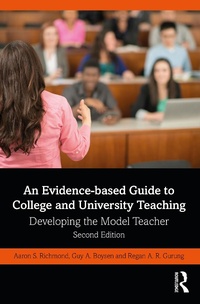
An Evidence-based Guide to College and University Teaching
Developing the Model Teacher
2nd Edition
Published on 29. November 2021
246 pages
978-1-000-48690-2 (ISBN)
Description

An Evidence-based Guide to College and University Teaching outlines a definition of "model teaching" based on research evidence and accepted best practices in high education.
Teachers at all levels of skill and experience can benefit from clear, objective guidelines for defining and measuring quality teaching. To fulfil this need, this book outlines six fundamental areas of teaching competency-model teaching characteristics-and provides detailed definitions of each characteristic. The authors define these essential characteristics as training, course content, the assessment process, instructional methods, syllabus construction, and the use of student evaluations. This guide outlines through research and supplemental evidence how each characteristic can be used toward tenure, promotion, teaching portfolios, and general professional development. Additional features include a self-assessment tool that corresponds to the model teaching characteristics, case studies illustrating common teaching problems, and lists of "must reads" about college teaching.
An Evidence-based Guide to College and University Teaching describes how college faculty from all disciplines and at all levels of their career - from graduate students to late-career faculty - can use the model teaching characteristics to evaluate, guide, and improve their teaching. The book is additionally useful for teachers, trainers, and administrators responsible for promoting excellence in college teaching.
Teachers at all levels of skill and experience can benefit from clear, objective guidelines for defining and measuring quality teaching. To fulfil this need, this book outlines six fundamental areas of teaching competency-model teaching characteristics-and provides detailed definitions of each characteristic. The authors define these essential characteristics as training, course content, the assessment process, instructional methods, syllabus construction, and the use of student evaluations. This guide outlines through research and supplemental evidence how each characteristic can be used toward tenure, promotion, teaching portfolios, and general professional development. Additional features include a self-assessment tool that corresponds to the model teaching characteristics, case studies illustrating common teaching problems, and lists of "must reads" about college teaching.
An Evidence-based Guide to College and University Teaching describes how college faculty from all disciplines and at all levels of their career - from graduate students to late-career faculty - can use the model teaching characteristics to evaluate, guide, and improve their teaching. The book is additionally useful for teachers, trainers, and administrators responsible for promoting excellence in college teaching.
Reviews / Votes
"Books on how to teach are usually written by educational researchers or by teachers. The strength of this book is that all three authors are both. They are influential researchers on pedagogy and award-winning teachers. They know how to integrate research, which generally focuses on one or two factors, into the complex whole that is teaching. This book provides readers with a coherent framework for thinking about their teaching, along with evidence-based approaches to use to improve teaching. This book is more than a set of teaching tips. It is a cycle of self-reflection, innovation, assessment, and more self-reflection, to help readers develop into model teachers." -- Stephen L. Chew, Professor of Psychology Samford University, USA; Chair, National Institute on the Teaching of Psychology (NITOP)"What a phenomenal resource for the world of college and university teaching. This book skillfully walks the reader through a very detailed playbook on how to work towards becoming a model teacher. With a clear identification of the six areas of model teaching, the authors provide case studies, self-assessment, evidence-based content, and even 5 book suggestions for anyone who desires further study in one of the areas of model teaching. Written in a friendly and fun style, this book is an essential resource for anyone who desired to teach well at the college and university level." -- Todd Zakrajsek, University of North Carolina at Chapel Hill, USA "Books on how to teach are usually written by educational researchers or by teachers. The strength of this book is that all three authors are both. They are influential researchers on pedagogy and award-winning teachers. They know how to integrate research, which generally focuses on one or two factors, into the complex whole that is teaching. This book provides readers with a coherent framework for thinking about their teaching, along with evidence-based approaches to use to improve teaching. This book is more than a set of teaching tips. It is a cycle of self-reflection, innovation, assessment, and more self-reflection, to help readers develop into model teachers." -- Stephen L. Chew, Professor of Psychology Samford University, USA; Chair, National Institute on the Teaching of Psychology (NITOP)
"What a phenomenal resource for the world of college and university teaching. This book skillfully walks the reader through a very detailed playbook on how to work towards becoming a model teacher. With a clear identification of the six areas of model teaching, the authors provide case studies, self-assessment, evidence-based content, and even 5 book suggestions for anyone who desires further study in one of the areas of model teaching. Written in a friendly and fun style, this book is an essential resource for anyone who desired to teach well at the college and university level." -- Todd Zakrajsek, University of North Carolina at Chapel Hill, USA
More details
Edition
2nd edition
Language
English
Place of publication
London
United Kingdom
Publishing group
Taylor & Francis Ltd
Target group
College/higher education
Professional and scholarly
Illustrations
31 Tables, black and white; 16 Line drawings, black and white; 16 Illustrations, black and white
ISBN-13
978-1-000-48690-2 (9781000486902)
Copyright in bibliographic data and cover images is held by Nielsen Book Services Limited or by the publishers or by their respective licensors: all rights reserved.
Schweitzer Classification
Other editions
Additional editions
Aaron S. Richmond
An Evidence-Based Guide to College and University Teaching
Developing the Model Teacher
Book
12/2021
Routledge
Unfortunately, price unknown
Available (delivery time upon request)
Aaron S. Richmond | Guy A. Boysen | Regan A. R. Gurung
An Evidence-based Guide to College and University Teaching
Developing the Model Teacher
Book
11/2021
2nd Edition
Routledge
€74.50
Shipment within 15-20 days
Aaron S. Richmond | Guy A. Boysen | Regan A. R. Gurung
An Evidence-based Guide to College and University Teaching
Developing the Model Teacher
Book
11/2021
2nd Edition
Routledge
€205.60
Shipment within 15-20 days
Persons
Aaron S. Richmond is a Professor at Metropolitan State University of Denver. He earned his bachelor's degree from the University of Montana, Western and is doctorate at the University of Nevada, Reno. He is an award-winning teacher and scholar who loves learning with, and teaching his students.
Guy A. Boysen is a Professor of Psychology at McKendree University. He received his Bachelor's degree from Saint John's University in Collegeville, Minnesota and his PhD from Iowa State University in Ames, Iowa. His scholarship emphasizes the teaching of psychology, professional development of teachers, and stigma toward mental illness.
Regan A. R. Gurung is the Associate Vice Provost and Executive Director of the Center for Teaching and Learning at Oregon State University and Professor of Psychological Science. He earned his BS from Carleton College (Northfield, MN), and his PhD from the University of Washington (Seattle, WA). After a postdoc at UCLA, he spent 20 years at the University of Wisconsin-Green Bay before moving to OSU.
Guy A. Boysen is a Professor of Psychology at McKendree University. He received his Bachelor's degree from Saint John's University in Collegeville, Minnesota and his PhD from Iowa State University in Ames, Iowa. His scholarship emphasizes the teaching of psychology, professional development of teachers, and stigma toward mental illness.
Regan A. R. Gurung is the Associate Vice Provost and Executive Director of the Center for Teaching and Learning at Oregon State University and Professor of Psychological Science. He earned his BS from Carleton College (Northfield, MN), and his PhD from the University of Washington (Seattle, WA). After a postdoc at UCLA, he spent 20 years at the University of Wisconsin-Green Bay before moving to OSU.
Content
1. Are You a Good Teacher? 2. What is Great Teaching? A Developmental Approach 3. How Do We Train to be Model Teachers? 4. What do Students Learn in Model Teachers' Courses? 5. How do Model Teachers Assess Student Learning? 6. What Instructional Methods do Model Teachers Use? 7. How do Model Teachers Construct Syllabi? 8. How do Model Teachers Use Student Evaluations? 9. There is no Such Thing as a Pedagogical Epilogue
