

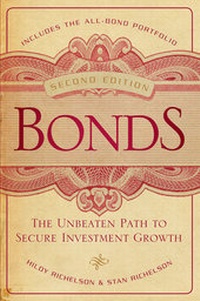
Bonds
Description

More details
Other editions
Additional editions
Persons
Content
Preface
The first edition of Bonds: The Unbeaten Path to Secure Investment Growth (2007) took the untraditional stand that high-quality bonds are a better investment than stocks for individual investors. We supported our thesis by concluding that stocks historically didn't outperform bonds when an individual investor's taxes, transaction fees, expenses, and bad timing are all taken into consideration.
Furthermore, we put forth the heresy that asset allocation to multiple asset classes is not required for investment success. Instead, we proposed the wisdom and logic of the All-Bond Portfolio as the safest and surest way to investment success. We concluded that allocating your assets in the traditional way to many asset classes would actually increase your investment risk rather than decrease it, when compared to the strategy of the All-Bond Portfolio.
The wisdom and logic of the All-Bond Portfolio was certified as correct by the dot-com Crash of 2000 to 2003 and, five years later, by the epic Crash of 2008 that shook the investing world. In the Crash of 2008, all asset classes went down together-all, that is, except high-quality individual bonds. Stocks declined by almost 57 percent peak to trough. Looking back on the decade of 2000 to 2009, during which U.S. large company stocks returned an average of -0.95 percent,1 it is clear that bonds have been a better investment no matter how you evaluate the facts or measure performance.
The stock market roller-coaster ride from 2000 to 2009 resulted in much sound and fury but no net gain (apologies to Shakespeare). Despite this decade producing no stock market gain, there were the added indignities of taxes and fees to be paid, which further reduced performance. In addition, many investors sustained substantial losses due to trading in and out of the stock market at inappropriate times. Our view that the asset classes of stocks and bonds must be risk adjusted as part of every investor's analysis was demonstrated in spades.
In the Introduction to the first edition in 2007, we made the following predictions for the future:
- High-quality bonds can free investors from the fear of investing.
- High-quality tax exempt bonds will protect your principal and generate substantial after-tax income.
- High-quality bonds will provide as good or better returns than stocks without substantial volatility.
- High-quality bonds will provide growth through the magic of compound interest if the interest income is reinvested.
All these predictions proved to be true in the years following 2007, but to a greater extent than anyone anticipated. Those who invested in high-quality individual bonds were saved from the fear and destruction of volatile markets. High-quality individual bonds proved to be safe and continued to provide all the income they promised and growth if the interest income were reinvested in additional bonds. High-quality bonds substantially outperformed stocks without substantial volatility.
A typical portfolio of high-quality individual tax-free bonds returned about 5 percent per year from 2000 to 2009. Thus, a bond portfolio of $100,000, compounding at 5 percent tax-free over a 10-year period, would be worth over $162,000 (a 62 percent appreciation after tax). Moreover, this 5 percent tax-free return would be equivalent to a 7.7 percent taxable return for an individual investor in the 35 percent marginal federal income tax bracket.
A Short History of the Causes of the Crash of 2008
There has been much written about the Crash of 2008 and the effects of the Great Recession that is still with us at the beginning of 2011. The Great Recession is the most serious global financial crisis since the Great Depression of the 1930s. Financial bubbles and panics have been with us throughout history. The most recent history of these financial crises over the last 800 years has been brilliantly researched and recorded by Carmen M. Reinhart and Kenneth S. Rogoff in their book This Time Its Different, Eight Centuries of Financial Folly (Princeton University Press, 2009).
During the 20-year period that comprises the 1980s and '90s, declining inflation and declining interest rates stoked a massive stock market bubble, with the Dow Jones Industrial Average increasing from 825 on January 3, 1980, to 11,497 on December 31, 1999. The technology-led stock market bubble burst in March 2000, whereupon the large cap stock market index lost about half its value by early 2003. Technology stocks, as represented by the Nasdaq index, declined by 77.9 percent when the market bubble collapsed.
Although there was a massive real estate boom from 1996 to 2006, at the beginning of 2007, our public officials and business leaders believed that all was well, despite Federal Reserve Board chairman Alan Greenspan's rhetorically asked question, "But how do we know when irrational exuberance has unduly escalated asset values, which then become subject to unexpected and prolonged contractions as they have in Japan over the past decade?"2 His perception that "irrational exuberance" could be a problem then was obscured by the commodities boom and the housing bubble of the 2000s. Investors during this period believed that it would be different this time: The United States was not in a bubble and was not headed for a crash. However, it was not different for the United States in 2008. The real estate bubble popped and was quickly followed by a market crash and the Great Recession.
Our public officials and business leaders believed for a number of reasons that this time was different because the United States was not like other countries that foundered financially:
- The United States had the most innovative financial system ever devised and was supported by the most liquid capital markets that were wide and deep.
- The United States had the most reliable system of financial regulation and the strongest political system, monetary policy institutions, and policy makers.
- The increased worldwide financial integration of developed and emerging nations enabled countries such as the United States to increase its debt load. Creditor nations such as China needed a secure place to invest their surplus funds.3
The immediate cause of the 2008 Crash was the U.S. subprime real estate crisis. That crisis, which began in the summer of 2007, soon morphed into a global financial crisis. Reinhart and Rogoff conclude that as usual the major players, pundits, and investors in the United States didn't see a bubble forming in 2007. They believed that the U.S. boom in real estate between 1996 and 2006 would continue. They believed that "this time it was different"-there was no bubble and the boom would go on forever. Unfortunately, this time was not different. In 2008, the real estate bubble popped and set off a crash in all asset classes except for high-quality individual bonds. U.S. Treasury bonds actually went up in value.
In retrospect, a major cause of the Great Recession is clear. The U.S. real estate market from 1996 to 2006 increased by about 92 percent, more than three times the 27 percent real (after inflation) cumulative increase from 1890 to 1996!4 In 2005, at the height of the bubble, real housing prices soared by more than 12 percent (that was about six times the rate of increase in real per capita GDP for that year).5 By 2007, it was clear that something was wrong. Defaults on low-income housing mortgage loans made to subprime, generally low-income borrowers began to rise sharply. Many of these mortgage loans had low initial "teaser" rates and variable interest rates. When these low initial interest rates were reset at substantially higher rates the borrowers were unable to meet their obligations. When they could not sell their houses for at least the amount of the mortgage, they defaulted, and the subprime debacle resulted.
By August 2007, the financial markets began to seize up. However, it was not until 2008 that the stock market and other markets collapsed.
There were other causes of the 2008 crash in addition to the real estate bubble. The massive imbalance of U.S. trade with China and other countries resulted in a huge influx of cheap foreign capital that fueled the bubble. The United States was soaking up more than two out of three dollars that countries with trade surpluses were generating.6
In addition, deregulation of the U.S. financial markets had been going on for many years, setting the United States up for the crisis. The deregulation of the financial markets enabled financial movers and shakers, such as Goldman Sachs, Merrill Lynch, Bear Stearns, Lehman Brothers, and Citibank, to stoke their greed and maximize their profits through the use of massive borrowings. As their profits increased dramatically, they believed that their high returns were the result of innovation and financial genius, while underestimating the risks they were taking. They believed that their financial innovation allowed them to borrow 30 to 50 times their capital without risking the loss of their business. As we all know, Lehman went bankrupt and Bear Stearns and Merrill Lynch were acquired at the last minute before they went bust. Goldman Sachs and Citibank were rescued by the U.S. government.
Individuals were not without blame for the bubble and the crash as well. Financial engineering allowed individuals to leverage up by borrowing huge amounts on their homes and using them as ATM machines while also borrowing large amounts on...
