

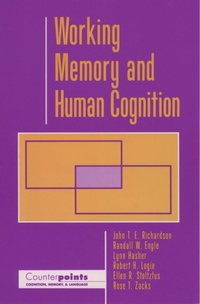
Working Memory and Human Cognition
1st Edition
Published on 16. May 1996
176 pages
978-0-19-535648-9 (ISBN)
Description

This new volume in the Counterpoints series compares and contrasts different conceptions of working memory, generally recognized as the human cognitive system responsible for temporary storage of information. The book includes proponents of several different views. Robert Logie discusses the theoretical and empirical utility of separating working memory into an articulatory loop, a phonological store, and a visuo-spatial sketchpad into visual and spatial subsystems. Patricia Carpenter provides evidence for a process view of working memory, arguing that both task-specific processing and general processing capabilities can account for the full range of working memory phenomena. She focuses on findings from reading comprehension and memory tasks suggesting that working memory is used to represent the set of skills and strategies necessary for complex tasks, while retaining residual capacity for use as a storage buffer. Lynn Hasher argues in favor of the new inhibitory model, with evidence drawn from the literature on aging and pathology that demonstrates parallels between memory disorders and normal memory functioning. Randall Engle addresses the issue of whether working memory resources are required for retrieval of information or whether that task is relatively automatic. Engle's empirical studies, in turn, bear directly on the positions of Carpenter, Hasher, and Logie. As interest in working memory is increasing at a rapid pace, an open discussion of the central issues involved is both useful and timely. This work serves this purpose for a wide audience of cognitive psychologists and their students.
More details
Other editions
Additional editions

John T. E. Richardson | Randall W. Engle | Lynn Hasher
Working Memory and Human Cognition
Book
07/1996
Oxford University Press Inc
€130.20
Shipment within 15-20 days
John T. E. Richardson | Randall W. Engle | Lynn Hasher
Working Memory and Human Cognition
Book
07/1996
Oxford University Press Inc
€71.80
Shipment within 15-20 days
Content
- Intro
- CONTENTS
- CONTRIBUTORS
- 1. Evolving Concepts of Working Memory
- Early Concepts of Working Memory
- Production-System Models
- Associative-Network Models
- Working Memory and Reading Comprehension
- A General Resource or a Domain-Specific Resource?
- Reading Comprehension and Working-Memory Capacity
- The Role of Inhibitory Processes
- Multicomponent Models of Working Memory
- Conclusion
- 2. The Seven Ages of Working Memory
- Age I: Working Memory as Contemplation
- Age II: Working Memory as Primary Memory
- Age III: Working Memory as Short-Term Memory
- Age IV: Working Memory as Processor
- Age V: Working Memory as a Constraint on Language Comprehension
- Age VI: Working Memory as Activation, Attention, and Expertise
- Age VII: Working Memory as Multiple Components
- Multiple Components and Dual-Task Performance
- The Model of Baddeley and Hitch
- The Multiple-Component Model: Gateway or Workspace?
- Working Memory as a Workspace, Not a Gateway
- Conclusion
- 3. Working Memory and Aging: Current Status of the Inhibitory View
- Working Memory and the Limited-Capacity Assumption
- Individual Differences in Working-Memory Capacity
- Group Differences in Working-Memory Capacity Associated with Aging
- An Alternative View to Capacity
- Further Considerations and Future Directions
- 4. Working Memory and Retrieval: An Inhibition-Resource Approach
- Free Retrieval from Natural Categories
- Speeded Recognition of Simple Facts
- Issues in Explaining Individual Differences in Working-Memory Capacity
- An Inhibition-Resource Hypothesis of Working-Memory Capacity
- Conclusion
- 5. Evolving Issues in Working Memory
- Working Memory and Long-Term Memory
- The Capacity of Working Memory
- Inhibitory Processes in Working Memory
- The Gateway Hypothesis
- A Single Component or a Complex System
- Reading Span and Memory Span
- A General Resource or a Domain-Specific Resource?
- Verbal and Visuospatial Working Memory
- The Phonological Loop
- The Visuospatial Scratchpad
- The Central Executive
- Conclusion
- AUTHOR INDEX
- A
- B
- C
- D
- E
- F
- G
- H
- J
- K
- L
- M
- N
- O
- P
- Q
- R
- S
- T
- U
- V
- W
- Y
- Z
- SUBJECT INDEX
- A
- B
- C
- D
- E
- F
- G
- I
- L
- M
- N
- O
- P
- R
- S
- T
- U
- V
- W
