

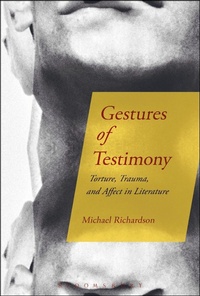
Gestures of Testimony
Torture, Trauma, and Affect in Literature
1st Edition
Published on 14. July 2016
208 pages
978-1-5013-1582-4 (ISBN)
Description

After 9/11, the United States became a nation that sanctioned torture. Detainees across the globe were waterboarded, deprived of sleep, beaten by guards, blasted with deafening music and forced into obscene acts. Their torture presents a profound problem for literature: torturous pain and its traumatic aftermath have long been held to destroy language, shatter experience, and refuse representation. Challenging accepted thinking, Gestures of Testimony asks how literature might bear witness to the tortures of a war waged against fear itself.
Bringing the vibrant field of affect theory to bear on theories of torture and power, Richardson adopts an interdisciplinary approach to show how testimony founded in affect can bear witness to torture and its traumas. Grounded in provocative readings of poems by Guantanamo detainees, memoirs of interrogators and detainees, contemporary films, the Bush Administration's Torture Memos, and fiction by George Orwell, Franz Kafka, Arthur Koestler, Anne Michaels, and Janette Turner Hospital, Michael Richardson traces the workings of affect, biopower, and aesthetics to re-think literary testimony. Gestures of Testimony gives shape to a mode of affective witnessing, a reaching beyond the page in the writing of torture that reveals violent trauma - even as it embodies its veiling.
Bringing the vibrant field of affect theory to bear on theories of torture and power, Richardson adopts an interdisciplinary approach to show how testimony founded in affect can bear witness to torture and its traumas. Grounded in provocative readings of poems by Guantanamo detainees, memoirs of interrogators and detainees, contemporary films, the Bush Administration's Torture Memos, and fiction by George Orwell, Franz Kafka, Arthur Koestler, Anne Michaels, and Janette Turner Hospital, Michael Richardson traces the workings of affect, biopower, and aesthetics to re-think literary testimony. Gestures of Testimony gives shape to a mode of affective witnessing, a reaching beyond the page in the writing of torture that reveals violent trauma - even as it embodies its veiling.
Reviews / Votes
Gestures of Testimony is an insightful, sometimes wrenching analysis of representations of torture from Franz Kafka's "In the Penal Colony" to the Bush Administration's "Torture Memos." The book's mission, in the broadest terms, is to return its readers to material they have encountered as felt history and translate it into the more reaching language of literary and cultural theory. Gestures of Testimony is an important contribution to ethics, aesthetics, and human rights. * James Dawes, DeWitt Wallace Professor of English, Macalester College, USA, and author of Evil Men * Torture. How to tell the unspeakable? Trauma. How to bear witness to what is unliveable yet refuses not to be relived? In Gestures of Testimony Michael Richardson approaches these fraught questions head on. In the face of what exceeds representation in language, he argues, we do not have to remain mute. There is a use of language that contrives to include in its expressions what by right exceeds it: literary language. Expertly weaving between literature, media imagery, cinema, official documents, and philosophy, Richardson produces a complex and compelling account of these limit-experiences and their social and political reverberations. Gestures of Testimony is a refreshingly original contribution to trauma studies, and more broadly affect theory in all of its ramifications. * Brian Massumi, Professor of Communication, University of Montreal, Canada, and author of Ontopower: War, Powers, and the State of Perception * This study glosses poetry, memoirs, legal memoranda, photographs, and films to theorize torture in the war on terror and in literature. Drawing from theories of power, trauma, affect, and testimony, Richardson brings into dialogue analysis of the post-9/11 world with literary testimonies of torture from the twentieth century, including works by Franz Kafka, J. M. Coetzee, and George Orwell. Both "critique and manifesto," the book seeks to demonstrate the belief of many human rights and literature scholars: fiction "can help achieve justice. * American Literature *More details
Edition
1. Auflage
Language
English
Place of publication
New York
United States
Publishing group
Bloomsbury Publishing PLC (Digital)
Target group
Professional and scholarly
Illustrations
12 b/w illustrations
ISBN-13
978-1-5013-1582-4 (9781501315824)
Copyright in bibliographic data and cover images is held by Nielsen Book Services Limited or by the publishers or by their respective licensors: all rights reserved.
Schweitzer Classification
Other editions
Additional editions
Book
01/2018
Bloomsbury Academic
€64.63
Shipment within 15-20 days
Book
07/2016
Bloomsbury Academic USA
€164.50
Shipment within 15-20 days
Person
Michael Richardson is Lecturer in the School of Arts & Media at the University of New South Wales, Australia.
Content
Acknowledgments
Introduction: Gesturing the Unrepresentable
Chapter 1: Tortured Bodies
Chapter 2: Reading Torture
Chapter 3: Seeing Torture
Chapter 4: Writing Trauma
Chapter 5: Witnessing and the Poetics of Trauma
Chapter 6: Writing Torturous Affect
Conclusion: Speaking Beyond Words
Endnotes
Bibliography
Index
Introduction: Gesturing the Unrepresentable
Chapter 1: Tortured Bodies
Chapter 2: Reading Torture
Chapter 3: Seeing Torture
Chapter 4: Writing Trauma
Chapter 5: Witnessing and the Poetics of Trauma
Chapter 6: Writing Torturous Affect
Conclusion: Speaking Beyond Words
Endnotes
Bibliography
Index
