

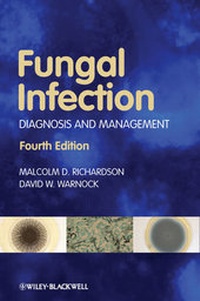
Fungal Infection
Description

Reviews / Votes
The third edition of this book has never been far away from myoffice phone and is now quite tatty, so I am delighted to reviewthe new fourth edition, written by the same two experts. This bookis an easy but detailed guide to fungal infections, ranging fromthose seen regularly by clinical microbiologists and infectiousdiseases specialists, such as Candida and Aspergillus, to exoticdiseases seen only outside the UK such as Pythiosis. The emphasisof the book is on clinical presentation, specimen collection,interpretation of laboratory findings and management of thepatient. The new edition is a little larger than the previous one, but willstill sit nicely on the desk. It has the same 27 chapters, most ofwhich have been extensively revised and some new ones substituted.The chapters are based around clinical syndromes so, for example,there is quite a long chapter on dermatophyte infections and ashorter one on mycetoma. The chapter on antifungal drugs is muchlonger due to the addition of agents such as posaconazole and thenewer echinocandins. New chapters have been added onPneumocystosis, and 'Unusual fungi and Pseudofungalinfections'. At the end of each chapter is a useful guide tofurther reading. Each chapter has a set of standard headings: definition,geographical distribution, causal organisms and habitat,epidemiology, clinical manifestations, differential diagnosis,essential investigations and their interpretation, management,prevention. This, coupled with the detailed index, makes it easy tofind the bit of information you need. In particular, I found thechapter on histoplasma most helpful when working on an onlineclinical interpretation scenario! As the authors say in the introduction, there have been a number ofsignificant developments in the diagnosis and management of fungalinfections since the last edition. Patients are now more complex bynature of their illness or their medical management, and thepotential for opportunistic infection in the immunosuppressed hasincreased. Although the book was published in 2012, the basics offungal infection such as microscopy and culture do not change. Theextended chapter on laboratory diagnosis covers new techniques inserology and molecular diagnosis. At the moment, there is a lack ofrapid and cost-effective tests in this area; many of the assaysbeing performed are not standardised and some more trials areneeded. I hope this section will be the one that goes out of datefirst, as more rapid or molecular tests are added to the diagnosticsetting. I will keep this book on my desk as quick reference during a phonecall, but also as a more detailed guide to managing patients withinvasive fungal infections. I recommend it to anyone who deals withfungal infections, whether in the laboratory or out on the wards,and to trainees and students as well. (Dr Fiona E. Donald,Consultant Medical Microbiologist, Nottingham University Hospitals,RCPATH Bulletin, October 2013)More details
Other editions
Additional editions

Persons
Content
Preface to the fourth edition xxvi
Preface to the first edition xxviii
Acknowledgements xxix
1 Introduction 1
2 Laboratory diagnosis of fungal infection 12
3 Antifungal drugs 32
4 Dermatophytosis 91
5 Superficial candidosis 121
6 Other cutaneous fungal infections 138
7 Mould infections of nails 151
8 Keratomycosis 156
9 Otomycosis 162
10 Aspergillosis 166
11 Invasive candidosis 201
12 Cryptococcosis 236
13 Mucormycosis 253
14 Pneumocystosis 264
15 Blastomycosis 277
16 Coccidioidomycosis 288
17 Histoplasmosis 304
18 Paracoccidioidomycosis 322
19 Chromoblastomycosis 332
20 Entomophthoromycosis 338
21 Mycetoma 344
22 Sporotrichosis 352
23 Hyalohyphomycosis 362
24 Penicillium marneffei infection 376
25 Phaeohyphomycosis 383
26 Other invasive yeast infections 396
27 Unusual fungal and pseudofungal infections 405
Select bibliography 419
Index 421
