

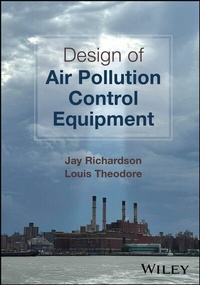
Design of Air Pollution Control Equipment
Description

Essential Insights, Design Details, and Real-world Examples??for??the??Design of Air Pollution Control Equipment
Providing the pragmatic perspective of practicing engineers and applied scientists, Design of Air Pollution Control Equipment serves as a unique technology-transfer guide in air pollution control, enabling readers to address pollutants across diverse industries.
The book shows how to curb air pollutants produced throughout human-made industrial processes, by providing the guidance needed to ensure the effectiveness and efficiency of various types of air pollution control equipment.
Readers will find:
- Comprehensive chapters on designing air pollution control equipment for gases and particulates, along with advanced systems such as hybrid systems, NOx control, CO2 control, and flue gas desulfurization systems
- 50 detailed examples and comprehensive field data for practical design and engineering solutions
- Technical details, calculation methods, and illustrative examples??in??a user-friendly format
- Design options to control air pollution emissions and the pros/cons of the alternatives
- Harmful effects of high concentrations of pollutants, including higher global temperatures, reduced visibility, and diminished overall air quality
This book is an ideal reference for consultants, federal, state, and local agency personnel, advanced students, practicing engineers, and science professionals working in environmental science, environmental health, and environmental control.
More details
Other editions
Additional editions
Persons
Jay Richardson is the owner of Falcon Combustion and has over ten years' experience in the engineering, design, construction, commissioning, and testing of combustion equipment for industrial and utility boilers, Low?NOx Burners, OFA, FGR, ignition, and control systems. He has designed over 1,000 industrial burners and has worked on combustion equipment that range in size from 6?MMBtu/hr catalyst activators to 100hp firetube boilers to 250 MMBtu/hr thermal oxidizers to 1,000 MW twin furnace T-fired utility boilers and everything in between.
Louis Theodore is a retired professor of chemical engineering with 50 years of experience. He is the author of many leading publications and an internationally recognized lecturer who has provided nearly 200 courses to industry, government and technical associations. Dr. Theodore is the recipient of the International Air & Waste Management Association?s prestigious Ripperton award and the American Society of Engineering Education (ASEE) AT&T Foundation award for "excellence in the instruction of engineering students".
Content
About the Authors xiii
Preface xv
Part I Prologue 1
1 The Air Pollution Problem 3
2 Classification, Sources, and Effects of Air Pollution 9
3 Air Pollution Regulatory Framework 23
4 Introduction to Air Pollution Control Equipment Technology 35
Part II Design of Air Pollution Control Equipment: Gases 47
5 Basic Principles: Gases 49
6 Absorbers 67
7 Adsorbers 95
8 Incinerators/Combustion Equipment 115
9 Condensers 137
Part III Air Pollution Control Equipment for Particulates 149
10 Basic Principles: Particulates 151
11 Gravity Settlers 163
12 Cyclones 179
13 Wet Scrubbers 199
14 Electrostatic Precipitators (ESPs) 217
15 Baghouses 241
Part IV Design of Other Air Pollution Control Equipment 269
16 Hybrid Systems 271
17 Flue Gas Desulfurization Systems 281
18 Controlling the Oxides of Nitrogen 297
19 Carbon Capture and Storage 313
20 Stacks 325
Part V Epilogue 343
21 Comparing, Selecting, and Purchasing Air Pollution Control Equipment 345
References 359
Appendix 361
Index 367
