

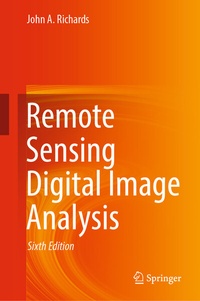
Remote Sensing Digital Image Analysis
Description

Remote Sensing Digital Image Analysis provides a comprehensive treatment of the methods used for the processing and interpretation of remotely sensed image data. Over the past decade there have been continuing and significant developments in the algorithms used for the analysis of remote sensing imagery, even though many of the fundamentals have substantially remained the same. As with its predecessors this new edition again presents material that has retained value but also includes newer techniques, covered from the perspective of operational remote sensing.
The book is designed as a teaching text for the senior undergraduate and postgraduate student, and as a fundamental treatment for those engaged in research using digital image analysis in remote sensing. The presentation level is for the mathematical non-specialist. Since the very great number of operational users of remote sensing come from the earth sciences communities, the text is pitched at a level commensurate with their background.
The chapters progress logically through means for the acquisition of remote sensing images, techniques by which they can be corrected, and methods for their interpretation. The prime focus is on applications of the methods, so that worked examples are included and a set of problems conclude each chapter.
Reviews / Votes
"This is a complete textbook on remote sensing, enriched and battle hardened by generations of students with engineering, computer science, and mathematics backgrounds. ... the book is very approachable. Its illustrations are well done, and engaging examples and exercises reinforce the key concepts. The magnitude of enticing analogies to technologies in our familiar seismic imaging worlds makes this book fascinating for TLE readers." (Andreas Rueger, The Leading Edge, Vol. 43 (4), April 24, 2025)
More details
Other editions
Additional editions
Person
John Richards has been active in remote sensing teaching and research for the past 40 years, mainly in image analysis and imaging radar. He is the author of four books, all published by Springer. He is an electrical engineering graduate from the University of New South Wales, Australia, and a life Fellow of the IEEE. He was the foundation director of the Centre for Remote Sensing at the University of New South Wales in the 1980s and has had a career that has taken him through teaching and research in remote sensing and engineering. He has also served in senior academic administration including as dean of the College of Engineering and Computer Science and vice-president of the Australian National University. He is an emeritus professor of both the Australian National University and the University of New South Wales.
Content
Sources and characteristics of remote sensing image data.- correcting and registering images.- interpreting images.- radiometric enhancement of images.- geometric processing and enhancement: image domain techniques.- spectral domain image transforms.- spatial domain image transforms.- supervised classification techniques.- clustering and unsupervised classification.- Feature Reduction.- Image Classification in Practice.- Multisource Image Analysis.
