

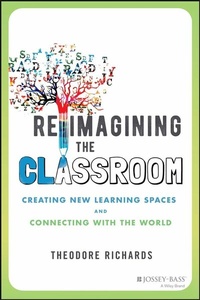
Reimagining the Classroom
Description

We are in a period of unknowns unlike any in a generation or more. As educators, we need new pathways and ideas that can help us educate children for the world to come. Reimagining the Classroom: Creating New Learning Spaces and Connecting with the World provides practical steps and examples that parents and educators can use to begin to create new learning spaces, approaches, and outcomes. Dr. Richards' provocative book asks us to reconsider some of our basic assumptions about teaching and learning. It helps parents and educators question and recast these assumptions and practices while providing concrete, tested activities and ideas that will help readers reimagine educational spaces rooted in the notion that classrooms--and the stories we tell in them--are a metaphor for the world we hope to create.
Reimagining the Classroom is divided into two parts. The first offers the intellectual framework parents and educators are seeking; it identifies specific problems with current approaches, offers an alternative vision and set of narratives, and then offers a new pedagogy to satisfy this vision. The second part of the book moves from the theoretical to the practical. Dr. Richards provides tested pedagogical tools for classrooms in science and math; literature and fine arts; spirituality and mindfulness; practical arts; and justice and social-emotional learning.
* Discover practical tools for creating educational spaces that prepare students for the world they will encounter
* Help students express their values and learn to live in community
* Replace or supplement school with at-home learning and activities that will give students an edge for the future
* Learn how the traditional approach to education is failing our kids and leading to an epidemic of depression and anxiety
For educators and parents ready to consider a radical shift in service of our children's wellbeing, this book explains what, fundamentally, education can and should look like.
More details
Other editions
Additional editions
Person
Content
Part I: Reimagining Education
Chapter One: The Crisis of Education: Childhood in the Age of Loneliness
Chapter Two: The Context for Education: The One-Planet Classroom
Chapter Three: The Process for Education: A Pedagogy for Reimagining the Story
Part II: Reimagining the Classroom
Chapter Four: Cosmos: Science and Math Through Cosmology and Ecology
Chapter Five: Arts: Literature, Performing Arts, Visual Arts
Chapter Six: Spirit: Spirituality, Mindfulness, Meditation
Chapter Seven: Hands: Practical Life, Work, and Hands-on Learning
Chapter Eight: Justice and Joy: Social-Emotional Justice Studies
Part III: Reimagining the World
Chapter Nine: Unstandardized Testing: From Classroom to World
Epilogue: Learning How to Love and Be Loved
References
Acknowledgments
About the Author
Chapter 1
The Crisis of Education: Childhood in the Age of Loneliness
From the melting polar caps to violence in our cities to the rise of fascist governments, ours is an age in which we seem to be able to agree on almost nothing-except that we are in crisis. It would be easy to think of the rising anxiety I'm feeling as disconnected from the rising sea levels, or to think of the migrant crisis as unrelated to the violence in our inner cities. But at the core, all of our crises actually share some of the same roots, and part of the individual healing process involves exploring those roots collectively.
This book is about this global crisis, but it isn't about the melting polar caps, or CO2 levels, or temperature. It isn't about increasing economic disparities, racism, or sexism. It's about a climate of loneliness that has taken over the planet-a planet of shrinking resources, imagination, hope. But how can we be hopeful when news of our demise comes on the television every night? How can we learn to share our resources when we are told that we can only find meaning by consuming more? Most significantly, how can we live as though the planet itself is a single, interconnected community when we have been told that our purpose is to find only individual success, only individual salvation?
I suggest that our spiritual malaise-the loneliness and loss of meaning-is connected to our ecological, political, and economic crises. It's all connected; and it's all about the deep story we tell about who we are and our place in the world. And this all comes down to how we educate our children.
Let me explain.
There's something in the air, as thick and unmistakable as the CO2 particulates, even if it isn't as easily quantified. All around us, there is an anxiety about our future, about the future of our children. And like climate change, this anxiety is so massive, so all-encompassing and -consuming, that it feels impossible to escape, impossible to confront.
We also live in an age of anger, and in an age of fear. But of all the emotions that dominate our age, I believe that loneliness is the most pervasive. It is loneliness that tortures the internet troll or Wall Street executive who never seems to have enough; it is loneliness that leads us to addictions to shopping or food or anti-anxiety meds.
In some ways, this is my greatest fear and, perhaps, that which we all fear: being alone, really alone. I've often suggested that this is the ultimate salvation we are all seeking-true communion, connection-far more than any lonely, segregated paradise.
Why are we lonely? The reasons are complex and have to do with the habits and lifestyles of the modern world. We spend less time with family and community; we spend more time staring at screens. But our loneliness begins with a story, a story about who we are on the most fundamental level. This story tells us that our deepest identity is individual, and that we need to buy our way into a meaningful life.
It's unmistakable how lonely we all are. You can feel it in crowds, among the masses of people ignoring one another, staring at their own privatized virtual space in favor of the physical world. How is it that I can feel less lonely alone in my living room, listening to Coltrane, than I do on a crowded bus? This feeling reveals to us that loneliness isn't entirely about being alone, at least not the kind of loneliness I am talking about. I am referring to more than the sadness at missing one's kin. This is a cosmic loneliness. This loneliness is the product of a narrative that tells us that our ultimate identity is individual, that we are not, in fact, in this together.
And we aren't just lacking in community with other people; we have lost our ecological place in the family of beings. We've lost our intimacy with the Earth-its rivers, its mountains, its seas-and the other species that make it up, that make us who we are. This requires us to experience the Earth in intimacy, not just stare at screens and drive from one sterile, climate-controlled space to another. It requires us to feel the texture of our world again, to fall in love again.
The climate crisis teaches us that we are an interconnected planet-decisions made on one continent impact another. Less widely considered is this crisis of the inner climate. This inner climate is, like the outer, interconnected. Our emotional lives are ecological webs, not isolated individuals. So, if the inner life is made toxic by a toxic story, we become unbalanced. I don't need to use extreme examples like mass shooters or oil spills here. Just spend some time on social media or watch the plastic bags floating down your street. There is something even more profound than the realization of our interconnectedness: our emotions are a part of the ecosystem and a part of the Earth itself.
And so, we must let go of the notion that loneliness-whether it's expressed on social media or by the person sitting in the cubical next to you, addicted to their meds-is merely an individual, psychological problem, a mental health issue. Loneliness, by its very nature, cannot be cured individually. It is a shared problem. It is a cultural problem. A problem of story.
OUR STORY
Think back to your earliest memories of childhood. What is one of the first stories you remember? If your childhood was like mine, you may recall curling up somewhere with a parent or another elder, listening to a story. Or perhaps you can recall attending a church or another place of worship and hearing the stories passed down through the generations. It was in these moments that you would have learned life's deepest and most important lessons. Through human touch, voice, and the magic of words, you began to put your world together. You began to discover your place in the world.
There is nothing more quintessentially human than sharing a story. Before there were books or churches, there were human communities that had to figure out how to survive in a dangerous and uncertain world. Humans weren't as fast as the antelope, as strong as the elephant, or as sharp-toothed as the lion. Their special gift and skill was the ability to care for each other and work together-to build community. And they did this through the magic of language and story.
In spite of those early childhood memories, many of us often wonder why it is that we don't simply act rationally to solve our problems. It's because any rational act is always performed in context-the unspoken, unseen story that lies behind our actions. If we have a story that tells us we are radically separate from the Earth, and from other people, and that our purpose is disembodied, individual salvation, it is rational to ignore the impact of climate change; it is rational for a society to have extreme-and growing-economic disparities; it is rational to think of our struggles as our own rather than part of the same collective struggle.
Modernity-the worldview that is based on the story I have referred to as the cosmology of loneliness-is rooted in the emergence of colonialism and capitalism. In these systems, lines were drawn-both in maps and in the human imagination-to separate that which is valued or sacred from that which is considered a mere resource. Even other human beings could be exploited or enslaved in such a system. Forests were razed, lakes and rivers redirected and poisoned. The Protestant Reformation in the sixteenth century put an increased importance on the salvation of the individual and taught that prosperity was a sign of God's favor: What did it matter if we destroyed the Earth if we were just trying to leave it all behind to get into heaven anyway? We couldn't be blamed for exploiting workers if this was merely God's will, a sign of our favor and their condemnation, could we? Many human beings gained a great deal of wealth and advanced technologically during this period, but it came at a great cost. We lost our place in the world.
While the notion of seeing a more interconnected world may seem radical, it is consistent with human cultures throughout most of history. All cultures have shared stories-myths-that reveal their core assumptions and values and help place the individual in relationship to the community, including the non-human, ecological community. For millennia, small groups of humans lived in a story that allowed them to understand themselves as interrelated to their world and embedded in a web of ecological and social relationships. But things have changed.
THE COSMOLOGY OF LONELINESS AND EDUCATION FOR LIBERATION
I will use the term cosmology synonymously with worldview, a way to describe how basic assumptions about the order of the world and our place in it, brought forth by cultural narratives. Cosmic loneliness is the result of a narrative that advocates for radical, absolute individualism. It isn't merely the product of being alone; it is the way we experience the world when our worldview is rooted in a story that tells us we are fundamentally separate from others, when we privilege independence over interdependence and relationship. How does this actually look in the world? In other words, how is the world put together through this story? Let's look at a few different elements of human experience.
- The Political. "Totalitarian movements are...
