

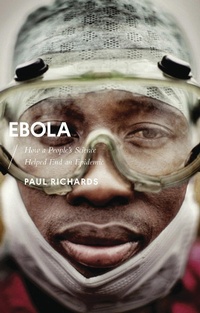
Ebola
How a People's Science Helped End an Epidemic
1st Edition
Published on 15. September 2016
194 pages
978-1-78360-860-7 (ISBN)
Description

Shortlisted for the Fage and Oliver Prize 2018
From December 2013, the largest Ebola outbreak in history swept across West Africa, claiming thousands of lives in Liberia, Sierra Leone and Guinea. By the middle of 2014, the international community was gripped by hysteria. Experts grimly predicted that millions would be infected within months, and a huge international control effort was mounted to contain the virus. Yet paradoxically, by this point the disease was already going into decline in Africa itself. So why did outside observers get it so wrong?
Paul Richards draws on his extensive first-hand experience in Sierra Leone to argue that the international community's panicky response failed to take account of local expertise and common sense. Crucially, Richards shows that the humanitarian response to the disease was most effective in those areas where it supported these initiatives and that it hampered recovery when it ignored or disregarded local knowledge.
From December 2013, the largest Ebola outbreak in history swept across West Africa, claiming thousands of lives in Liberia, Sierra Leone and Guinea. By the middle of 2014, the international community was gripped by hysteria. Experts grimly predicted that millions would be infected within months, and a huge international control effort was mounted to contain the virus. Yet paradoxically, by this point the disease was already going into decline in Africa itself. So why did outside observers get it so wrong?
Paul Richards draws on his extensive first-hand experience in Sierra Leone to argue that the international community's panicky response failed to take account of local expertise and common sense. Crucially, Richards shows that the humanitarian response to the disease was most effective in those areas where it supported these initiatives and that it hampered recovery when it ignored or disregarded local knowledge.
Reviews / Votes
Policymakers involved in responding to global pandemics [should] read this book and to think more seriously about how to develop approaches that really listen to affected communities. * Africa at LSE * The importance of this work for fighting future epidemics cannot be overstated. * African Affairs * The book is useful for any individual teaching or practicing in the fields of psychology or medical education, as well as those in social work, education, and public health. * Choice * In this provocative book, Richards argues that the international response may actually have extended the epidemic's duration. * Foreign Affairs * With some 40 years' experience living, working and writing about the Mano River Region, Paul Richards' manuscript provides a succinct, erudite and important contribution to this debate. * Journal of Modern African Studies * [A] first-hand analysis of the complicated situation that arose from the outbreak, a fascinating story of the success and failures of experts, volunteers and village people ... eye-opening reading. * Medicine, Conflict and Survival * A must-read for all involved in epidemics, epidemiology and public health. * Nature * A book rich in practical examples from extensive knowledge of the region, with theory to underpin observation...fascinating. * Oxfam 'From Poverty to Power' blog * A scholarly exercise that will appeal to medical and health policy academics ... convincingly argues the broader lesson for containing future epidemics. * Publishers Weekly * Represents the first serious attempt to grapple with some of the practical as well as epistemological questions posed by the local response to the outbreak...Offers important insights, especially concerning the central issue of burial practices, one of the epidemic's main routes of infection. * The Economist * A valuable reflection of the experiences of affected communities and aid workers in Sierra Leone. This book is a must for all disease control professionals in Africa and beyond. The book is also exceptionally well written and easily accessible to interested novices. * Ger J. Steenbergen, first secretary of health, Netherlands Embassy in Ghana * With his decades of experience in rural Sierra Leone, Richards is almost uniquely placed to write this book, which highlights the strong potential at community level for learning about and acting against a deadly disease. We would do well to implement these principles in future emergency responses of all kinds, as well as within long-term development work. * Sinead Walsh, Irish ambassador to Sierra Leone and Liberia *More details
Series
Edition
1. Auflage
Language
English
Place of publication
London
United Kingdom
Publishing group
Bloomsbury Publishing PLC
Target group
College/higher education
Professional and scholarly
Illustrations
Tables, black and white 8 ; Figures 11
ISBN-13
978-1-78360-860-7 (9781783608607)
Copyright in bibliographic data and cover images is held by Nielsen Book Services Limited or by the publishers or by their respective licensors: all rights reserved.
Schweitzer Classification
Other editions
Additional editions
Book
09/2016
Zed Books Ltd
€117.40
Shipment within 3-4 weeks
Person
Paul Richards is an anthropologist with over forty-five years' experience of living and working in West Africa. He is emeritus professor of technology and agrarian development at Wageningen University in the Netherlandsand and adjunct professor at Njala University in central Sierra Leone. His previous books include No Peace, No War: An Anthropology of Contemporary Armed Conflicts (2005).
Content
Introduction
1. The World's First Ebola Epidemic
2. The Epidemic's Rise and Decline
3. Washing the Dead: Does Culture Spread Ebola?
4. Ebola in Rural Sierra Leone: A Technography
5. Burial Technique
6. Community Responses to Ebola
Conclusion: Strengthening an African People's Science
Postscript
Appendices
1. The World's First Ebola Epidemic
2. The Epidemic's Rise and Decline
3. Washing the Dead: Does Culture Spread Ebola?
4. Ebola in Rural Sierra Leone: A Technography
5. Burial Technique
6. Community Responses to Ebola
Conclusion: Strengthening an African People's Science
Postscript
Appendices
