

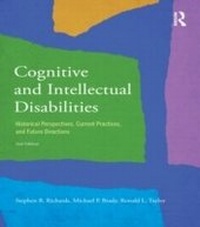
Cognitive and Intellectual Disabilities
Historical Perspectives, Current Practices, and Future Directions
2nd Edition
Published on 15. September 2014
434 pages
978-1-135-04926-3 (ISBN)
Description

Cognitive and Intellectual Disabilities: Historical Perspectives, Current Practices, and Future Directions provides thorough coverage of the causes and characteristics of cognitive and intellectual disabilities (formerly known as mental retardation) as well as detailed discussions of the validated instructional approaches in the field today. Features include:
A companion website that offers students and instructors learning objectives, additional activities, discussion outlines, and practice tests for each chapter of the book
An up-to-date volume that reflects the terminology and criteria of the DSM-V and is aligned with the current CEC standards
Teaching Applications: presents the strongest coverage available in any introductory text on instructional issues and applications for teaching students with cognitive and intellectual disabilities
A unique chapter on "Future Issues" that explores the philosophical, social, legal, medical, educational, and personal issues that professionals and people with cognitive and intellectual disabilities face
This comprehensive and current introductory textbook is ideally suited for introductory or methods courses related to cognitive and intellectual disabilities.
A companion website that offers students and instructors learning objectives, additional activities, discussion outlines, and practice tests for each chapter of the book
An up-to-date volume that reflects the terminology and criteria of the DSM-V and is aligned with the current CEC standards
Teaching Applications: presents the strongest coverage available in any introductory text on instructional issues and applications for teaching students with cognitive and intellectual disabilities
A unique chapter on "Future Issues" that explores the philosophical, social, legal, medical, educational, and personal issues that professionals and people with cognitive and intellectual disabilities face
This comprehensive and current introductory textbook is ideally suited for introductory or methods courses related to cognitive and intellectual disabilities.
Reviews / Votes
"I am most impressed by the high quality of the information and broad range of coverage of this text, which, while thorough and rigorous, has many appealing features and a writing style that is easy to understand and reader-friendly. I plan to use this book in my own work, as it provides an up-to-date source that helps the reader understand the importance of inclusion and social justice as well as effective instructional settings and practices for intellectually disabled students."--James McLeskey, Professor, School of Special Education, School Psychology, and Early Childhood Studies, University of Florida
"An essential text, Cognitive and Intellectual Disabilities provides a complete foundation in special education, grounded in an historical perspective of pivotal events, research, and legislation that have shaped the field. The guiding questions and additional online sources will challenge readers to evaluate and apply the information presented. This book equips future teachers with the knowledge needed to effectively implement best practices for educating students with disabilities."
--Fred Spooner, Ph.D., Professor of Special Education and Child Development, University of North Carolina at Charlotte
More details
Edition
2nd edition
Language
English
Place of publication
London
United Kingdom
Publishing group
Taylor & Francis Ltd
Target group
College/higher education
Illustrations
26 s/w Tabellen
26 Tables, black and white
ISBN-13
978-1-135-04926-3 (9781135049263)
Copyright in bibliographic data and cover images is held by Nielsen Book Services Limited or by the publishers or by their respective licensors: all rights reserved.
Schweitzer Classification
Other editions
Additional editions

Stephen B. Richards | Michael P. Brady | Ronald L. Taylor
Cognitive and Intellectual Disabilities
Historical Perspectives, Current Practices, and Future Directions
Book
09/2015
1st Edition
Routledge
€141.13
The article will not be published
Stephen B. Richards | Michael P. Brady | Ronald L. Taylor
Cognitive and Intellectual Disabilities
Historical Perspectives, Current Practices, and Future Directions
Book
08/2014
2nd Edition
Routledge
€155.99
Article exhausted; check different version
Persons
Stephen B. Richards, Ed.D. is Associate Professor and Coordinator of Undergraduate Intervention Specialist Program in the Department of Teacher Education at the University of Dayton, USA.
Michael P. Brady, Ph.D. is Professor and Chair of the Department of Exceptional Student Education at Florida Atlantic University, USA.
Ronald L. Taylor was Professor of Exceptional Student Education at Florida Atlantic University, USA.
Michael P. Brady, Ph.D. is Professor and Chair of the Department of Exceptional Student Education at Florida Atlantic University, USA.
Ronald L. Taylor was Professor of Exceptional Student Education at Florida Atlantic University, USA.
Content
Preface
Chapter 1: Historical Concepts and Perspectives
Chapter 2: Definition and Classification of Cognitive/Intellectual Disabilities
Chapter 3: Assessment for Identification
Chapter 4: Genetic and Chromosomal Factors
Chapter 5: Environmental and Psychosocial Causes
Chapter 6: Cognitive and Learning Characteristics
Chapter 7: Educational, Psychological, and Behavioral Characteristics
Chapter 8: Societal, Family, and Multicultural Characteristics
Chapter 9: Instructional Assessment
Chapter 10: Instructional Content
Chapter 11: Instructional Procedures
Chapter 12: Instructional Settings
Chapter 13: Future Directions
References
Chapter 1: Historical Concepts and Perspectives
Chapter 2: Definition and Classification of Cognitive/Intellectual Disabilities
Chapter 3: Assessment for Identification
Chapter 4: Genetic and Chromosomal Factors
Chapter 5: Environmental and Psychosocial Causes
Chapter 6: Cognitive and Learning Characteristics
Chapter 7: Educational, Psychological, and Behavioral Characteristics
Chapter 8: Societal, Family, and Multicultural Characteristics
Chapter 9: Instructional Assessment
Chapter 10: Instructional Content
Chapter 11: Instructional Procedures
Chapter 12: Instructional Settings
Chapter 13: Future Directions
References
