

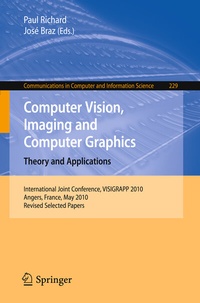
Computer Vision, Imaging and Computer Graphics. Theory and Applications
International Joint Conference, VISIGRAPP 2010, Angers, France, May 17-21, 2010. Revised Selected Papers
Published on 25. February 2012
XV, 319 pages
978-3-642-25382-9 (ISBN)
Description

This book constitutes the refereed proceedings of the International Conference, VISIGRAPP 2010, the Joint Conference on Computer Vision Theory and Applications (VISAPP), on Imaging Theory and Applications (IMAGAPP), and on Computer Graphics Theory and Applications (GRAPP), held in Angers, France, in May 2010. The 19 revised full papers presented together with two invited papers were carefully reviewed and selected. The papers are organized in topical sections on computer vision theory and applications; imaging theory and applications; computer graphics theory and applications; and information visualization theory and applications.
More details
Series
Language
English
Place of publication
Berlin
Germany
Publishing group
Springer Berlin
Target group
Professional and scholarly
Illustrations
XV, 319 p. 180 illus., 95 illus. in color.
File size
12,83 MB
ISBN-13
978-3-642-25382-9 (9783642253829)
DOI
10.1007/978-3-642-25382-9
Schweitzer Classification
Other editions
Additional editions
Paul Richard | José Braz
Computer Vision, Imaging and Computer Graphics. Theory and Applications
International Joint Conference, VISIGRAPP 2010, Angers, France, May 17-21, 2010. Revised Selected Papers
Book
12/2011
Springer
€53.49
Shipment within 7-9 days
Content
- Intro
- Title
- Preface
- Organization
- Table of Contents
- Invited Papers
- Vision-Realistic Rendering: Simulation of the Scanned Foveal Image with Elimination of Artifacts due to Occlusion and Discretization
- Introduction
- Optometry and Ophthalmology Motivation
- Previous and Related Work
- Shack-Hartmann Device
- Algorithm
- Constructing the Object Space Point Spread Function
- Fitting a Wavefront Surface to Aberrometry Data
- Rendering Steps
- Elimination of Artifacts Due to Occlusion and Discretization
- Object Identification as a Solution for Image Space Artifacts
- Edge Detection Technique for Object Identification
- Adjacent Pixel Difference Technique for Object Identification
- Sample Images
- Validation
- Conclusions and Future Work
- References
- Fisher Vectors: Beyond Bag-of-Visual-Words Image Representations
- Introduction
- Image Representations
- Image Categorization with FV
- Image Retrieval
- Other Applications
- Conclusions
- References
- Part I Computer Vision Theory and Applications (VISAPP)
- Decoding 1-D Barcode from Degraded Images Using a Neural Network
- Introduction
- Identification and Decoding Techniques
- Image Restoration
- Barcodes Decoding
- The Proposed Method
- Experiments
- Conclusions
- References
- Perspective Two-Frame-Theory for Shape Recovery under Turntable Motion
- Introduction
- First Order Quasi-linear PDE
- Boundary Condition
- Experiments
- Experiment with Synthetic Model
- Experiment with Real Images
- Conclusions
- References
- Expanding the Local Binary Pattern to Multispectral Images Using Total Orderings
- Introduction
- Local Multispectral Binary Pattern
- Local Binary Pattern
- Total Orderings in Rn
- The LMBP Operator
- Results
- Multispectral Texture Information
- LMBP vs. Another Multispectral Texture Definition
- Conclusions
- References
- A Deformable Model for Bringing Particles in Focus
- Introduction
- Motivation
- Related Work
- Contribution
- Method
- Experiments
- Discussion
- Conclusions
- References
- AutomaticWood Log Segmentation Using Graph Cuts
- Introduction
- Related Work
- Problem Discussion
- Our Approach
- Our Novel Approach for Fore- and Background Extraction
- Graph-Cut and Weight Setting
- Results
- Conclusions and Future Work
- References
- Image Block Error Recovery Using Adaptive Patch_Based Inpainting
- Introduction
- The Framework
- The Framework
- Recovery Order
- Patch-Based Inpainting
- Combination Strategy
- Experiments and Results
- Implementation Details
- Comparison Results
- Conclusions
- References
- On Euclidean Metric Approximation via Graph Cuts
- Introduction
- Cut Metrics
- Proposed Euclidean Metric Approximation
- 2D Grids
- 3D Grids
- Experimental Results
- Approximation Error
- Applications to Image Segmentation
- Conclusions
- References
- Gabor-Like Image Filtering for Transient Feature Detection and Global Energy Estimation Applied to Multi-expression Classification
- Introduction
- Holistic and Feature Based Processing
- Holistic Face Processing for Emotional Segment Detection
- Feature-Based Processing of Emotional Segments
- Numerical to Symbolic Conversion of Facial Feature Behavior
- TBM Belief Modeling
- Belief Modeling
- Temporal Information
- Beliefs Fusion
- Performances and Classification Results
- Performances of Emotional Segment Detection
- Performances of Transient Features Detection
- Performances of Facial Expression Classification
- Conclusions
- References
- Adaptive Segmentation of Particles and Cells for Fluorescent Microscope Imaging
- Introduction
- Related Work
- Detection of Particles
- Cell Segmentation
- Introduction to Snakes
- Region Homogeneity Criterium
- Snake Coupling
- Cascaded Active Contours
- Results
- Image Data
- Segmentation Results
- Conclusions
- References
- Improving Ventricle Detection in 3-D Cardiac Multislice Computerized Tomography Images
- Introduction
- Related Work
- Purpose
- Method
- Dataset
- Hough Transform Based Seed Localization
- Unsupervised Segmentation
- Results
- Conclusions
- References
- Part II Imaging Theory and Applications (IMAGAPP)
- Closing the Gap: From Planning to Intervention in Cardiology
- Introduction
- Related Work
- Application Workflow
- Methods
- Image Processing
- Registration Method
- Parallelization
- Results
- Discussion
- Conclusions
- References
- Part III Computer Graphics Theory and Applications (GRAPP)
- Data-Driven Progressive Mesh Compression Using Associated Properties
- Introduction
- Related Work
- Progressive Mesh Compression
- Property Compression
- Data-Driven Compression
- Our Data-Driven Framework
- Data-Driven Cell Splitting
- Distance and Average Functions
- Plane Coding
- Results
- Rate/Distortion
- Perceptive Evaluation
- Other Properties
- Conclusions
- References
- Interactive Rigid Body Dynamics Using a Projected Gauss-Seidel Subspace Minimization Method
- Introduction
- Previous Work
- The Nonlinear Complementarity Problem Formulation
- The Projected Gauss-Seidel Method
- The Projected Gauss-Seidel Subspace Minimization Method
- Determining Index Sets
- Posing the Reduced Problem
- The Complete Algorithm
- Experiments
- Stability Improvements
- Conclusions
- References
- Change-Point Detection on the Lie Group SE(3)
- Introduction
- Discussions and Related Works
- The Lie Group SE(3) and the Lie Algebra se(3)
- General Overview of Lie Groups
- The Special Euclidean Group SE(3)
- Proposed Method for Detecting Change-Point
- Overview of the Method
- Transformation between SE(3) and se(3)
- Application of the Mean Filter
- Change-Point Detection
- Results
- Synthetic Data
- Real Data
- Conclusions
- References
- Slab-Based Raycasting: Exploiting GPU Computing for Volume Visualization
- Introduction
- Related Work
- Raycasting with CUDA
- CUDA Architecture
- Accelerating Raycasting
- Basic Raycasting
- Slab-Based Raycasting
- Approach
- CUDA Implementation
- Results
- Testing Methodology
- Basic Raycaster
- Slab-Based Raycaster
- Discussion
- Conclusions
- References
- Non-linear Particle Systems for Scalable Simulation of Deformable Models
- Introduction
- Related Work
- Proposed Method
- Full Cubic Force
- Constraint Based Force Parameterization
- Time Integration
- Damping
- Experimental Results
- Conclusions
- References
- Photon Differentials in Space and Time
- Introduction
- Temporal Photon Differentials
- The Temporal Radiance Estimate
- Results
- Conclusions
- References
- Part IV Information Visualization Theory and Applications (IVAPP)
- Improving Audio Information Visualization by Showing Melodic Content
- Introduction
- Related Work
- Proposed Method
- Evaluation
- Results
- Conclusions
- References
- ZoomTree: Unrestricted Zoom Paths in Multiscale Visual Analysis of Relational Databases
- Introduction
- Related Work
- Multi-dimensional Dataset Visualization
- Data Cubes
- System Architecture
- Visual Interface
- Schema Based Subcube Selection
- Table Based Overview
- Zoom Trees for Detail Visualization
- Query Formation
- Query Formalism
- Query Generation
- Server-Side Algorithms
- Graphics Processors
- H-tree Structures
- Online Cubing
- Online Clustering for Plot Charts
- Performance
- Usability Evaluation
- Methods and Procedure
- Results and Observations
- Conclusions
- References
- Author Index
