

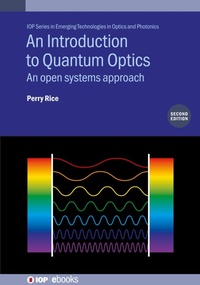
An Introduction to Quantum Optics (Second Edition)
Description

This book is for upper-level undergraduates and younger graduate students, using course tested material. It is also well suited for more senior people who are newcomers to the field. The only things assumed are basic principles of quantum mechanics and electromagnetism, which are reviewed early in the book. The treatment is somewhat informal, hopefully presenting the simplest path to basic understanding, which can serve as a good foundation. Signposts to other physics and more rigorous approaches are mentioned, but not explored deeply. It covers the basics of quantum optics of open systems, i.e. real systems interacting with their environment via inputs and outputs. This means the quantum state of a system is described by a reduced density matrix rather than a wave function approach applicable for closed systems. This is the central departure from quantum mechanics and quantum field theory texts. Examples of the application of these techniques are discussed.
The second edition has added content in the early chapters on the basics, and the later, new chapters, discuss recent techniques from other fields that are now being introduced into the quantum optics/quantum information arena. The emphasis is on optical systems that involve a few atoms and/or cavity modes, where quantum noise effects are most noticeable. The interest is in fundamental limits imposed by nature, in terms of communication, computing, and metrology.
More details
Other editions
Additional editions
Person
Dr. Perry Rice earned a B. S. in Physics from Wright State University in 1981, and a Ph. D. in Physics from the University of Arkansas in 1988. He then spent 30 years as a professor at Miami University where he is an emeritus Professor, followed by a year at the Oregon Center for Optical, Molecular, and Atomic Physics. His research focuses on the interaction of quantized light with matter and the properties of quantum noise, including resonance fluorescence, cavity quantum electrodynamics, and nonlinear optics. Currently he uses neural networks to work on waveguide quantum electrodynamics, quantum phase transitions, error correction codes, and the distribution of multipartite entanglement.
Content
Preface
Author biography
1 Introduction
2 Classical electromagnetism and linear optics
3 Quantum mechanics review
4 Two-level dynamics
5 Multilevel systems
6 Quantum fields I
7 Quantum fields II
8 Two-level atom coupled to a quantized field
9 Coherence and detection
10 The density matrix and the master equation or wave functions: the big lie
11 Quantum trajectory theory
12 Quasiprobability distributions
13 Stochastic differential equations
14 The Schwinger-Keldysh formalism
15 Double-sided Feynman diagrams
16 Entanglement
17 Further!
