

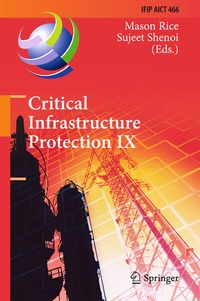
Critical Infrastructure Protection IX
9th IFIP 11.10 International Conference, ICCIP 2015, Arlington, VA, USA, March 16-18, 2015, Revised Selected Papers
Published on 12. November 2015
XVIII, 331 pages
978-3-319-26567-4 (ISBN)
Description

The
information infrastructure---comprising computers, embedded devices, networks
and software systems---is vital to day-to-day operations in every sector:
information and telecommunications, banking and finance, energy, chemicals and
hazardous materials, agriculture, food, water, public health, emergency
services, transportation, postal and shipping, government and defense. Global
business and industry, governments, indeed society itself, cannot function
effectively if major components of the critical information infrastructure are
degraded, disabled or destroyed.
Critical
Infrastructure Protection describes original research results and innovative
applications in the interdisciplinary field of critical infrastructure
protection. Also, it highlights the
importance of weaving science, technology and policy in crafting sophisticated,
yet practical, solutions that will help secure information, computer and network
assets in the various critical infrastructure sectors. Areas of coverage include: Themes and Issues,
Control Systems Security, Cyber-Physical Systems Security, Infrastructure
Security, Infrastructure Modeling and Simulation, Risk and Impact Assessment.
This
book is the ninth volume in the annual series produced by the International
Federation for Information Processing (IFIP) Working Group 11.10 on Critical
Infrastructure Protection, an international community of scientists, engineers,
practitioners and policy makers dedicated to advancing research, development
and implementation efforts focused on infrastructure protection. The book contains a selection of nineteen
edited papers from the Ninth Annual IFIP WG 11.10 International Conference on
Critical Infrastructure Protection, held at SRI International, Arlington,
Virginia, USA in the spring of 2015.
Critical
Infrastructure Protection IX is an important resource for researchers, faculty
members and graduate students, as well as for policy makers, practitioners and
other individuals with interests in homeland security.
Mason
Rice is an Assistant Professor of Computer Science at the Air Force Institute
of Technology, Wright-Patterson Air Force Base, Ohio, USA.
Sujeet
Shenoi is the F.P. Walter Professor of Computer Science and a Professor of
Chemical Engineering at the University of Tulsa, Tulsa, Oklahoma, USA.
More details
Series
Language
English
Place of publication
Cham
Switzerland
Publishing group
Springer International Publishing
Target group
Professional and scholarly
Illustrations
XVIII, 331 p. 95 illus. in color.
File size
20,86 MB
ISBN-13
978-3-319-26567-4 (9783319265674)
DOI
10.1007/978-3-319-26567-4
Schweitzer Classification
Other editions
Additional editions
Mason Rice | Sujeet Shenoi
Critical Infrastructure Protection IX
9th IFIP 11.10 International Conference, ICCIP 2015, Arlington, VA, USA, March 16-18, 2015, Revised Selected Papers
Book
11/2015
Springer
€53.49
Shipment within 10-15 days
Content
- Intro
- Contents
- Contributing Authors
- Preface
- THEMES AND ISSUES
- A MODEL FOR CHARACTERIZING CYBERPOWER
- 1. Introduction
- 2. Related Work
- 3. Unified Cyberspace Model
- 4. Defining Cyberpower
- 4.1 Cyberpower
- 4.2 State and Non-State Actors
- 5. Characterizing Cyberpower
- 5.1 Cyber Attack Attributes
- 5.2 Cyber Attack Evaluation
- 6. Conclusions
- References
- CYBER ATTACKS AND POLITICAL EVENTS: THE CASE OF THE OCCUPY CENTRAL CAMPAIGN
- 1. Introduction
- 2. Initial Violent Attacks
- 3. Silent Attacks on Protest Supporters
- 4. Violent Attacks on Protest Supporters
- 5. Violent Attacks on the Government
- 6. Attack Characteristics
- 7. Motivation for the Cyber War Framework
- 8. Cyber Warfare Framework
- 9. Conclusions
- References
- ON THE SHARING OF CYBER SECURITY INFORMATION
- 1. Introduction
- 2. Definitions
- 3. Previous Work
- 4. Analytic Framework for Information Sharing
- 4.1 Information Exchange Classes and Elements
- 4.2 Framework Levels
- 4.3 Incident Management Cycle
- 4.4 Mapping the Elements to the Grid
- 5. Standards and Standardization Efforts
- 6. Conclusions
- References
- CONTROL SYSTEMS SECURITY
- MODELING MESSAGE SEQUENCES FOR INTRUSION DETECTION IN INDUSTRIAL CONTROL SYSTEMS
- 1. Introduction
- 2. Background
- 3. Sequence Attacks
- 4. Sequences and Sequence Events
- 5. Modeling Message Sequences
- 6. Experiments and Analysis
- 6.1 Modbus
- 6.2 MMS
- 6.3 IEC104
- 6.4 Discussion
- 7. Related Work
- 8. Conclusions
- References
- INDUSTRIAL CONTROL SYSTEM FINGERPRINTING AND ANOMALY DETECTION
- 1. Introduction
- 2. Related Work
- 3. Background
- 4. Experimental Setup
- 5. Fingerprinting Methodology
- 6. Fingerprint-Based Anomaly Detection
- 7. Conclusions
- References
- TRAFFIC-LOCALITY-BASED CREATION OF FLOW WHITELISTS FOR SCADA NETWORKS
- 1. Introduction
- 2. Background
- 2.1 Network Flow and Flow Whitelists
- 2.2 Traffic Summary
- 2.3 Degree Centrality
- 2.4 Locally Frequently-Used Ports
- 3. Flow Whitelist Creation
- 3.1 Overview
- 3.2 Phase 1: Preparation
- 3.3 Phase 2: Generation
- 3.4 Phase 3: Inspection
- 4. Experimental Results
- 4.1 Phase 1: Preparation
- 4.2 Phase 2: Generation
- 4.3 Phase 3: Inspection
- 4.4 Discussion
- 5. Conclusions
- References
- A SYMBOLIC HONEYNET FRAMEWORK FOR SCADA SYSTEM THREAT INTELLIGENCE
- 1. Introduction
- 2. Related Work
- 3. SCyPH Framework
- 3.1 Overview
- 3.2 Honeynet Layer
- 3.3 Interaction Layer
- 3.4 Infrastructure Modeling Layer
- 3.5 Logging Layer
- 4. GridPot
- 4.1 IEC 61850
- 4.2 Experiment Design
- 4.3 Infrastructure Modeling
- 4.4 Logging and Anomaly Detection
- 4.5 Experimental Results
- 5. Conclusions
- References
- ENHANCING A VIRTUAL SCADA LABORATORY USING SIMULINK
- 1. Introduction
- 2. Related Work
- 3. SCADA Laboratory Overview
- 3.1 Process Simulation
- 3.2 Programmable Logic Controller Simulation
- 3.3 Human-Machine Interface
- 4. SCADA Laboratory Enhancements
- 5. Experimental Results
- 5.1 Normal Operation
- 5.2 Startup Operation
- 5.3 Attack Operation
- 6. Conclusions
- References
- HOW INDUSTRIAL CONTROL SYSTEM SECURITY TRAINING IS FALLING SHORT
- 1. Introduction
- 2. Background
- 3. Gap Analysis
- 3.1 Training Facility Evaluation
- 3.2 Training Curricula Evaluation
- 4. Recommendations
- 4.1 Training Facilities
- 4.2 Training Curricula
- 5. Conclusions
- References
- CYBER-PHYSICAL SYSTEMS SECURITY
- RUNTIME INTEGRITY FOR CYBERPHYSICAL INFRASTRUCTURES
- 1. Introduction
- 2. Related Work
- 3. Dynamic Integrity
- 4. Trusted Infrastructures
- 5. Dynamic Software Integrity
- 6. Constraining Software by Calibration
- 6.1 Design Constraints
- 6.2 Dynamic Constraints
- 7. Dynamic Call Integrity via Calibration
- 7.1 Experimental Setup
- 7.2 Evaluation and Calibration
- 7.3 Parameter Length
- 7.4 Call Parameter Parity
- 8. Conclusions
- References
- SECURITY CHALLENGES OF ADDITIVE MANUFACTURING WITH METALS AND ALLOYS
- 1. Introduction
- 2. Related Work
- 3. Additive Manufacturing Threat Surface
- 3.1 Attack Vectors
- 3.2 Impact of Manufacturing Parameters
- 4. Conclusions
- References
- USING INFORMATION FLOW METHODS TO SECURE CYBER-PHYSICAL SYSTEMS
- 1. Introduction
- 2. Background
- 2.1 Information Flow Security
- 2.2 Physical System Security
- 2.3 Cyber System Security
- 2.4 Information Flow as Information Leakage
- 3. Securing Cyber-Physical Systems
- 3.1 Physical Security Analysis
- 3.2 Cyber Security Analysis
- 3.3 Complications
- 4. Nondeducibility and Security
- 4.1 Deducibility vs. Nondeducibility
- 4.2 Definitions
- 5. Nondeducibility Secure Attacks
- 5.1 Drive-by-Wire Car
- 5.2 Cream Separator
- 6. Conclusions
- References
- INFRASTRUCTURE SECURITY
- EVALUATING ITU-T G.9959 BASED WIRELESS SYSTEMS USED IN CRITICAL INFRASTRUCTURE ASSETS
- 1. Introduction
- 2. ITU-T G.9959-Based Z-Wave Protocol
- 2.1 PHY Layer
- 2.2 MAC Layer
- 2.3 Routing Layer
- 2.4 Application Layer
- 3. ITU-T G.9959/Z-Wave Attack Classes
- 3.1 Reconnaissance Attacks
- 3.2 Denial-of-Service Attacks
- 3.3 Packet Injection Attacks
- 4. Passive Reconnaissance Techniques
- 4.1 Controller-Device Pairing
- 4.2 Controller-Specific Behavior
- 4.3 Device-Specific ACK Times
- 5. Conclusions
- References
- IMPLEMENTING CYBER SECURITY REQUIREMENTS AND MECHANISMS IN MICROGRIDS
- 1. Introduction
- 2. Security Requirements for Microgrids
- 3. µGridSec Methodology
- 3.1 Information and Communications
- 3.2 µGridSec Components and Details
- 4. Implementing µGridSec
- 5. Cyber Security Requirements
- 6. Threat Model
- 6.1 Unauthorized Access
- 6.2 Privilege Escalation
- 6.3 Spoofing
- 6.4 Denial-of-Service
- 6.5 Software and Firmware Integrity
- 6.6 Unauthorized Network Access
- 6.7 Repudiation
- 7. Related Work
- 8. Conclusions
- References
- A CYBER SECURITY ARCHITECTURE FOR MICROGRID DEPLOYMENTS
- 1. Introduction
- 2. Problem Description
- 3. SNAPE Cyber Security Architecture
- 3.1 Security Properties
- 3.2 Architecture
- 3.3 OPC UA Integration
- 4. SNAPE Threat Model Analysis
- 5. Discussion
- 6. Related Work
- 7. Conclusions
- References
- INFRASTRUCTURE MODELING AND SIMULATION
- ALLOCATION AND SCHEDULING OF FIREFIGHTING UNITS IN LARGE PETROCHEMICAL COMPLEXES
- 1. Introduction
- 2. Related Work
- 3. Proposed Decision Support System
- 3.1 Fire Severity Model
- 3.2 Production Loss Model
- 3.3 Optimization Agent
- 4. Case Study
- 4.1 Framework Description
- 4.2 Results and Analysis
- 5. Conclusions
- References
- SITUATIONAL AWARENESS USING DISTRIBUTED DATA FUSION WITH EVIDENCE DISCOUNTING
- 1. Introduction
- 2. Overview of the Methodology
- 3. Data Fusion
- 4. Data Fusion Methodology
- 4.1 Motivation
- 4.2 Weighted Digraphs
- 4.3 Agent Interactions
- 4.4 Graph Construction
- 5. Simulation Results
- 5.1 Static Network Topology
- 5.2 Dynamic Network Topology
- 6. Conclusions
- References
- RISK AND IMPACT ASSESSMENT
- USING CENTRALITY MEASURES IN DEPENDENCY RISK GRAPHS FOR EFFICIENT RISK MITIGATION
- 1. Introduction
- 2. Graph Centrality Analysis
- 3. Related Work
- 4. Centrality Measures for Dependency Graphs
- 4.1 Centrality Measures for Dependency Graphs
- 4.2 Centrality Measures for Risk Mitigation
- 5. Experimental Results
- 5.1 Risk Mitigation Based on Centrality
- 5.2 Efficient Risk Mitigation Algorithm
- 6. Conclusions
- References
- ASSESSING CYBER RISK USING THE CISIApro SIMULATOR
- 1. Introduction
- 2. Related Work
- 2.1 Infrastructure Modeling and Simulation
- 2.2 Cyber Attack Impact Assessment
- 3. CISIApro Simulator
- 3.1 Mixed Holistic Reductionist Approach
- 3.2 Simulator Description
- 4. Case Study
- 5. Simulation Results
- 6. Conclusions
- References
