

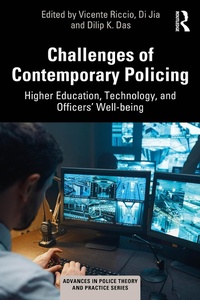
Challenges of Contemporary Policing
Higher Education, Technology, and Officers' Well-Being
1st Edition
Published on 2. October 2024
266 pages
978-1-040-09842-4 (ISBN)
Description

This edited collection reflects contemporary challenges faced by police forces across the globe and the role of technology in addressing them. The use of science and technology raises questions about ethics, training, the well-being of people, and freedom. New technologies promise to foster police practices based on intelligence, accuracy, and preparedness, and are considered necessary to overcome challenges such as declining budgets, lack of personnel, and legitimacy. However, technologies can also be used for authoritarian and nefarious purposes. For those reasons, this book aims to discuss related topics from various contexts to establish connections among common problems in the field of policing across the globe.
This book provides an internationally relevant assessment of the use of technology in the field of policing, as well as the impact on training and police well-being. It is ideal for an academic audience at both graduate and undergraduate levels in the fields of criminal justice studies, police studies, legal sociology, and public policy, and will be of interest to police practitioners, legal professionals, social service workers, and public-sector managers.
This book provides an internationally relevant assessment of the use of technology in the field of policing, as well as the impact on training and police well-being. It is ideal for an academic audience at both graduate and undergraduate levels in the fields of criminal justice studies, police studies, legal sociology, and public policy, and will be of interest to police practitioners, legal professionals, social service workers, and public-sector managers.
More details
Series
Edition
1. Auflage
Language
English
Place of publication
London
United Kingdom
Publishing group
Taylor & Francis Ltd
Target group
College/higher education
Professional and scholarly
Illustrations
28 Tables, black and white; 7 Line drawings, black and white; 7 Illustrations, black and white
ISBN-13
978-1-040-09842-4 (9781040098424)
Copyright in bibliographic data and cover images is held by Nielsen Book Services Limited or by the publishers or by their respective licensors: all rights reserved.
Schweitzer Classification
Other editions
Additional editions
Vicente Riccio | Di Jia | Dilip K. Das
Challenges of Contemporary Policing
Higher Education, Technology, and Officers' Well-Being
Book
10/2024
1st Edition
Routledge
€73.60
Shipment within 10-20 days
Vicente Riccio | Di Jia | Dilip K. Das
Challenges of Contemporary Policing
Higher Education, Technology, and Officers' Well-Being
Book
10/2024
1st Edition
Routledge
€205.80
Shipment within 10-20 days

Challenges of Contemporary Policing
Higher Education, Technology, and Officers' Well-Being
Book
08/2024
Routledge
Unfortunately, price unknown
Available (delivery time upon request)
Persons
Vicente Riccio holds a doctorate in Sociology from Instituto Universitario de Pesquisas do Rio de Janeiro and was the coordinator of the graduate program of Law and Innovation at the Federal University of Juiz de Fora (2017-2023), Brazil. He also has worked as a consultant for many public institutions in Brazil, such as the Ministry of Justice, the Public Security Secretary of Rio de Janeiro, and the Civil Police of Amazonas. His research interests are police reform, legal systems in developing democracies, media, justice and video evidence. He has coedited Police and Society in Brazil (Routledge) with Wesley Skogan (Northwestern University). He has also published articles and book chapters in both international and Brazilian publications.
Di Jia is Associate Professor in the Department of Criminal Justice and Criminology at MSU Denver. After receiving her Ph.D. from the College of Criminal Justice at Sam Houston State University, Dr. Jia has committed to teaching in criminal justice. As a former law enforcement officer in emergency and crisis policing, she applies her research and working experience to the classroom. Her teaching/research interests include Police Systems and Practices, Crime Analysis, Homeland Security and Crisis Management, and International and Comparative Studies on Criminal Justice Issues.
Dilip K. Das is the Founding President of the International Police Executive Symposium, IPES, and the Founding and former Editor-in-Chief of Police Practice and Research: An International Journal. He is the current editor of Advances in Police Theory and Practice, and Interviews with Global Leaders in Policing, Courts and Prisons. Dr. Das has also worked as Human Rights Consultant for the United Nations and is professor of Criminal Justice. He currently teaches at the Coppin State University in Baltimore. He has also authored and coauthored diverse books in the field of Criminal Justice.
Di Jia is Associate Professor in the Department of Criminal Justice and Criminology at MSU Denver. After receiving her Ph.D. from the College of Criminal Justice at Sam Houston State University, Dr. Jia has committed to teaching in criminal justice. As a former law enforcement officer in emergency and crisis policing, she applies her research and working experience to the classroom. Her teaching/research interests include Police Systems and Practices, Crime Analysis, Homeland Security and Crisis Management, and International and Comparative Studies on Criminal Justice Issues.
Dilip K. Das is the Founding President of the International Police Executive Symposium, IPES, and the Founding and former Editor-in-Chief of Police Practice and Research: An International Journal. He is the current editor of Advances in Police Theory and Practice, and Interviews with Global Leaders in Policing, Courts and Prisons. Dr. Das has also worked as Human Rights Consultant for the United Nations and is professor of Criminal Justice. He currently teaches at the Coppin State University in Baltimore. He has also authored and coauthored diverse books in the field of Criminal Justice.
Content
Introduction
Vicente Riccio, Di Jia & Dilip K. Das
1. Performance evaluation of integrated public security areas: Application of the PROMETHEE II method in the Brazilian context
Marcio Pereira Basilio, Valdecy Pereira, Max William Coelho Moreira de Oliveira & Antonio Fernandes da Costa Neto
2. Addressing the Challenges of Law Enforcement Higher Education in Hungary
Laszlo Christian
3. The Formation of the Local Prevention Police Units at the National University of Lanus
Daniel Russo & Alejandro Hener
4. Exploring an incorporated model of community justice in Chinese immigrant community: The perspective of law enforcement
Jurg Gerber, Di Jia & Charles W. Russo
5. Understanding Officer's Behavior in a Non-Traffic Situation: Why will police officers use force and verbally attack citizens during a street stop?
Francis D. Boateng & Michael K. Dzordzormenyoh
6. The determinant factors of religious radicalization: The case of Kyrgyzstan
Erlan Bakiev & Zairbek Kozhomberdiev
7. Cameras, community, and police: possible correlations in the evaluation of the body-worn cameras for the Brazilian Federal Highway Police
Otavio Lacerda, Eduardo Magrone, Vicente Riccio and Wagner Silveira Rezende
8. Officer Suicide: Agency Protocol and Prevention Strategies
Charles W. Russo, Jarrod Sadulski & Matthew Loux
9. Police suicide in Brazil: What do we know about?
Dayse Assuncao Miranda & Fernanda Cruz
10. PTSD: Is it Pension Worthy
Charles Russo & Stephanie Myers-Hunziker
11. Addictive Hypervigilance and Uncontrolled Police Use of Force
Jesse Cheng
12. The Law Enforcement Workforce Crisis: Developing Targeted Recruitment and Retention Strategies for Future Generations
Nicole Cain
Vicente Riccio, Di Jia & Dilip K. Das
1. Performance evaluation of integrated public security areas: Application of the PROMETHEE II method in the Brazilian context
Marcio Pereira Basilio, Valdecy Pereira, Max William Coelho Moreira de Oliveira & Antonio Fernandes da Costa Neto
2. Addressing the Challenges of Law Enforcement Higher Education in Hungary
Laszlo Christian
3. The Formation of the Local Prevention Police Units at the National University of Lanus
Daniel Russo & Alejandro Hener
4. Exploring an incorporated model of community justice in Chinese immigrant community: The perspective of law enforcement
Jurg Gerber, Di Jia & Charles W. Russo
5. Understanding Officer's Behavior in a Non-Traffic Situation: Why will police officers use force and verbally attack citizens during a street stop?
Francis D. Boateng & Michael K. Dzordzormenyoh
6. The determinant factors of religious radicalization: The case of Kyrgyzstan
Erlan Bakiev & Zairbek Kozhomberdiev
7. Cameras, community, and police: possible correlations in the evaluation of the body-worn cameras for the Brazilian Federal Highway Police
Otavio Lacerda, Eduardo Magrone, Vicente Riccio and Wagner Silveira Rezende
8. Officer Suicide: Agency Protocol and Prevention Strategies
Charles W. Russo, Jarrod Sadulski & Matthew Loux
9. Police suicide in Brazil: What do we know about?
Dayse Assuncao Miranda & Fernanda Cruz
10. PTSD: Is it Pension Worthy
Charles Russo & Stephanie Myers-Hunziker
11. Addictive Hypervigilance and Uncontrolled Police Use of Force
Jesse Cheng
12. The Law Enforcement Workforce Crisis: Developing Targeted Recruitment and Retention Strategies for Future Generations
Nicole Cain
