

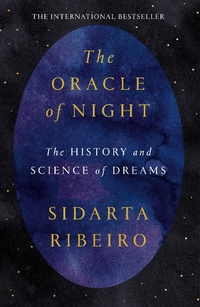
The Oracle of Night
The history and science of dreams
Published on 17. August 2021
480 pages
978-1-4735-8122-7 (ISBN)
Description

*THE INTERNATIONAL BESTSELLER*
What is a dream? Why do we dream? How do our bodies and minds use dreams?
These questions are the starting point for this unprecedented, astonishing study of the role and significance of dreams, from the beginning of human history. An investigation on the grand scale, encompassing literature, anthropology, religion, and science, it articulates the essential place dreams occupy in human culture, and how they functioned as the catalyst that compelled us to transform our earthly habitat into a human world.
From the earliest cave paintings - where the author finds a key to humankind's first dreams, which contributed to our capacity to perceive past and future - to cutting-edge scientific research, Ribeiro arrives at startling and revolutionary conclusions about the role of dreams in human existence and evolution.
He explores the advances that contemporary neuroscience, biochemistry and psychology have made into the connections between sleep, dreams, and learning, before revealing what dreams have taught us about the neural basis of memory and the transformation of memory in recall. And he makes clear that the earliest insight into dreams as oracular has been confirmed by contemporary research.
Accessible, authoritative, and fascinating from first to last, The Oracle of Night gives us a wholly new way to understand this most basic of human experiences.
What is a dream? Why do we dream? How do our bodies and minds use dreams?
These questions are the starting point for this unprecedented, astonishing study of the role and significance of dreams, from the beginning of human history. An investigation on the grand scale, encompassing literature, anthropology, religion, and science, it articulates the essential place dreams occupy in human culture, and how they functioned as the catalyst that compelled us to transform our earthly habitat into a human world.
From the earliest cave paintings - where the author finds a key to humankind's first dreams, which contributed to our capacity to perceive past and future - to cutting-edge scientific research, Ribeiro arrives at startling and revolutionary conclusions about the role of dreams in human existence and evolution.
He explores the advances that contemporary neuroscience, biochemistry and psychology have made into the connections between sleep, dreams, and learning, before revealing what dreams have taught us about the neural basis of memory and the transformation of memory in recall. And he makes clear that the earliest insight into dreams as oracular has been confirmed by contemporary research.
Accessible, authoritative, and fascinating from first to last, The Oracle of Night gives us a wholly new way to understand this most basic of human experiences.
Reviews / Votes
The Oracle of Night makes a resounding case for the mystery, beauty and cognitive importance of dreams. Ribeiro marshals prodigious evidence to bolster his case . . . This book is the culmination of decades of thought and collaborative work. It's also the expression of remarkable, if sometimes all-over-the-map, scholarship, drawing on history, literature, biology, anthropology, neuroscience, sociology and psychology, among other disciplines . . . His lyrical account is aided by Daniel Hahn's beautiful translation from the Portuguese . . . Delightful . . . You can't help being awed and enchanted by the wonder with which Ribeiro approaches his subject, by the depth of his knowledge and passion. * The New York Times * A comprehensive consideration of the sleeping mind . . . [Ribeiro] offers a capacious examination of the phenomenon of dreaming. The author draws on biology, chemistry, neurophysiology, anthropology, mythology, history, literature, biography, and art-along with myriad examples of dream narratives-to create a rich history of the human mind . . . A stimulating and informative overview. * Kirkus * [Ribeiro] explores hypotheses about the evolutionary value of sleep to humans, presenting a fascinating analysis of the debate about the relationship between sleep and cognitive ability . . . concluding, among other things, that nap rooms would be a valuable addition to school environments. * Publishers Weekly * A groundbreaking history of the human mind told through our experience of dreams-from the earliest accounts to current scientific findings-and the essential role of dreams in the formation of who we are and the world we have made. * Next Big Idea Club * "A sweeping account as tangled and chaotic-and fascinating-as the dreams themselves . . . It reinfuses the dreamscape with beauty, mystery and significance . . . The Oracle of Night takes a breakneck journey through history, from cave paintings and the ancient Greeks to Celtic myths, Egyptian pharaohs, Gilgamesh and Julius Caesar. The text, translated from the Portuguese by Daniel Hahn, moves fluidly from systemic historiography to guesswork and lighthearted extrapolation . . . The result is a curiously hybridized book, at times playful, at times intensely scientific . . . Poetic and visceral." * The Wall Street Journal * 'A detailed, complex guide to the history, science, philosophy and psychology of dreams' * The Independent * 'It has a sound scientific core...and it's argument stands up. Dreams matter. They deserve our serious attention.' * The Sunday Times * 'In this fascinating book Professor Sidarta Ribeiro, a neuroscientist, reveals what is going on when we close our eyes for the night.' * The Mail on Sunday * 'His work is more poetic than merely factual, and the esoteric significance of dreaming is discussed in an equally compelling manner...the appealing mystery of the topic is never lost.' * The Press and Journal (Inverness, Highlands & Islands) * '[Ribeiro] lifts the lid on the human mind. The Oracle of Night contains a number of interesting insights...and includes the intriguing possibility of a link between dreams and psychosis.' * The Guardian *More details
Language
English
Place of publication
London
United Kingdom
Publishing group
Transworld Publishers Ltd
Target group
Professional and scholarly
College/higher education
File size
7,78 MB
ISBN-13
978-1-4735-8122-7 (9781473581227)
Copyright in bibliographic data and cover images is held by Nielsen Book Services Limited or by the publishers or by their respective licensors: all rights reserved.
Schweitzer Classification
Other editions
Additional editions
Book
09/2022
Penguin (Transworld)
€16.50
Available immediately
Persons
Sidarta Ribeiro (Author)
SIDARTA RIBEIRO is the founder and first director of the Brain Institute of Federal University or Rio Grande do Norte in Brazil, where he currently is Professor of Neuroscience. He received a Ph.D in Animal Behavior from Rockefeller University. His research topics encompass memory, sleep and dreams, neuroplasticity, symbolic competence in in non-human animals, computational psychiatry, and psychedelics.
Daniel Hahn (Translator)
Daniel Hahn is a writer, editor and literary translator. He translates from Portuguese, Spanish and French and has translated literature from Europe, Africa and the Americas, including the work of Jose Eduardo Agualusa, Philippe Claudel, Maria Duenas, Eduardo Halfon, Jose Luis Peixoto, Jose Saramago and Goncalo M. Tavares. His translations have won literary awards including the Independent Foreign Fiction Prize and the International Dublin Literary Award, and been shortlisted for the Man Booker International Prize and the LA Times Book Award. He is also the author of several works of non-fiction, including The Tower Menagerie and the forthcoming If This Be Magic, and the award-winning children's picture-book Happiness is a Watermelon on Your Head, and is co-editor of 'The Ultimate Book Guide' series. He reviews for publications including the Guardian, Spectator and Prospect, and is former Chair of the Translators Association and the Society of Authors and former National Programme Director of the British Centre for Literary Translation.
SIDARTA RIBEIRO is the founder and first director of the Brain Institute of Federal University or Rio Grande do Norte in Brazil, where he currently is Professor of Neuroscience. He received a Ph.D in Animal Behavior from Rockefeller University. His research topics encompass memory, sleep and dreams, neuroplasticity, symbolic competence in in non-human animals, computational psychiatry, and psychedelics.
Daniel Hahn (Translator)
Daniel Hahn is a writer, editor and literary translator. He translates from Portuguese, Spanish and French and has translated literature from Europe, Africa and the Americas, including the work of Jose Eduardo Agualusa, Philippe Claudel, Maria Duenas, Eduardo Halfon, Jose Luis Peixoto, Jose Saramago and Goncalo M. Tavares. His translations have won literary awards including the Independent Foreign Fiction Prize and the International Dublin Literary Award, and been shortlisted for the Man Booker International Prize and the LA Times Book Award. He is also the author of several works of non-fiction, including The Tower Menagerie and the forthcoming If This Be Magic, and the award-winning children's picture-book Happiness is a Watermelon on Your Head, and is co-editor of 'The Ultimate Book Guide' series. He reviews for publications including the Guardian, Spectator and Prospect, and is former Chair of the Translators Association and the Society of Authors and former National Programme Director of the British Centre for Literary Translation.
