

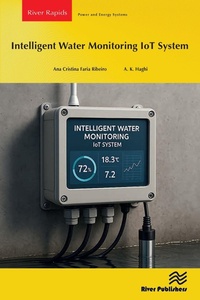
Intelligent Water Monitoring IoT System
Description

The current issues of water security, economic efficiency and environmental protection worldwide along with the issue of loss control in water distribution networks are becoming increasingly important. It is important to note that both technical and economic aspects should be closely considered in the context of water losses, especially in situations of water scarcity or rapid growth in water demand.
This volume bridges the gap between theory and practice by presenting the practical applications of IoT devices, sensors, and cloud-based platforms to collect, process, and analyze data. This information was used for regression analysis which investigated dependent variables such as water saving (m³), the flow interred network (m³), and independent variables such as water average pressure, which led to water saving.
Inside this book, you will also find:
- Explanatory figures that accompany detailed discussions on key concepts, making complex ideas accessible and understandable.
- The standard measures to ensure the safety and reliability of water systems.
- Practical advice through networked sensors, and the intelligent water monitoring IoT system.
More details
Other editions
Additional editions
Persons
Ana Cristina Faria Ribeiro is a researcher in the Department of Chemistry at the University of Coimbra, Portugal. Her area of scientific activity is physical chemistry and electrochemistry. Her main areas of research interest are the transport properties of ionic and non-ionic components in aqueous solutions. Dr Ribeiro obtained her PhD and Habilitation from the University of Coimbra, Coimbra, Portugal.
A. K. Haghi is a retired professor and is currently a research associate at the University of Coimbra, Portugal. Professor Haghi holds a BSc in urban and environmental engineering from the University of North Carolina (USA) and holds two MSc degrees, one in mechanical engineering from North Carolina State University (USA) and another one in applied mechanics, acoustics, and materials from the Université de Technologie de Compiègne (France). He was awarded a PhD in engineering sciences at Université de Franche-Comté (France). He has written, co-written, edited, or co-edited more than 1000 publications, including books, book chapters, and papers in refereed journals with over 4400 citations and an h-index of 35, according to Google Scholar database.
Content
1. Introduction 2. Materials and Methods 3. Results 4. Conclusion
