

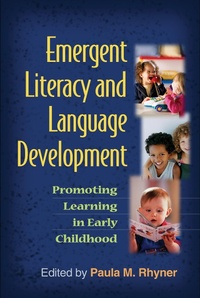
Emergent Literacy and Language Development
Description

Reading specialists, speech?language pathologists, and early childhood educators (general and special education). May serve as a supplemental text in graduate-level courses.
More details
Other editions
Additional editions
Person
Paula M. Rhyner, PhD, CCC-SLP, is Professor in the Department of Communication Sciences and Disorders at the University of Wisconsin-Milwaukee (UWM). She is a Board Recognized Specialist in Child Language and has served in various roles on the Specialty Board on Child Language, including that of Chair. Dr. Rhyner is a member of the editorial board for Communication Disorders Quarterly, and served as an Associate Editor for Language, Speech, and Hearing Services in Schools. She directs the Child Language Lab at UWM, which conducts interdisciplinary research in areas related to development and disabilities in children from birth through 5 years of age. Her published research on language assessment and intervention and her interest in emergent literacy and early language acquisition led her to collaborate with the series editors and the other contributing authors to create this book.
Content
Introduction, Paula M. Rhyner
1. Understanding Frameworks for the Emergent Literacy Stage, Paula M. Rhyner, Eileen K. Haebig, and Kaycee M. West
2. Book Sharing and the Development of Meaning, Judith Vander Woude, Anne van Kleeck, and Elizabeth Vander Veen
3. Metaphonological Awareness: Enhancing Literacy Skills, Elizabeth Hester and Barbara W. Hodson
4. Early Writing and Spelling Development, Joan N. Kaderavek, Sonia Q. Cabell, and Laura M. Justice
5. Children's Early Narratives, Froma P. Roth
6. Multiculturalism, Language, and Emergent Literacy, Dolores E. Battle
