

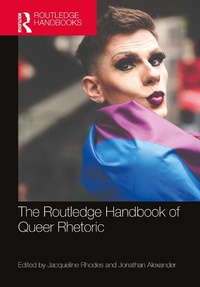
The Routledge Handbook of Queer Rhetoric
1st Edition
Published on 25. April 2022
500 pages
978-1-000-56778-6 (ISBN)
Description

The Routledge Handbook of Queer Rhetoric maps the ongoing becoming of queer rhetoric in the late twentieth and early twenty-first centuries, offering a dynamic overview of the history of and scholarly research in this field.
The handbook features rhetorical scholarship that explicitly uses and extends insights from work in queer and trans theories to understand and critique intersections of rhetoric, gender, class, and sexuality. More important, chapters also attend to the intersections of constructs of queerness with race, class, ability, and neurodiversity. In so doing, the book acknowledges the many debts contemporary queer theory has to work by scholars of color, feminists, and activists, inside and outside the academy. The first book of its kind, the handbook traces and documents the emergence of this subfield within rhetorical studies while also pointing the way toward new lines of inquiry, new trajectories in scholarship, and new modalities and methods of analysis, critique, intervention, and speculation.
This handbook is an invaluable resource for scholars, graduate students, and advanced undergraduate students studying rhetoric, communication, cultural studies, and queer studies.
The handbook features rhetorical scholarship that explicitly uses and extends insights from work in queer and trans theories to understand and critique intersections of rhetoric, gender, class, and sexuality. More important, chapters also attend to the intersections of constructs of queerness with race, class, ability, and neurodiversity. In so doing, the book acknowledges the many debts contemporary queer theory has to work by scholars of color, feminists, and activists, inside and outside the academy. The first book of its kind, the handbook traces and documents the emergence of this subfield within rhetorical studies while also pointing the way toward new lines of inquiry, new trajectories in scholarship, and new modalities and methods of analysis, critique, intervention, and speculation.
This handbook is an invaluable resource for scholars, graduate students, and advanced undergraduate students studying rhetoric, communication, cultural studies, and queer studies.
Reviews / Votes
"The Routledge Handbook of Queer Rhetoric does exactly what a handbook should do: it challenges the boundaries of the field while providing parameters, it provokes, it intervenes, and it offers something of interest for almost everyone. Smart, naughty, and cutting edge, both new and established voices come together to create a queer and trans rhetorical theory agenda that will be impossible to ignore for many years to come." - Karma R. Chavez, author of Queer Migration Politics: Activist Rhetoric and Coalitional Possibilities and The Borders of AIDS: Race, Quarantine, and Resistance"This handbook will be the definitive overview of the fabulous, diverse, and rigorous work in queer rhetorics for years to come. Contributors are well-attuned to the important ways in which identities and communities materialize in and through rhetoric, while simultaneously-through provocations, interventions, and speculations. Queer futures like the ones Jose Esteban Munoz imagined when he encouraged us to cruise utopia are on full display in this indispensable volume." - Robert McRuer, author of Crip Theory: Cultural Signs of Queerness and Disability and Crip Times: Disability, Globalization, and Resistance
"From the erotic to the fabulous, the resilient to the radical, this comprehensive collection maps the current landscapes of queer rhetorics as it also makes space for an un-imagined future. Queer rhetorics emerge here in all their varied possibilities." - Lisa A. Flores, University of Colorado Boulder
More details
Series
Edition
1. Auflage
Language
English
Place of publication
London
United Kingdom
Publishing group
Taylor & Francis Ltd
Target group
College/higher education
Product notice
Reflowable
Illustrations
4 Line drawings, black and white; 10 Halftones, black and white; 14 Illustrations, black and white
ISBN-13
978-1-000-56778-6 (9781000567786)
Copyright in bibliographic data and cover images is held by Nielsen Book Services Limited or by the publishers or by their respective licensors: all rights reserved.
Schweitzer Classification
Other editions
Additional editions
Jacqueline Rhodes | Jonathan Alexander
The Routledge Handbook of Queer Rhetoric
Book
01/2024
1st Edition
Routledge
€68.80
Shipment within 15-20 days
Jacqueline Rhodes | Jonathan Alexander
The Routledge Handbook of Queer Rhetoric
Book
04/2022
1st Edition
Routledge
€331.90
Shipment within 15-20 days
Persons
Jacqueline Rhodes is the Kelleher Centennial Professor of Rhetoric and Composition at the University of Texas at Austin. Her work on queer and feminist rhetorics has been published in journals such as College Composition & Communication, College English, Computers & Composition, enculturation, JAC, PRE/TEXT, and Rhetoric Review. Her co-authored and co-edited books have won a number of awards, including the 2014 CCCC Outstanding Book Award and the 2015 Computers & Composition Distinguished Book Award (for On Multimodality); the 2016 CCCC Lavender Rhetorics Award for Excellence in Queer Scholarship (for Techne: Queer Meditations on Writing the Self); and the same award in 2017 for Sexual Rhetorics: Methods, Identities, Publics. Her award-winning documentary feature Once a Fury (Morrigan House, 2020), which profiles the members of a 1970s lesbian separatist collective, is currently streaming on tellofilms.com.
Jonathan Alexander is Chancellor's Professor of English at the University of California, Irvine. The author, co-author, or co-editor of twenty-one books, Alexander writes frequently about queer culture and conducts research in the areas of life writing, lifespan writing, and the rhetorics of popular culture. His most recent work has been in creative nonfiction, consisting of Creep: A Life, a Theory, an Apology (finalist for a Lambda Literary Award), Stroke Book: The Diary of a Blindspot, Bullied: The Story of an Abuse, and Dear Queer Self: An Experiment in Memoir.
Jonathan Alexander is Chancellor's Professor of English at the University of California, Irvine. The author, co-author, or co-editor of twenty-one books, Alexander writes frequently about queer culture and conducts research in the areas of life writing, lifespan writing, and the rhetorics of popular culture. His most recent work has been in creative nonfiction, consisting of Creep: A Life, a Theory, an Apology (finalist for a Lambda Literary Award), Stroke Book: The Diary of a Blindspot, Bullied: The Story of an Abuse, and Dear Queer Self: An Experiment in Memoir.
Content
1. Introduction HISTORIES, RE-HISTORIES, ARCHIVES 2. Undoing Happiness with Pleasure: Rhetorics of Affect in The Ladder 3. Retroactivism and the Institutional Archive 4. Bisexual Invisibility, David Bowie, and the Prospects of Queer Memory 5. The Ready-Made Queerness of Greco-Roman Rhetoric 6. Printing a Queer Identity: Edward Carpenter, Iolaeus, and the Affirmation of Same-Sex Desires in the Nineteenth Century 7. Re-Storying Trans* Zines 8. An Archive of Disposability: (Trans)gender and Sexuality in South Africa 9. Re-Historicizing the "Lacking South": Archiving Queer Memory and Sexual Visibilities in Alabama, Mississippi, and Georgia Through the Invisible Histories Project 10. The Trans Rhetorical Practice of Archive Building METHODOLOGIES 11. Wobbly Words and Transnational Queer Slippages 12. Queer Topoi: Writing "Like" Sedgwick 13. Methodologies Not Yet Known: The Queer Case for Relational Research 14. Blake Brockington's Rhetorical Afterlife: Fugitive Black Trans* Data and Queer Kairotic Methodology 15. Histories in (Trans)lation: Xie Jianshun and the Potential and Perils of Trans Historiography 16. Subatomic Literacies and Queer Quantum Storytelling 17. Between the Sheets: Gavin Arthur's Sexual Circulation 18. Queer Ecovisual Rhetorics 19. Queering Spaces COMMUNITIES 20. "Let's Get Some Family Chosen": Refugees, Homonationalism, and Queer Family Rhetoric 21. Queer Memes as Rhetorical Scenes 22. Womyn's Words: Rhetorical Practices of Lesbians in the Tampa Bay Area 23. Mountain Dirt(y) Queer Rhetorics: Making Appalachian Queerness Visible 24. Queer Rhetorics of Resistance in HIV Healthcare 25. "People Can't Say I'm a Man, They Can't Say I'm a Woman": Reality Expansion in the Kewpie Collection 26. Converging in a Room of Our Own: The Ladder, Autostraddle, and Queer Convergence in Online Communities IDENTITIES 27. Prescribe for Me, Doctor, for I Have Sex: Rhetorics of Empowerment, Queer Shame, and the Confessional in PrEP Prescribing 28. Making Nothing Out of Something: Asexuality and the Rhetorics of Silence and Absence 29. The Queer Potential of Bisexual Rhetorics 30. Fuck (Gay) Racism: Queer Asian American Rhetorics of Abe Kim's TikTok 31. Anthos, Bottoms, and Anal Sex in Troye Sivan's "Bloom" 32. How Much Does It Take? Persuasion and the Stakes of Will in The Transformation 33. Irreversible Damage: Trans Masculine Affectability and the White Family 34. Disidentification (as a Survival Strategy for Religious Trauma) 35. Resilient Closets, Addressivity, and Opening Pandora's Box 36. Rhetoric of the Invisible (or, How Bisexual People Demand to be Seen) PROVOCATIONS & INTERVENTIONS 37. Sexual Assaults, Queer Panics: Gemma Watts and Reynhard Sinaga 38. Anti-Normativity Under Duress: An Intersectional Intervention in Queer Rhetoric 39. Lettering me Queer: An Open Letter to Gurlesque 40. Chronicity Rhetoric as Queercrip Activism 41. Rhetorical Work: Genre Fluidity as a Queer Rhetorical Practice of Activists: a Play/Chapter in Multiple Acts 42. On Taking the Bottom's Stance, or Not Your Typical Submissive 43."Soft Armor" for Ugly Bodies: The Radical Visibility of QueerCrip Fashion 44. Dear Queer Memoir Writers... 45. Queer Rhetorics as Intervention Methods: The Curious Case of Conversion Violence SPECULATIONS 46. The Fabulous Rhetorics of Queer Inhumanity: Speculating with Queer Inhuman Figures to Restory Queerphobic Histories 47. The Queer Babadook: Circulation of Queer Affects 48. Rhetorics of Gay Future and Queer Futurity: Strategies of Disruption 49. (Queer) Optimism Ain't (Im)Possible 50. Between Queer and Digital: Toward an Understanding of the Rhetoric of Digital Queerdom 51. Queering the Rhetoric of Health and Medicine: Bodies, Embodiment, and the Future 52. Cuir-ing Queer: Speculations on Latin American Notions of Queerness 53. Queer Hauntings, Queer Renewings 54. Pathological Desire, Perverse Erotics, and Paraphiliac Entelechies
