

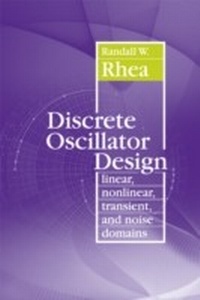
Discrete Oscillator Design
Linear, Nonlinear, Transient, and Noise Domains
1st Edition
Published on 1. January 2010
464 pages
978-1-60807-048-0 (ISBN)
Description

Oscillators are an essential part of all spread spectrum, RF, and wireless systems, and today's engineers in the field need to have a firm grasp on how they are designed. Presenting an easy-to-understand, unified view of the subject, this authoritative resource covers the practical design of high-frequency oscillators with lumped, distributed, dielectric and piezoelectric resonators. Including numerous examples, the book details important linear, nonlinear harmonic balance, transient and noise analysis techniques. Moreover, the book shows you how to apply these techniques to a wide range of oscillators. You gain the knowledge needed to create unique designs that elegantly match your specification needs. Over 360 illustrations and more than 330 equations support key topics throughout the book.
More details
Other editions
Additional editions
Book
02/2010
Artech House Publishers
€141.13
Shipment within 10-20 days
Content
- Intro
- Discrete Oscillator Design:Linear, Nonlinear, Transient, and Noise Domains
- Contents
- Preface
- 1 Linear Techniques
- 1.1 Open-Loop Method
- 1.2 Starting Conditions
- 1.2.1 Match Requirements
- 1.2.2 Aligning the Maximum Phase Slope
- 1.2.3 Stable Amplifier
- 1.2.4 Gain Peak at Phase Zero Intersection
- 1.2.5 Moderate Gain
- 1.3 Random Resonator and Amplifier Combination
- 1.4 Naming Conventions
- 1.5 Amplifiers for Sustaining Stages
- 1.5.1 Bipolar Amplifier Configurations
- 1.5.2 Stabilizing Bipolar Amplifiers
- 1.5.3 Stabilized FET Amplifier Configurations
- 1.5.4 Basic Common Emitter Amplifier
- 1.5.5 Statistical Analysis of the Amplifier
- 1.5.6 Amplifier with Resistive Feedback
- 1.5.7 General-Purpose Resistive-Feedback Amplifier
- 1.5.8 Transformer-Feedback Amplifiers
- 1.5.9 Monolythic Microwave Integrated Circuit Amplifiers
- 1.5.10 Differential Amplifiers
- 1.5.11 Phase-Lead Compensation
- 1.5.12 Amplifier Summary
- 1.6 Resonators
- 1.6.1 R-C Phase Shift Network
- 1.6.2 Delay-Line Phase-Shift Network
- 1.6.3 L-C Parallel and Series Resonators
- 1.6.4 Loaded Q
- 1.6.5 Unloaded Q
- 1.6.6 Resonator Loss
- 1.6.7 Colpitts Resonator
- 1.6.8 Resonator Coupling
- 1.6.9 Matching with the Resonator
- 1.6.10 Measuring the Unloaded Q
- 1.6.11 Coupled Resonator Oscillator Example
- 1.6.12 Resonator Summary
- 1.7 One-Port Method
- 1.7.1 Negative-Resistance Oscillators
- 1.7.2 Negative-Conductance Oscillators
- 1.8 Analyzing Existing Oscillators
- 1.9 Optimizing the Design
- 1.10 Statistical Analysis
- 1.11 Summary
- References
- 2 Nonlinear Techniques
- 2.1 Introduction
- 2.2 Harmonic Balance Overview
- 2.3 Nonlinear Amplifiers
- 2.3.1 Quiescent Current and Compression
- 2.3.2 Impedance Shift
- 2.3.3 Phase Shift
- 2.3.4 Output Spectrum
- 2.3.5 Time Domain Waveform
- 2.3.6 Conversion Efficiency
- 2.3.7 Operating Class
- 2.3.8 Power Amplifier Case Study
- 2.4 Nonlinear Open-Loop Cascade
- 2.4.1 Nonlinear Open-Loop Cascade Example 1
- 2.4.2 Nonlinear Open-Loop Cascade Example 2
- 2.5 Nonlinear HB Colpitts Example
- 2.5.1 Closing the Loop and Excitation
- 2.5.2 Harmonic Balance Colpitts Output Spectrum
- 2.5.3 Excitation Current Versus Oscillator Parameters
- 2.6 Nonlinear Negative-Resistance Oscillator
- 2.7 Output Coupling
- 2.7.1 Coupling Node
- 2.7.2 Load Pulling
- 2.7.3 Loaded Q and Load Pulling
- 2.7.4 Degree of Coupling
- 2.7.5 Loaded Q and Coupling
- 2.7.6 Coupling Reactance and Load Pulling
- 2.7.7 Coupling Reactance and Harmonics
- 2.7.8 Output Coupling Example 2
- 2.7.9 Coupling Summary
- 2.8 Passive Level Control
- 2.9 Supply Pushing
- 2.10 Spurious Modes
- 2.10.1 Unstable Amplifiers
- 2.10.2 Multiple Phase Zero Crossings
- 2.10.3 Bias Relaxation Modes
- 2.10.4 Parametric Modes
- 2.10.5 Multiple Resonance Modes
- 2.10.6 Spurious Mode Summary
- 2.11 Ultimate Test
- References
- 3 Transient Techniques
- 3.1 Introduction
- 3.2 Starting Modes
- 3.2.1 Noise Mode of Starting
- 3.2.2 Transient Mode of Starting
- 3.2.3 Time Constant of the Supply Step
- 3.3 Starting Basic Example
- 3.4 Simulation Techniques
- 3.4.1 SPICE
- 3.4.2 Cayenne
- 3.5 Second Starting Example
- 3.6 Starting Case Study
- 3.7 Triggering
- 3.8 Simulation Techniques for High Loaded Q
- 3.9 Steady-State Oscillator Waveforms
- 3.9.1 Clapp Oscillator Waveforms
- 3.9.2 The Resonator Voltage
- 3.9.3 Varactor Coupling
- 3.10 Waveform Derived Output Spectrum
- References
- 4 Noise
- 4.1 Definitions
- 4.1.1 Vector Representation of the Oscillator Output
- 4.1.2 Jitter
- 4.1.3 The Output in the Frequency Domain
- 4.1.4 SSB Phase Noise
- 4.1.5 Residual FM and Residual PM
- 4.1.6 Two-Port Noise
- 4.1.7 Acoustic Disturbances
- 4.2 Predicting Phase Noise
- 4.2.1 Linear Time Invariant Theory
- 4.2.2 Extensions to LTI-Based Theory
- 4.2.3 Linear Time Variant Theory
- 4.3 Measuring Phase Noise
- 4.3.1 Direct Method with a Spectrum Analyzer
- 4.3.2 Selective Receiver Method
- 4.3.3 Heterodyne/Counter Method
- 4.3.4 Reference Oscillator Method
- 4.3.5 Frequency Discriminator Method
- 4.3.6 Example Phase-Noise Measurement System
- 4.4 Designing for Low Phase Noise
- 4.4.1 Estimating the Predominant Noise Source
- 4.4.2 Reducing Leeson Noise
- 4.4.3 Reducing Pushing Induced Noise
- 4.4.4 Reducing Buffer Noise
- 4.4.5 Reducing Varactor Modulation Noise
- 4.4.6 Reducing Oscillator Noise Summary
- 4.5 Nonlinear Noise Simulation
- 4.5.1 Negative Resistance Oscillator Noise Example
- 4.5.2 Linear Oscillator Phase Noise Example
- 4.6 PLL Noise
- References
- 5 General-Purpose Oscillators
- 5.1 Comments on the Examples
- 5.2 Oscillators Without Resonators
- 5.2.1 R-C Oscillators
- 5.2.2 Wien Bridge
- 5.2.3 Multivibrators
- 5.2.4 Ring Oscillators
- 5.2.5 Twin-T Oscillators
- 5.3 L-C Oscillators
- 5.3.1 Colpitts
- 5.3.2 Clapp
- 5.3.3 Seiler
- 5.3.4 Hartley
- 5.3.5 Pierce
- 5.3.6 Coupled Series Resonator
- 5.3.7 Rhea
- 5.3.8 Coupled Parallel Resonator
- 5.3.9 Gumm
- 5.3.10 Simplified Gumm
- 5.4 Oscillator Topology Selection
- References
- 6 Distributed Oscillators
- 6.1 Resonator Technologies
- 6.2 Lumped and Distributed Equivalents
- 6.3 Quarter-Wavelength Resonators
- 6.3.1 The Quarter-Wavelength Resonator
- 6.3.2 Ceramic-Loaded Coaxial Resonators
- 6.3.3 Capacitor-Loaded Quarter-Wavelength Resonator
- 6.4 Distributed Oscillator Examples
- 6.4.1 Negative-Resistance Hybrid Oscillator
- 6.4.2 Negative-Resistance High-Power 1 GHz Oscillator
- 6.4.3 Quarter-Wavelength Hybrid Oscillator
- 6.4.4 Simple Hybrid Coaxial Resonator MMIC
- 6.4.5 Probe-Coupled Coaxial Resonator Bipolar
- 6.4.6 End-Coupled Hybrid Half-Wavelength Bipolar
- 6.4.7 Helical Transmission Line Resonator Bipolar
- 6.5 DRO Oscillators
- 6.5.1 Dielectric Resonator Basic Properties
- 6.5.2 Dielectric Resonator Resonant Frequency
- 6.5.3 Dielectric Resonator Unloaded Q
- 6.5.4 Dielectric Resonator Coupling
- 6.5.5 DRO Examples
- 6.5.6 Coupling Test by Modulation
- References
- 7 Tuned Oscillators
- 7.1 Resonator Tuning Bandwidth
- 7.2 Resonator Voltage
- 7.3 Permeability Tuning
- 7.4 Tunable Oscillator Examples
- 7.4.1 Permeability Tuned Colpitts JFET
- 7.4.2 Vackar JFET VCO
- 7.4.3 Hybrid Negative Resistance VCO
- 7.4.4 Capacitor-Transformed Negative-Resistance VCO
- 7.4.5 Negative-Resistance VCO with Transformer
- 7.4.6 Negative-Conductance VCO
- 7.4.7 Hybrid Coaxial Resonator MMIC
- 7.4.8 Loaded Quarter-Wavelength MMIC
- 7.4.9 Seiler Coaxial-Resonator CC VCO
- 7.5 YIG Oscillators
- References
- 8 Piezoelectric Oscillators
- 8.1 Bulk Quartz Resonators
- 8.1.1 Quartz Blank Cuts
- 8.1.2 Crystal Resonator Model
- 8.1.3 Calculating Crystal Resonator Parameters
- 8.1.4 Crystal Resonator Frequency Pulling
- 8.1.5 Inverted-Mesa Crystal Resonators
- 8.1.6 Crystal Oscillator Operating Mode
- 8.1.7 Crystal Oscillator Frequency Accuracy
- 8.1.8 Temperature Effects on Crystal Oscillators
- 8.1.9 Crystal Resonator Drive Level
- 8.1.10 Crystal Resonator Spurious Modes
- 8.1.11 Crystal Resonator Aging
- 8.1.12 Crystal Resonator 1/f Noise
- 8.1.13 Crystal Resonator Acceleration Effects
- 8.1.14 Crystal Resonator Standard Holders
- 8.2 Fundamental Mode Crystal Oscillators
- 8.2.1 Miller JFET Crystal
- 8.2.2 Colpitts Bipolar Crystal
- 8.2.3 Colpitts JFET Crystal
- 8.2.4 Pierce Bipolar Crystal
- 8.2.5 Pierce MMIC Crystal
- 8.2.6 Pierce Inverter TTL Crystal
- 8.2.7 Pierce Inverter CMOS Crystal
- 8.2.8 Butler Dual Bipolar Crystal
- 8.2.9 Driscoll Bipolar Crystal
- 8.2.10 Inverted-Mesa Pierce Bipolar Crystal
- 8.3 Overtone Mode Crystal Oscillators
- 8.3.1 Colpitts Overtone Bipolar Crystal
- 8.3.2 CB Butler Overtone Bipolar Crystal
- 8.3.3 CC Butler Overtone Bipolar Crystal
- 8.4 Crystal Oscillator Examples Summary
- 8.5 Oscillator with Frequency Multiplier
- 8.6 Crystal Oscillator Starting
- 8.7 Surface Acoustic Wave Resonators
- 8.7.1 SAW Resonator Models
- 8.7.2 SAW Resonator Frequency Stability
- 8.8 SAW Oscillators
- 8.8.1 SAW 1-Port Colpitts Bipolar
- 8.8.2 SAW 1-Port Butler Bipolar
- 8.8.3 SAW 2-Port Pierce MMIC
- 8.9 Piezoelectric Ceramic Resonators
- 8.9.1 Ceramic Resonator Models
- 8.9.2 Ceramic Resonator Accuracy and Stability
- 8.9.3 Ceramic Resonator Oscillators
- 8.10 MEMS and FBAR Resonators
- References
- Appendix A: Modeling
- A.1 Capacitors
- A.1.1 Capacitor: First-Level Model
- A.1.2 Capacitor: Second-Level Model
- A.1.3 Capacitor: Third-Level Model
- A.2 Varactors
- A.3 Inductors
- A.3 Inductors
- A.3.1 Single-Layer Wire Solenoid
- A.3.2 Toroid
- A.3.3 Ferrite Beads
- A.3.4 Mutually Coupled Inductors
- A.4 Helical Transmission Lines
- A.5 Signal Control Devices
- A.5.1 Bifilar Transformer Operating Modes
- A.5.2 Ruthroff Impedance Transformer
- A.5.3 Wire-Wound Couplers
- A.6 Characteristic Impedance of Transmission Lines
- A.6.1 Coax
- A.6.2 Coax with Square Ground
- A.6.3 Rod over Ground
- A.6.4 Rod over Flat Ground with Dielectric Layer
- A.6.5 Rod Between Ground Planes
- A.6.6 Stripline
- A.6.7 Microstrip
- A.6.8 Twisted-Pair Transmission Line
- A.7 Helical Resonators
- References
- Appendix B: Device Biasing
- B.1 Biasing Bipolar Transistors
- B.1.1 Bipolar Model for Biasing
- B.1.2 Common Emitter Bias Networks
- B.1.3 Bias 7 Network with Base Diode
- B.1.4 Bias 8 Network with Zener
- B.1.5 Bias 9 Active Network
- B.1.6 Bias 10 Dual Supply
- B.1.7 Bias 11 Common Collector Network
- B.1.8 Bipolar Bias Network Summary
- B.1.9 Saturated Output Power and Biasing
- B.2 FET Bias Networks
- B.2.1 Bias 15 Simple FET Network
- B.2.2 Bias 16 Gate Voltage
- B.2.3 Bias 17 Source FB
- B.2.4 Bias 18 Dual-Gate FET
- B.3 Bias 19 MMIC Gain Block
- References
- Constants and Symbols
- About the Author
- Index
