

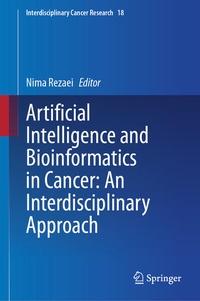
Artificial Intelligence and Bioinformatics in Cancer: An Interdisciplinary Approach
Description

The "Artificial Intelligence and Bioinformatics in Cancer: An Interdisciplinary Approach" is the eighteenth volume of the "Interdisciplinary Cancer Research" series, publishes comprehensive volume on the advances of machine learning and bioinformatics in cancer. The volume starts with a chapter on application of artificial intelligence for early diagnosis of cancer. Then digital health technologies in cancer care and research is discussed. Unveiling cancer complexity: machine learning insights into multi-omics data and the role of integrated bioinformatics in cancer research are also discussed. In silico and biophysical approaches in cancer research and in silico methods and targeted receptors used in cancer studies are explained in the following chapters. The modeling uncertain growth and diffusion in cancer tumors with heterogeneous cell mutations, imaging tumor metabolism and its heterogeneity with special focus on radiomics and artificial intelligence are also discussed. Mathematical modeling of cancer tumor dynamics as well as recent advances in artificial intelligence for cancer treatment are presented, while signature-based drug repositioning for drug discovery employing machine learning tools is also discussed. After a chapter on mathematical analysis of cancer-tumor models, the subsequent chapters discuss on the role of artificial intelligence in colorectal cancer, breast cancer, lung cancer, brain tumor, and cervical cancer. This is the main concept of Cancer Immunology Project (CIP), which is a part of Universal Scientific Education and Research Network (USERN). This interdisciplinary book will be of special value for oncologists who wish to have an update on application of artificial intelligence in diagnosis and treatment of cancers.
More details
Other editions
Additional editions
Person
Professor Nima Rezaei gained his medical degree (MD) from Tehran University of Medical Sciences and subsequently obtained an MSc in Molecular and Genetic Medicine and a PhD in Clinical Immunology and Human Genetics from the University of Sheffield, UK. He also spent a short-term fellowship of Pediatric Clinical Immunology and Bone Marrow Transplantation in the Newcastle General Hospital. Professor Rezaei is now the Full Professor of Immunology and Vice Dean of Research and Technologies, School of Medicine, Tehran University of Medical Sciences, and the co-founder and Head of the Research Center for Immunodeficiencies. He is also the Founder of Universal Scientific Education and Research Network (USERN). Prof. Rezaei has already been the Director of more than two hundred research projects and has designed and participated in several international collaborative projects. Prof. Rezaei is the editor, editorial assistant, or editorial board member of more than fifty international journals. He has edited more than one hundred international books, has presented more than a thousand lectures/posters in congresses/meetings, and has published more than 1,500 scientific papers in the international journals.
Content
Digital Pathology and Artificial Intelligence for Early Diagnosis of Pediatric Solid Tumors: Implication For Improved Healthcare Strategies.- Digital Health Technologies in Cancer Care and Research.- Unveiling Cancer Complexity: Machine Learning Insights into Multi-Omics Data.- The Role of Integrated Bioinformatics in Cancer Research: Transforming Genomic Insights into Precision Medicine.- In Silico and Biophysical Techniques in Anticancer Drug Discovery Research.- In Silico Methods and Targeted Receptors Used in Cancer Studies.- Modeling Uncertain Growth and Diffusion in Cancer Tumors with Heterogeneous Cell Mutations.- Imaging Tumor Metabolism and Its Heterogeneity: Special Focus on Radiomics and AI.- Mathematical Modeling of Cancer Tumor Dynamics with Multiple Fuzzification Approaches in Fractional Environment.- Is Cancer Our Equal or Our Better? Artificial Intelligence in Cancer Drug Discovery.- Recent Advances in Artificial Intelligence and Cancer Treatment.- Signature-Based Drug Repositioning: Tackling Speeding Up Drug Discovery of Anticancer Drugs Employing Recently Developed Machine Learning Tools.- Mathematical Analysis of Cancer-Tumor Models with Variable Depression Effects and Integrated Treatment Strategies.- Emerging Role of Artificial Intelligence in Colorectal Cancer: Screening and Diagnosis.- Measuring the Performance of Supervised Machine Learning Approaches Using Cancer Data.- VRTumor: Integrating AI-Based Segmentation with Virtual Reality for Precise Tumor Analysis. Artificial Intelligence Applications to Detect Pediatric Brain Tumor Biomarkers.
