

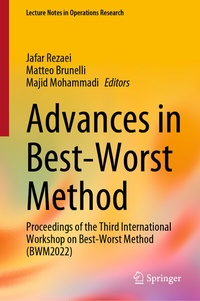
Advances in Best-Worst Method
Description

This book presents recent advances in the theory and application of the Best-Worst Method (BWM). It includes selected papers from the Third International Workshop on Best-Worst Method (BWM2022), held in Delft, the Netherlands, from 9 to 10 June 2022. The book provides valuable insights on why and how to use BWM in a diverse range of applications including health, energy, supply chain management, and engineering. Moreover, it highlights the use of BWM in different settings including individual decision-making vs group decision-making, and with complete information vs incomplete and uncertain information. Academics and practitioners whose work involves multi-criteria decision-making and decision analysis will particularly benefit from the papers gathered here.
More details
Other editions
Additional editions
Persons
Jafar Rezaei is an Associate Professor and Head of the Transport and Logistics Section at the Department of Engineering Systems and Services, Faculty of Technology, Policy, and Management, Delft University of Technology, the Netherlands. He completed his Ph.D. at the same university. He has a background in operations research and has published in several peer-reviewed journals. He is Editor-in-Chief of Journal of Supply Chain Management Science and serves as an Editorial Board Member for several scientific journals. In 2015, he developed the Best-Worst Method (BWM). His main research interests are in multi-criteria decision-making and its applications in different fields.
Matteo Brunelli is an Associate Professor of Mathematical Methods at the Department of Industrial Engineering, University of Trento, Italy. He received his Bachelor and Master degrees from the University of Trento, Italy, and his Ph.D. from Åbo Akademi University, Finland. He spent five years as a Postdoctoral Researcher at Aalto University, Finland. His research interests include decision analysis, preference modelling, mathematical representations of uncertainty, and fuzzy sets.
Majid Mohammadi is a Postdoctoral Researcher at Vrije Universiteit Amsterdam (VU), the Netherlands. Prior to joining VU, he pursued postdoctoral research at Eindhoven University of Technology and completed his Ph.D. at Delft University of Technology, earning a cum laude, the highest distinction in the Dutch academic system. His research interests are in methodological contributions to various domains such as multi-criteria decision-making, machine and deep learning, Bayesian statistics, and statistical learning theory.
Content
- Intro
- Preface
- Organization
- Scientific Committee
- Organizing Committee
- Contents
- An Overview of the Applications of BWM in Health
- 1 Introduction
- 2 Best Worst Method (BWM)
- 3 Literature Review of Applications of BWM in Health
- 3.1 BWM in Healthcare System Evaluation Studies
- 3.2 BWM in Hospital, Performance and Service Quality Studies
- 3.3 BWM in Diagnosing and Treatment-Related Studies
- 3.4 BWM in Healthcare Supply Chain Studies
- 3.5 BWM in Healthcare Support Systems
- 3.6 BWM in Occupational Health and Safety
- 4 Observations and Concluding Remarks
- References
- A State-of the-Art Survey of Best-Worst Method Applications for the Problems Related to COVID-19
- 1 Introduction
- 2 Analysis of Literature
- 2.1 Descriptive Analyses
- 2.2 N-grams Application and Analyses
- 3 Conclusion
- 3.1 Implications
- 3.2 Limitations and Future Directions
- References
- Why Should Not a Decision Analyst be Content with Only (n-1) Pairwise Comparisons? Echoes from the Literature
- 1 Introduction
- 2 Preliminaries
- 3 The Agreement in the Literature
- 3.1 Normative Decision Theory
- 4 The Roles of Redundancy and Inconsistency
- 5 Conclusions
- References
- Identifying Relative Marginal Value Functions for Ranking
- 1 Introduction
- 2 Ranking Method Based on Relative Marginal Value Functions
- 3 Numerical Example
- 4 Conclusion and Future Work
- References
- A Consensus-Based Best-Worst Method for Multi-criteria Group Decision-Making
- 1 Introduction
- 2 Background
- 2.1 Group Decision-Making and Consensus
- 2.2 Best-Worst Method
- 3 Consensus-Based Best-Worst Method
- 4 Illustrative Example
- 5 Conclusions
- References
- A Fuzzy Best-Worst Method Based on the Fuzzy Interval Scale
- 1 Introduction
- 2 Fuzzy Cognitive Best Worst Method Under the Fuzzy Interval Scale
- 2.1 Fuzzy Cognitive Best Worst Method
- 2.2 Consistency Index and Consistency Ratio
- 3 Application
- 3.1 Comparative Analysis and Discussion
- 4 Conclusion
- References
- Integrating Sustainable Goals in Transmission System Operators' Projects
- 1 Introduction
- 2 Literature Review
- 3 Methodology
- 3.1 Sustainable Decision Criteria - Aspects of Sustainability
- 3.2 Analysing Importance - The BWM
- 3.3 Analysing Performance - The Maturity Model
- 3.4 The Importance-Performance Analysis
- 4 Results and Discussion
- 5 Conclusion
- References
- A GIS-Based BWM Approach for the Location Selection of Solar Power Plant in Tunceli Province (Turkey)
- 1 Introduction
- 2 Literature Review
- 3 Research Methodology and Application Results
- 3.1 Criteria Used in the Location Selection
- 3.2 Weighting Criteria with the Best-Worst Method
- 3.3 Data Preparation for GIS Environment
- 3.4 Study Province
- 3.5 Integration of Criterion Weights to GIS Environment
- 4 Conclusion
- References
- A Fuzzy Best Worst Method Based Prioritization of Solar Panel Selection Criteria
- 1 Introduction
- 2 Literature Review
- 3 Methodology
- 4 Application
- 5 Conclusion
- References
- Prioritizing Competitive Capabilities in Additive Manufacturing Systems Using Best-Worst Method
- 1 Introduction
- 2 Literature Review
- 2.1 Additive Manufacturing Systems
- 2.2 Competitive Capabilities
- 3 Methodology
- 3.1 The Best-Worst Method
- 4 Results and Discussion
- 5 Conclusion and Implications
- References
- Identifying Impact of the Entrepreneurship Ecosystem on the Success of Entrepreneurial Start-Up Firms
- 1 Introduction
- 2 Theoretical Background
- 2.1 Entrepreneurship Ecosystem
- 2.2 The Lifecycle of Entrepreneurial Start-Up Firms
- 2.3 Success Measures of Start-Ups
- 3 Methodology
- 3.1 Data Collection
- 4 Results and Discussion
- 4.1 Bayesian Best-Worst Method
- 4.2 Importance-Performance Analysis
- 5 Conclusions
- Appendix
- References
- Prioritizing the Distributor's Key Performance Indicators and Constraints to Implement TOC-Based Solution for Outbound Supply Chain Network
- 1 Introduction
- 2 Literature Review
- 2.1 TOC in Supply Chain
- 2.2 Constraint to Implement TOC Solution in Outbound Supply Chain
- 2.3 KPIs of Distributors
- 3 Research Methodology
- 3.1 Procedure to Conduct BWM Method
- 3.2 Computing Consistency Ratio
- 4 Results and Discussion
- 5 Conclusion
- References
- Evaluating and Ranking the Supplier Selection Criteria for Additive Manufacturing Firms Using Best-Worst Method
- 1 Introduction
- 2 Literature Review
- 2.1 Gap in the Literature
- 3 Methodology
- 3.1 Best-Worst Method (BWM)
- 3.2 Steps of BWM
- 3.3 Consistency Measurement
- 4 Results and Discussion
- 5 Conclusion
- References
- Author Index
