

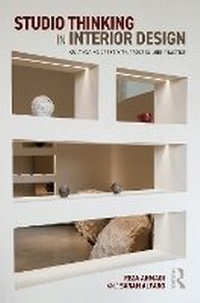
Studio Thinking in Interior Design
Cultivating Creativity, Process, and Practice
Will be published approx. on 21. October 2026
288 pages
E-Book
978-1-040-87564-3 (ISBN)
Description

This book is a practical and reflective guide to how interior designers learn, think, and create. It demystifies the concept of studio thinking and translates it into clear habits, tools, and workflows that support imaginative, ethical, and evidence-informed design practice.
Organized in four parts, Foundations, Mindsets, Methods, and Making, the book provides a structured path from curiosity to concept and ultimately to realized projects. It demonstrates how designers frame problems, generate and test ideas, and communicate decisions with clarity. Chapters address observation and empathy, research and precedent analysis, ideation and visual thinking, prototyping, material and spatial strategies, critique and reflection, and project delivery. Each chapter combines concise theoretical discussions with step-by-step methods, studio exercises, case studies from diverse contexts, and practical templates for both individual and collaborative projects.
Readers will learn how to cultivate a growth mindset, navigate ambiguity, integrate research with intuition, collaborate across disciplines, and align design intentions with measurable outcomes. The authors present a contemporary framework that emphasizes human experience and environmental responsibility while strengthening the creative processes that make studio culture a powerful mode of learning.
By the end of the book, students, educators, and early-career practitioners will be equipped to organize purposeful studio processes, lead constructive critiques, document and evaluate design decisions, and confidently carry studio thinking into professional practice.
Organized in four parts, Foundations, Mindsets, Methods, and Making, the book provides a structured path from curiosity to concept and ultimately to realized projects. It demonstrates how designers frame problems, generate and test ideas, and communicate decisions with clarity. Chapters address observation and empathy, research and precedent analysis, ideation and visual thinking, prototyping, material and spatial strategies, critique and reflection, and project delivery. Each chapter combines concise theoretical discussions with step-by-step methods, studio exercises, case studies from diverse contexts, and practical templates for both individual and collaborative projects.
Readers will learn how to cultivate a growth mindset, navigate ambiguity, integrate research with intuition, collaborate across disciplines, and align design intentions with measurable outcomes. The authors present a contemporary framework that emphasizes human experience and environmental responsibility while strengthening the creative processes that make studio culture a powerful mode of learning.
By the end of the book, students, educators, and early-career practitioners will be equipped to organize purposeful studio processes, lead constructive critiques, document and evaluate design decisions, and confidently carry studio thinking into professional practice.
More details
Language
English
Place of publication
London
United Kingdom
Publishing group
Taylor & Francis Ltd
Target group
College/higher education
Professional and scholarly
Product notice
Reflowable
Illustrations
67 Tables, black and white; 22 Halftones, color; 22 Illustrations, color
ISBN-13
978-1-040-87564-3 (9781040875643)
Copyright in bibliographic data and cover images is held by Nielsen Book Services Limited or by the publishers or by their respective licensors: all rights reserved.
Schweitzer Classification
Other editions
Additional editions
Reza Ahmadi | Sarah Alfaro
Studio Thinking in Interior Design
Cultivating Creativity, Process, and Practice
Book
approx. 10/2026
1st Edition
Routledge
€191.50
Not yet published
Reza Ahmadi | Sarah Alfaro
Studio Thinking in Interior Design
Cultivating Creativity, Process, and Practice
Book
approx. 10/2026
1st Edition
Routledge
€52.50
Not yet published
Persons
Reza Ahmadi is Associate Professor of Interior Design at Ball State University.
Sarah Alfaro is the Program Coordinator of the Interior Design Program at Ball State University.
Sarah Alfaro is the Program Coordinator of the Interior Design Program at Ball State University.
Content
Introduction Part I: Foundations of Studio Thinking 1. The Studio as a Learning Environment 2. Conceptual Thinking in Interior Design 3. Project-Based Learning in Studio Part II: The Studio Process 4. Programming and Research 5. Schematic Design and Concept Development 6. Design Development and Refinement 7. Presentation and Communication Part III: Studio in Practice 8. Collaboration in Studio 9. Inclusive and Responsible Design 10. Studio Beyond the Classroom Part IV: The Future Studio 11. Artificial Intelligence and Emerging Technologies in Interior Design Studios PART V: Teaching Studio Thinking 12. Rubrics, Checklists, and Evaluation Tools 13. Instructor Resources and Tools
