

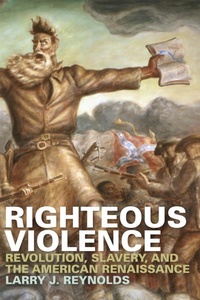
Righteous Violence
Description

Righteous Violence examines the struggles with the violence of slavery and revolution that engaged the imaginations of seven nineteenth-century American writers-Margaret Fuller, Ralph Waldo Emerson, Frederick Douglass, Henry David Thoreau, Louisa May Alcott, Nathaniel Hawthorne, and Herman Melville.
These authors responded not only to the state terror of slavery and the Civil War but also to more problematic violent acts, including unlawful revolts, insurrections, riots, and strikes that resulted in bloodshed and death. Rather than position these writers for or against the struggle for liberty, Larry J. Reynolds examines the profoundly contingent and morally complex perspectives of each author. Tracing the shifting and troubled moral arguments in their work, Reynolds shows that these writers, though committed to peace and civil order, at times succumbed to bloodlust, even while they expressed ambivalence about the very violence they approved. For many of these authors, the figure of John Brown loomed large as an influence and a challenge. Reynolds examines key works such as Fuller's European dispatches, Emerson's political lectures, Douglass's novella The Heroic Slave, Thoreau's Walden, Alcott's Moods, Hawthorne's late unfinished romances, and Melville's Billy Budd.
In addition to demonstrating the centrality of righteous violence to the American Renaissance, this study deepens and complicates our understanding of political violence beyond the dichotomies of revolution and murder, liberty and oppression, good and evil.
More details
Other editions
Additional editions
Person
Content
- COVER
- CONTENTS
- PREFACE
- ACKNOWLEDGMENTS
- INTRODUCTION: Righteous Violence
- CHAPTER ONE: Margaret Fuller's Revolutionary Example
- CHAPTER TWO: Emerson, Guns, and Bloodlust
- CHAPTER THREE: Douglass, Insurrection, and The Heroic Slave
- CHAPTER FOUR: Contemplation versus Violence in Thoreau's World
- CHAPTER FIVE: Violent Virtue and Alcott's Moods
- CHAPTER SIX: Pacifism, Savagery, and Hawthorne's Last Romances
- CHAPTER SEVEN: The Revolutionary Times of Melville's Billy Budd
- EPILOGUE
- NOTES
- BIBLIOGRAPHY
- INDEX
- A
- B
- C
- D
- E
- F
- G
- H
- J
- K
- L
- M
- N
- O
- P
- R
- S
- T
- V
- W
- Y
- Z
