

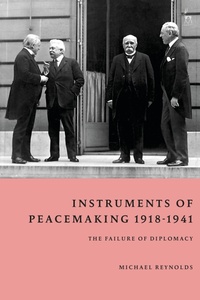
Instruments of Peacemaking 1918-1941
The Failure of Diplomacy
1st Edition
Published on 22. January 2026
328 pages
978-1-5099-7629-4 (ISBN)
Description

This book is a sequel to Instruments of Peacemaking 1870-1914 in that it considers how attempts were made to settle disputes between states without recourse to war after 'the war to end all wars'.
It considers the idealism of President Woodrow Wilson's Fourteen Points which formed the basis for the Armistice in 1918, and his scheme for a League of Nations providing for self-determination of nations and 'collective security' for European states.
It goes on to analyse the key challenges that faced statesmen and jurists in attempting to resolve disputes under the provisions of the Treaty of Versailles. It considers the consequences of the Peace Conference of 1919 as well as defects in the treaty as an instrument for resolving future disputes and tensions between the victors and the vanquished.
Cases referred to the Reparations Commission and to arbitration under the Treaty of Versailles regarding boundary, industrial property, and shipping including the Lusitania claims are considered. More importantly, it analyses the diplomatic challenges faced by statesmen after 1919. The decline and failure of Wilsonian idealism, the League of Nations, collective security, and diplomacy are traced through the various diplomatic exchanges that took place between governments from official records and contemporaneous accounts of the times as well as academic sources. Mr Chamberlain's private diplomacy to appease Hitler is critically analysed. The final chapter briefly considers aspects of America's isolationism resulting in the attack on Pearl Harbor and her peacetime state of unreadiness.
It considers the idealism of President Woodrow Wilson's Fourteen Points which formed the basis for the Armistice in 1918, and his scheme for a League of Nations providing for self-determination of nations and 'collective security' for European states.
It goes on to analyse the key challenges that faced statesmen and jurists in attempting to resolve disputes under the provisions of the Treaty of Versailles. It considers the consequences of the Peace Conference of 1919 as well as defects in the treaty as an instrument for resolving future disputes and tensions between the victors and the vanquished.
Cases referred to the Reparations Commission and to arbitration under the Treaty of Versailles regarding boundary, industrial property, and shipping including the Lusitania claims are considered. More importantly, it analyses the diplomatic challenges faced by statesmen after 1919. The decline and failure of Wilsonian idealism, the League of Nations, collective security, and diplomacy are traced through the various diplomatic exchanges that took place between governments from official records and contemporaneous accounts of the times as well as academic sources. Mr Chamberlain's private diplomacy to appease Hitler is critically analysed. The final chapter briefly considers aspects of America's isolationism resulting in the attack on Pearl Harbor and her peacetime state of unreadiness.
More details
Edition
1. Auflage
Language
English
Place of publication
London
United Kingdom
Publishing group
Bloomsbury Publishing PLC
Target group
Professional and scholarly
College/higher education
ISBN-13
978-1-5099-7629-4 (9781509976294)
Copyright in bibliographic data and cover images is held by Nielsen Book Services Limited or by the publishers or by their respective licensors: all rights reserved.
Schweitzer Classification
Other editions
Additional editions
Book
approx. 01/2026
Hart Publishing
€141.24
Not yet published
Person
Michael Reynolds is a lawyer, arbitrator and Professor of Dispute Resolution and Arbitration at BPP University Law School, UK. He is also a member of The Royal Institute of International Affairs (Chatham House).
Content
Preface
Acknowledgements
Table of Cases
Table of Legal and Related Instruments
1. A New International Order or a Precarious Armistice
2. Arbitration as an Instrument of Dispute Resolution
3. Diplomacy as an Instrument of Prevention
4. The Crisis that Led to War and Why Diplomacy Failed
5. American and Japanese Relations
Acknowledgements
Table of Cases
Table of Legal and Related Instruments
1. A New International Order or a Precarious Armistice
2. Arbitration as an Instrument of Dispute Resolution
3. Diplomacy as an Instrument of Prevention
4. The Crisis that Led to War and Why Diplomacy Failed
5. American and Japanese Relations
