

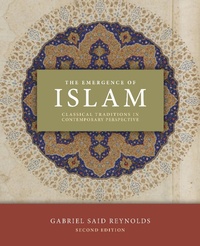
Emergence of Islam
Description

Now in an updated second edition, Gabriel Said Reynolds tells the story of Islam in this brief illustrated survey, beginning with Muhammad's early life and rise to power, then tracing the origins and development of the Qur'an juxtaposed with biblical literature, and concluding with an overview of modern and fundamentalist narratives of the origin of Islam. Reynolds offers a fascinating look at the structure and meaning of the Qur'an, revealing the ways in which biblical language is used to advance the Qur'an's religious meaning. Reynolds' analysis identifies the motives that shaped each narrative--Islamic, Jewish, and Christian. The book's conclusion yields a rich understanding of diverse interpretations of Islam's emergence, suggesting that its emergence is itself ever-developing.
More details
Other editions
Additional editions
Person
Content
- Cover
- Title Page
- Copyright Page
- Contents
- Illustrations and Features
- Illustration Acknowledgments
- Preface
- Timeline of Traditional Chronology from the Birth of Muhammad to the Death of 'Ali
- The Family Tree of the Prophet Muhammad According to the Traditional Biography
- Part 1: The Prophet Muhammad and the Rightly Guided Caliphs
- Introduction to Part 1: Historical Overview
- The Evidence of Pre-Islamic Inscriptions
- Chapter 1: Muhammad in Mecca
- Monotheism and Paganism in Muhammad's Arabia
- Muhammad's Early Life
- Muhammad's Conflict with the Pagans of Mecca
- A Heavenly and an Earthly Journey
- Muhammad in Mecca and Historical Research
- Study Questions
- Chapter 2: Muhammad in Medina
- The Fight for Islam
- Muhammad's Relationships in Medina
- The Triumph of Islam
- The Final Years of the Last Prophet
- Study Questions
- Chapter 3: The Birth of an Empire
- The First Caliph and the First Imam
- The Early Islamic Conquests
- The Lives of 'Umar, 'Uthman, and 'Ali
- Study Questions
- Conclusion to Part One
- Part 2: The Qur'an
- Introduction to Part 2: History and Literature
- Chapter 4: The Qur'an and Its Message
- The Nature of the Qur'anic Text
- The Traditional Account of the Qur'an's Development
- The Qur'an on Repentence and Belief
- The Qur'an on Divine Majesty
- Study Questions
- Chapter 5: The Qur'an and the Bible
- Biblical Literature and Qur'anic Rhetoric
- The Qur'an's Conversation with Biblical Literature
- Study Questions
- Chapter 6: The Qur'an and the Biography of the Prophet
- The Biography of Muhammad and Exegesis of the Qur'an
- The Sectarian Milieu
- Study Questions
- Chapter 7: The Historical Context of the Qur'an
- Qur'anic Evidence
- Islam and Theological Rivalries
- Study Questions
- Conclusion to Part Two
- Part 3: Contemporary Perspectives
- Introduction to Part 3: Classical Texts and Contemporary Religion
- Chapter 8: Contemporary Muslim Narratives of Islam's Emergence
- The Struggle for an Islamic Society Today: Egypt, Pakistan, Afghanistan, and Iran
- Islam and Modernity and Islam in the West
- Study Questions
- Conclusion
- Glossary of Proper Nouns and Technical Terms
- Bibliography and Further Reading
- Index
