

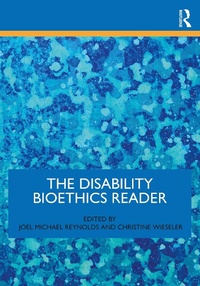
The Disability Bioethics Reader
1st Edition
Published on 30. May 2022
418 pages
978-1-000-58717-3 (ISBN)
Description

The Disability Bioethics Reader is the first introduction to the field of bioethics presented through the lens of critical disability studies and the philosophy of disability.
Introductory and advanced textbooks in bioethics focus almost entirely on issues that disproportionately affect disabled people and that centrally deal with becoming or being disabled. However, such textbooks typically omit critical philosophical reflection on disability. Directly addressing this omission, this volume includes 36 chapters, most appearing here for the first time, that cover key areas pertaining to disability bioethics, such as:
state-of-the-field analyses of modern medicine, bioethics, and disability theory
health, disease, and the philosophy of medicine
issues at the edge- and end-of-life, including physician-aid-in-dying, brain death, and minimally conscious states
enhancement and biomedical technology
invisible disabilities, chronic pain, and chronic illness
implicit bias and epistemic injustice in health care
disability, quality of life, and well-being
race, disability, and healthcare justice
connections between disability theory and aging, trans, and fat studies
prenatal testing, abortion, and reproductive justice.
The Disability Bioethics Reader, unlike traditional bioethics textbooks, also engages with decades of empirical and theoretical scholarship in disability studies-scholarship that spans the social sciences and humanities-and gives serious consideration to the history of disability activism.
Introductory and advanced textbooks in bioethics focus almost entirely on issues that disproportionately affect disabled people and that centrally deal with becoming or being disabled. However, such textbooks typically omit critical philosophical reflection on disability. Directly addressing this omission, this volume includes 36 chapters, most appearing here for the first time, that cover key areas pertaining to disability bioethics, such as:
state-of-the-field analyses of modern medicine, bioethics, and disability theory
health, disease, and the philosophy of medicine
issues at the edge- and end-of-life, including physician-aid-in-dying, brain death, and minimally conscious states
enhancement and biomedical technology
invisible disabilities, chronic pain, and chronic illness
implicit bias and epistemic injustice in health care
disability, quality of life, and well-being
race, disability, and healthcare justice
connections between disability theory and aging, trans, and fat studies
prenatal testing, abortion, and reproductive justice.
The Disability Bioethics Reader, unlike traditional bioethics textbooks, also engages with decades of empirical and theoretical scholarship in disability studies-scholarship that spans the social sciences and humanities-and gives serious consideration to the history of disability activism.
Reviews / Votes
"Covers an impressive range of topics. . . [and] a wealth of diversity in issues, perspectives, and arguments . . . . Overall, this book is an excellent resource, and should be considered by those designing university courses relating to bioethics [and] medical law and ethics."Heloise Robinson in Medical Law Review
"The Disability Bioethics Reader provides a much-needed course correction for the field [of bioethics] and contains context that should be provided via graduate and undergraduate bioethics courses, medical school curricula, and continuing medical education courses. Practitioners, educators, and scholars alike would benefit from the authors' careful consideration of the intersections between bioethics and disability." Heather Swadley, Lehigh University
More details
Edition
1. Auflage
Language
English
Place of publication
London
United Kingdom
Publishing group
Taylor & Francis Ltd
Target group
College/higher education
Illustrations
2 Line drawings, black and white; 2 Illustrations, black and white
ISBN-13
978-1-000-58717-3 (9781000587173)
Copyright in bibliographic data and cover images is held by Nielsen Book Services Limited or by the publishers or by their respective licensors: all rights reserved.
Schweitzer Classification
Other editions
Additional editions
Joel Michael Reynolds | Christine Wieseler
The Disability Bioethics Reader
Book
03/2023
1st Edition
Routledge
€185.00
Shipment within 15-20 days
Joel Michael Reynolds | Christine Wieseler
The Disability Bioethics Reader
Book
06/2022
1st Edition
Routledge
€73.20
Shipment within 15-20 days
Persons
Joel Michael Reynolds is Assistant Professor of Philosophy and Disability Studies at Georgetown University, Senior Research Scholar in the Kennedy Institute of Ethics, Senior Advisor to The Hastings Center, and core faculty in Georgetown's Disability Studies Program. Reynolds is author of The Life Worth Living: Disability, Pain, and Morality (University of Minnesota Press), the founder of The Journal of Philosophy of Disability, and co-founder of the Oxford Studies in Disability, Ethics, and Society book series from Oxford University Press.
Christine Wieseler is Assistant Professor of Philosophy at California State Polytechnic University, Pomona. Wieseler is author of articles published in Hypatia, IJFAB: International Journal of Feminist Approaches to Bioethics, and Social Philosophy Today as well as chapters in two edited book collections.
Christine Wieseler is Assistant Professor of Philosophy at California State Polytechnic University, Pomona. Wieseler is author of articles published in Hypatia, IJFAB: International Journal of Feminist Approaches to Bioethics, and Social Philosophy Today as well as chapters in two edited book collections.
Content
1. A Short History of Modern Medicine and Disability 2. Eugenics, Disability, and Bioethics 3. Theories of Disability 4. A Critical History of Bioethics 5. Methods of Bioethics 6. Disability Bioethics 7. Disability and the Definition of Health 8. The Lived Experiences of Illness and Disability 9. Abortion, Disability Rights, and Reproductive Justice 10. A Fatal Attraction to Normalizing 11. Being Disabled and Contemplating Disabled Children 12. The Wrongs of Wrongful Birth 13. Disability, Ideology, and Quality of Life 14. The Challenge of Chronic Pain 15. Chronic Illness and Well-Being 16. Disability and Aging Studies 17. Death, Pandemic, and Intersectionality 18. Disorders of Consciousness, Disability Rights, and Triage during the COVID-19 Pandemic 19. Bioethical Issues in Dementia and Alzheimer's Disease 20. Between "Aid in Dying" and "Assisted Suicide" 21. Theorizing the Intersections of Ableism, Sanism, Ageism and Suicidism in Suicide and Physician-Assisted Death Debates 22. Disability Bioethics and Race 23. Bioethics and the Deaf Community 24. Hunger Always Wins 25. Trans Care within and against the Medical-Industrial Complex 26. Defining Mental Illness & Psychiatric Disability 27. Research Ethics and Intellectual Disability 28. Inconvenient Complications to Patient Choice and Psychiatric Detention 29. Disability Bioethics, Ashley X, and Disability Justice for People with Cognitive Impairments 30. Feminist Theorizing and Disability Bioethics 31. Disability Bioethics and Epistemic Injustice 32. Disability Studies Meets Animal Studies 33. Improving Access within the Clinic 34. The Goals of Medical Technology 35. "Why insist on justice, why not settle for kindness?" Kindness, justice, and cognitive disability 36. Selections of Brilliant Imperfection
