

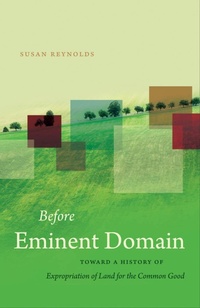
Before Eminent Domain
Description

In this concise history of expropriation of land for the common good in Europe and North America from medieval times to 1800, Susan Reynolds contextualizes the history of an important legal doctrine regarding the relationship between government and the institution of private property.
Before Eminent Domain concentrates on western Europe and the English colonies in America. As Reynolds argues, expropriation was a common legal practice in many societies in which individuals had rights to land. It was generally accepted that land could be taken from them, with compensation, when the community, however defined, needed it. She cites examples of the practice since the early Middle Ages in England, France, Germany, Italy, and Spain, and from the seventeenth century in America.
Reynolds concludes with a discussion of past and present ideas and assumptions about community, individual rights, and individual property that underlie the practice of expropriation but have been largely ignored by historians of both political and legal thought.
More details
Other editions
Additional editions
Person
Content
- Intro
- Contents
- Acknowledgments
- CHAPTER 1 Introduction
- 1.1 The Problem of Origins
- 1.2 Historians and Expropriation
- 1.3 The Evidence
- 1.4 The Plan and Scope of the Book
- CHAPTER 2 Western Europe before 1100
- 2.1 Ancient Greece and Rome
- 2.2 The Problem of Evidence in the Early Middle Ages
- 2.3 Church Property
- 2.4 Fortifications
- 2.5 Other Probable Expropriations
- 2.6 Unjust Expropriations
- 2.7 Conclusion
- CHAPTER 3 Western Europe and British North America, 1100-1800
- 3.1 The Plan of the Chapter
- 3.2 England
- 3.3 Italy
- 3.4 France
- 3.5 Germany
- 3.6 Spain
- 3.7 The English Colonies in America
- 3.8 Conclusion
- CHAPTER 4 Justifications and Discussions
- 4.1 The Problem
- 4.2 Before Grotius
- 4.3 Grotius and After
- 4.4 Conclusion
- CHAPTER 5 Communities, Individuals, and Property
- 5.1 The Problem
- 5.2.1 Before Grotius: Communities
- 5.2.2 Before Grotius: Individuals
- 5.2.3 Before Grotius: Property
- 5.3 Grotius and After
- 5.4 Conclusion
- Works Cited
- Index
- A
- B
- C
- D
- E
- F
- G
- H
- I
- J
- K
- L
- M
- N
- O
- P
- Q
- R
- S
- T
- U
- V
- W
- Z
