

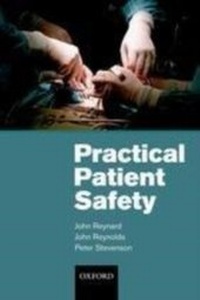
Practical Patient Safety
1st Edition
Published on 19. March 2009
319 pages
978-0-19-157540-2 (ISBN)
Description

Following recent high profile cases of surgical error in the UK and USA, patient safety has become a key issue in healthcare, now placed at heart of junior doctor's training. Errors made by doctors are very similar to those made in other high risk organisations, such as aviation, nuclear and petrochemical industries. Practical Patient Safety aims to demonstrate how core principles of safety from these industries can be applied in surgical and medical practice, in particular through training for health care professionals and healthcare managers. Whilst theoretical aspects of risk management form the backdrop, the book focuses on key techniques and principles of patient safety in a practical way, giving the reader practical advice on how to avoid personal errors, and more importantly how to start patient safety training within his or her department or hospital.
More details
Other editions
Additional editions
John Reynard | John Reynolds | Peter Stevenson
Practical Patient Safety
Book
03/2009
Oxford University Press
€97.70
Shipment within 15-20 days
Content
- Intro
- Contents
- Preface
- Acknowledgements
- 1 Clinical error: the scale of the problem
- The Harvard Medical Practice Study 1984
- The Quality in Australian Healthcare Study 1992
- The University College London Study 2001
- Danish, New Zealand, Canadian, and French studies
- The frequency and costs of adverse drug events
- Accuracy of retrospective studies
- Error rates revealed in retrospective studies are of the same order of magnitude as those found in observational studies
- Error rates according to type of clinical activity
- Deaths from adverse events
- Extra bed days as a consequence of error
- Criminal prosecutions for medical errors
- Reliability: other industries
- Reliability: healthcare
- References
- 2 Clinical errors:What are they?
- Sources of error in primary care and office practice
- Sources of error along the patient pathway in hospital care and potential methods of error prevention
- Errors in dealing with referral letters
- Errors of identification
- Errors in note keeping
- Errors with medical records in general
- Other slips in letters that you have dictated
- Errors as a consequence of patients failing to attend appointments for investigations or for outpatient consultations
- Washing your hands between patients and attention to infection control
- Admission to hospital
- Diagnostic errors in general
- Errors in drug prescribing and administration
- Reducing errors in blood transfusion
- Intravenous drug administration
- Errors in the operating theatre
- The use of diathermy
- Harm related to patient positioning
- Leg supports that give way
- Generic safety checks prior to any surgical procedure
- Failure to give DVT prophylaxis
- Failure to give antibiotic prophylaxis
- Errors in the postoperative period
- Shared care
- Medical devices
- References
- 3 Safety culture in high reliability organizations
- High reliability organizations: background
- High reliability organizations: common features
- The consequences of failure
- 'Convergent evolution' and its implication for healthcare
- Learning from accidents: overview of basic high reliability organizational culture
- Elements of the safety culture
- Counter-intuitive aspects of high reliability organization safety culture
- References
- 4 Case studies
- Case study 1: wrong patient
- Case study 2: wrong blood
- Case study 3: wrong side nephrectomy
- Case study 4: another wrong side nephrectomy
- Case study 5: yet another wrong side nephrectomy case
- Case study 6: medication error-wrong route (intrathecal vincristine)
- Case study 7: another medication error-wrong route (intrathecal vincristine)
- Case study 8: medication error-wrong route (intrathecal vincristine)
- Case study 9: medication error-miscalculation of dose
- Case study 10: medication error-frequency of administration mis-prescribed as 'daily' instead of 'weekly'
- Case study 11: medication error-wrong drug
- Case study 12: miscommunication of path lab result
- Case study 13: biopsy results for two patients mixed up
- Case study 14: penicillin allergy death
- Case study 15: missing X-ray report
- Case study 16: medication not given
- Case study 17: oesophageal intubation
- Case study 18: tiredness error
- Case study 19: inadequate training
- Case study 20: patient fatality-anaesthetist fell asleep
- References
- 5 Error management
- How accidents happen: the person approach versus the systems approach
- Error chains
- System failures
- 'Catalyst events'
- Human error
- Error classification
- How experts and novices solve problems
- Three error management opportunities
- Detecting and reversing incipient adverse events in real time: 'Red flags'
- Red flags: the symptoms and signs of evolving error chains
- Speaking up protocols
- Error management using accident and incident data
- References
- 6 Communication failure
- The prevalence of communication failures in adverse events in healthcare
- Communication failure categories
- Whose fault: message sender or receiver?
- Safety-critical communications (SCC) protocols
- How to prevent communication errors in specific healthcare situations
- Composing an 'abnormal' (non-routine) safety-critical message
- Written communication/documentation communication failures
- References
- 7 Situation awareness
- Situation awareness: definitions
- Three levels of situation awareness
- Catastrophic loss of situation awareness and the associated syndrome: 'mind lock'
- Understanding loss of situation awareness
- Cognitive failures: the role of mental models/the psychology of mistakes
- Mental models: the problems
- Ensuring high situation awareness
- Two special cases involving loss of situation awareness
- References
- 8 Professional culture
- Similarities between two professions
- Negative aspects of professional cultures
- Steep hierarchy
- Changing the pilots' professional culture
- Team resource management/non-technical skills
- References
- 9 When carers deliberately cause harm
- References
- 10 Patient safety toolbox
- Practical ways to enhance the safety of your patients
- 11 Conclusions
- Glossary
- A
- B
- C
- E
- F
- H
- I
- L
- M
- N
- O
- P
- R
- S
- T
- U
- W
- Appendices
- Appendix 1: Initiating a safety-critical (verbal) communication (STAR)
- Appendix 2: I-SBAR-to describe a (deteriorating) patient's condition
- Appendix 3: General patient safety tools
- Appendix 4: Red flags (the symptoms and signs of an impending error)
- Index
- A
- B
- C
- D
- E
- F
- G
- H
- I
- J
- K
- L
- M
- N
- O
- P
- Q
- R
- S
- T
- U
- V
- W
