

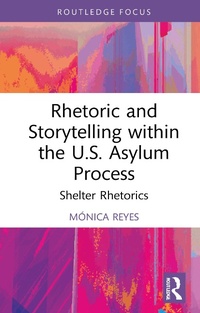
Rhetoric and Storytelling within the U.S. Asylum Process
Shelter Rhetorics
1st Edition
Published on 20. September 2024
138 pages
978-1-040-19358-7 (ISBN)
Description

This book explores the U.S. asylum process and how those seeking shelter deal with the rhetorical pressures of compelling asylum narratives they need to write in order to stay.
Centered around a study conducted at a shelter on the U.S. border, this book moves beyond this context to demonstrate how liminal sites provide opportunities for displaced communities to employ distinct shared rhetorical practices of daily life-like silence and routine-that both safeguard vulnerabilities and enact agency for individuals within precarious spaces. Placing people who seek asylum and those who work with them as rhetorical and socio-cultural experts on this issue, the study adds to the emerging importance of rhetoric within discussions of asylum and forced migration and demonstrates the significance of rhetorical ecology theory as part of a blended methodology in understanding people seeking asylum as a group in a perpetual and explicit state of ethos development.
Highlighting the need for support which is sensitive to the narrative struggles people seeking asylum face, this book will have important findings for scholars and upper-level students of cultural rhetorics, feminist rhetoric, migration studies, political science, and intercultural communication.
Centered around a study conducted at a shelter on the U.S. border, this book moves beyond this context to demonstrate how liminal sites provide opportunities for displaced communities to employ distinct shared rhetorical practices of daily life-like silence and routine-that both safeguard vulnerabilities and enact agency for individuals within precarious spaces. Placing people who seek asylum and those who work with them as rhetorical and socio-cultural experts on this issue, the study adds to the emerging importance of rhetoric within discussions of asylum and forced migration and demonstrates the significance of rhetorical ecology theory as part of a blended methodology in understanding people seeking asylum as a group in a perpetual and explicit state of ethos development.
Highlighting the need for support which is sensitive to the narrative struggles people seeking asylum face, this book will have important findings for scholars and upper-level students of cultural rhetorics, feminist rhetoric, migration studies, political science, and intercultural communication.
More details
Series
Edition
1. Auflage
Language
English
Place of publication
London
United Kingdom
Publishing group
Taylor & Francis Ltd
Target group
College/higher education
Illustrations
25 Halftones, black and white; 25 Illustrations, black and white
ISBN-13
978-1-040-19358-7 (9781040193587)
Copyright in bibliographic data and cover images is held by Nielsen Book Services Limited or by the publishers or by their respective licensors: all rights reserved.
Schweitzer Classification
Other editions
Additional editions
Book
05/2026
1st Edition
Routledge
€31.50
Shipment within 10-20 days

Book
11/2024
Taylor & Francis
Unfortunately, price unknown
Available (delivery time upon request)
Book
09/2024
1st Edition
Routledge
€74.80
Shipment within 10-20 days
Person
Monica Reyes is Assistant Professor in the Writing, Rhetoric & Discourse Department at DePaul University. Her research interests include cultural rhetorics; rhetorical ecologies; critical refugee studies; and transnational feminist rhetorical literacies. Her work has been featured most recently in Grassroots Activisms: Public Rhetorics in Localized Contexts (2024); Enculturation: A Journal of Rhetoric, Writing & Culture (2020); and Postcolonial Text (2019). She is also a Public Voices Fellow of The OpEd Project.
Content
1. A Short Tour of the Project
2. La Mesa Redonda: A Located-Listening Approach to Knowledge-Building
3. En la Frontera: Resisting Spatial Conventions
4. Public Narratives of Asylum and Silence as an Echo of Displacement
5. Cooking, Crocheting, y Cantando: Composing Agency through Routine
6. The Long Path Out through Advocacy-Building
2. La Mesa Redonda: A Located-Listening Approach to Knowledge-Building
3. En la Frontera: Resisting Spatial Conventions
4. Public Narratives of Asylum and Silence as an Echo of Displacement
5. Cooking, Crocheting, y Cantando: Composing Agency through Routine
6. The Long Path Out through Advocacy-Building
