

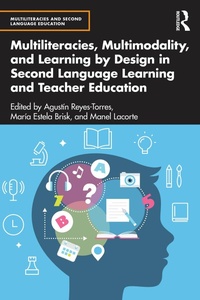
Multiliteracies, Multimodality, and Learning by Design in Second Language Learning and Teacher Education
1st Edition
Published on 30. April 2025
260 pages
978-1-040-32628-2 (ISBN)
Description

Multiliteracies, Multimodality, and Learning by Design in Second Language Learning and Teacher Education offers valuable insights and practical strategies for addressing the language and literacy needs of students in diverse, multilingual classrooms.
This edited volume delves into the dynamic interplay between multimodality, multiliteracies, and Learning by Design (LbyD), providing evidence-based research and actionable guidance for their effective implementation in second language learning and teacher education. Examining the advantages of incorporating multimodality and multiliteracies in second language teacher training, this book emphasizes the use of multimodal texts to create engaging and meaningful lessons for L2 learners. By empowering students as active co-constructors of knowledge, this book equips educators with the necessary tools to foster a vibrant and inclusive learning environment.
Designed specifically for pre-service and practicing teachers, this book serves as an indispensable resource for integrating the pedagogy of multiliteracies into both coursework and classroom practices.
This edited volume delves into the dynamic interplay between multimodality, multiliteracies, and Learning by Design (LbyD), providing evidence-based research and actionable guidance for their effective implementation in second language learning and teacher education. Examining the advantages of incorporating multimodality and multiliteracies in second language teacher training, this book emphasizes the use of multimodal texts to create engaging and meaningful lessons for L2 learners. By empowering students as active co-constructors of knowledge, this book equips educators with the necessary tools to foster a vibrant and inclusive learning environment.
Designed specifically for pre-service and practicing teachers, this book serves as an indispensable resource for integrating the pedagogy of multiliteracies into both coursework and classroom practices.
More details
Series
Edition
1. Auflage
Language
English
Place of publication
London
United Kingdom
Publishing group
Taylor & Francis Ltd
Target group
Professional and scholarly
Illustrations
33 Tables, black and white; 5 Line drawings, black and white; 21 Halftones, black and white; 26 Illustrations, black and white
File size
6,63 MB
ISBN-13
978-1-040-32628-2 (9781040326282)
Copyright in bibliographic data and cover images is held by Nielsen Book Services Limited or by the publishers or by their respective licensors: all rights reserved.
Schweitzer Classification
Other editions
Additional editions
Agustin Reyes-Torres | Maria Estela Brisk | Manel Lacorte
Multiliteracies, Multimodality, and Learning by Design in Second Language Learning and Teacher Education
Book
04/2025
1st Edition
Routledge
€206.50
Shipment within 10-20 days
Agustin Reyes-Torres | Maria Estela Brisk | Manel Lacorte
Multiliteracies, Multimodality, and Learning by Design in Second Language Learning and Teacher Education
Book
04/2025
1st Edition
Routledge
€68.90
Shipment within 10-20 days

Book
04/2025
Routledge
Unfortunately, price unknown
Available (delivery time upon request)
Persons
Agustin Reyes-Torres is an associate professor in the Department of Languages and Literature Education at the Universitat de Valencia, Spain. He has lectured on an extensive range of courses and conducted research fellowships at the University of Virginia, Boston College, Middlebury Language Schools, and Columbia University. His current lines of research focus on the teaching of English and Spanish as additional languages and on teacher education. He is the principal investigator of the research group Lit(T)erart.
Maria Estela Brisk, a native of Argentina, is Professor Emerita of Education, Boston College, USA. She received her PhD in linguistics and education from the University of New Mexico. Her research and teaching interests include writing instruction, genre pedagogy, bilingual education, bilingual language, and literacy acquisition. She is the author of numerous articles and several books. She has received numerous awards, including the American Educational Research Association (AERA), Scholars of Color Distinguished Career, and AERA, Bilingual Research SIG, Lifetime achievement.
Manel Lacorte is a professor of applied Spanish linguistics at the University of Maryland, USA. His research explores pedagogical and sociopolitical issues in the teaching of Spanish as L2 and LH, teacher training, and general issues in applied linguistics. His most recent works as co-author and editor are The Routledge Handbook of Multiliteracies for Spanish Language Teaching: multimodalidad e interdisciplinariedad (2024), Didactica del espanol como 2/L en el siglo XXI (2021), and Introduction to Current Hispanic Linguistics: Theory and Practice (2017).
Maria Estela Brisk, a native of Argentina, is Professor Emerita of Education, Boston College, USA. She received her PhD in linguistics and education from the University of New Mexico. Her research and teaching interests include writing instruction, genre pedagogy, bilingual education, bilingual language, and literacy acquisition. She is the author of numerous articles and several books. She has received numerous awards, including the American Educational Research Association (AERA), Scholars of Color Distinguished Career, and AERA, Bilingual Research SIG, Lifetime achievement.
Manel Lacorte is a professor of applied Spanish linguistics at the University of Maryland, USA. His research explores pedagogical and sociopolitical issues in the teaching of Spanish as L2 and LH, teacher training, and general issues in applied linguistics. His most recent works as co-author and editor are The Routledge Handbook of Multiliteracies for Spanish Language Teaching: multimodalidad e interdisciplinariedad (2024), Didactica del espanol como 2/L en el siglo XXI (2021), and Introduction to Current Hispanic Linguistics: Theory and Practice (2017).
Content
Introduction
Part I. Theoretical aspects
Chapter 1. Born-Digital Literature: Applying Multiliteracies and Learning by (Inclusive) Design Principles
Chapter 2. Visual and verbal meaning making in photo-stories in Instagram
Chapter 3. Navigating in the HL/L2 Language Writing Curriculum: Delicate Balance between Genres and Modes
Part II. Learning and Pedagogical Applications
Chapter 4. Infographics by Design: Beginning French Learners' Multimodal Composition and Authorial Agency
Chapter 5. Virtual reality street art with L2 learners as multimodal literacy
Chapter 6. Joyful Vocabulary Acquisition: Pedagogies for Developing Children's Literary Vocabulary (and Analysis of Characters in Narratives)
Chapter 7. Learning by Design and L2 teacher mediation in multimodal lessons
Chapter 8. Developing students' repertoires of nuanced attitudinal expression through pedagogies of multimodal text interpretation and creation
Part III. L2 Teacher Education
Chapter 9. Solidarity by Design: Expanding Repertoires of Practice
Chapter 10. Responding to Graduate Students' Needs Through Multiliteracies Professional Development
Chapter 11. Effective Literacy Teaching in L2: a Study on Pre-service Teachers' Reflective Practices Implementing the Pedagogy of Multiliteracies
Chapter 12. Introducing German pre-service teachers to the topic of artificial intelligence through multimodal and inclusive learning paths
Part I. Theoretical aspects
Chapter 1. Born-Digital Literature: Applying Multiliteracies and Learning by (Inclusive) Design Principles
Chapter 2. Visual and verbal meaning making in photo-stories in Instagram
Chapter 3. Navigating in the HL/L2 Language Writing Curriculum: Delicate Balance between Genres and Modes
Part II. Learning and Pedagogical Applications
Chapter 4. Infographics by Design: Beginning French Learners' Multimodal Composition and Authorial Agency
Chapter 5. Virtual reality street art with L2 learners as multimodal literacy
Chapter 6. Joyful Vocabulary Acquisition: Pedagogies for Developing Children's Literary Vocabulary (and Analysis of Characters in Narratives)
Chapter 7. Learning by Design and L2 teacher mediation in multimodal lessons
Chapter 8. Developing students' repertoires of nuanced attitudinal expression through pedagogies of multimodal text interpretation and creation
Part III. L2 Teacher Education
Chapter 9. Solidarity by Design: Expanding Repertoires of Practice
Chapter 10. Responding to Graduate Students' Needs Through Multiliteracies Professional Development
Chapter 11. Effective Literacy Teaching in L2: a Study on Pre-service Teachers' Reflective Practices Implementing the Pedagogy of Multiliteracies
Chapter 12. Introducing German pre-service teachers to the topic of artificial intelligence through multimodal and inclusive learning paths
