

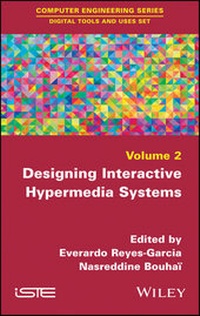
Designing Interactive Hypermedia Systems
Description

More details
Other editions
Additional editions
Persons
Everardo Reyes-Garcia is Senior Lecturer in Information Sciences and Communication, Paragraph Laboratory, (EA 349), University Paris 8, COMUE University Paris-Lumières, France.
Nasreddine Bouhai is Senior Lecturer in Information Sciences and Communication, Paragraph Laboratory, (EA 349), University Paris 8, COMUE University Paris-Lumières, France.
Content
Introduction
The terms "hypertext" and "hypermedia" were introduced in scientific literature 51 years ago, in the description by the visionary computer engineer Ted Nelson of his Evolutionary List File (ELF) file structure. The main idea of the system was to make computers more user-friendly for personal and creative use. Nelson believed that information required an environment that was not only flexible but also able to support "idiosyncratic" arrangements that were modifiable and in a transitory state if final or definitive alternative organization methods had not been determined [NEL 65]. As we will see in this book, hypermedia systems are still very much a relevant and timely topic1. Different perspectives have evolved over the years, and we can identify schools of thought that have emerged (in the United States, France and the northern European countries, to cite a few examples2), but the main thing is that we continue to exploit (and have not yet exploited all of) the possibilities offered by these systems.
The study of hypermedia includes all of the problems, methods, tools, uses and ideologies associated with it. In the literature, these studies have addressed, at various points in time: man-machine interaction, documentation systems, digital literature and poetry, online teaching, new forms of media, the Web, social networks, and, most recently, digital humanities and the Internet of Things (IoT). This ubiquity and persistence can be explained by the fact that hypermedia systems are a specific type of software oriented toward linking digital information within a graphic environment.
Hypermedia systems are productions that exist onscreen, a property that raises questions having to do with display support. Unlike texts that are printed or engraved on solid surfaces, digital texts are represented in the form of two basic components - links and nodes - and their integration follows rules drawn from disciplinary fields of application. In other words, they require a structuring model in order for the linked information to be usable and understandable for users.
Together, nodes and links create a hypertextual structure. In the computer environment, the screen is the reference location within which the content of nodes and link relations is updated and refreshed. Additionally, the rhetoric of hypertexts tells us that meaning is given by the understanding of the structuring of ideas, and this understanding is attained not only by choices of navigation (from one node to another) but also by constant backtracking within the content itself (that is, within the structuring model). Therefore, the problem is one of having reference points in the structure, much like section and chapter titles, footnotes and numbering are used in printed texts, but this time for electronic formats.
Historically, we can differentiate between two interdependent axes in hypermedia research: systems and models. The former refers to the technical and engineering aspects of software (data architectures, formats and structures). From this point of view, the technical evolution of systems is often perceived as going from monolithic hypermedia (in which the components are located in a single place) to open systems by means of the abstraction of services (in which functionalities and content of information can exist as independent blocs and on demand).
The second axis focuses on navigation models, types of structures, ergonomics and cognitive problems. With regard to navigation models, we have a repertoire and vocabulary of hypertextual structural models. Petersen [PET 11] summarizes five of these:
- - associative structures: used to associate pieces of information (nodes) in an arbitrary fashion (with links);
- - spatial structures: their use is based on visual attributes (such as colors, shapes, dimensions and positions in space) representing relationships;
- - taxonomic structures: support multiple tasks of categorization. Relationships are represented by inclusion and exclusion rather than by association;
- - argumentative or problem-based structures: used to "type" entities (nodes or links) according to the problems being discussed, positions with regard to these problems and the evidence supporting or refuting these positions;
- - annotation and metadata structures: can be used to add comments or descriptive information to entities or to the overall information structure.
These models are used in various domains supporting aid with decision-making above all else; however, it is also possible to use and detect hypertextual structures in an artistic context. The well-known term "ergodic literature" [AAR 97], for example, looks at systems from the perspective of the work done by a reader to find his way in the text. This work can not only be composed of a traditional reading process, but may also begin with a corpus in which everything is linked; these links are then progressively deleted until a satisfactory point is reached (what Bernstein calls "structural hypertexts"), or it may be done via "fractal narratives", suggesting that two adjacent nodes can be amplified by adding a third node between them and replicating the process recursively [HAR 12]. The term "strange hypertexts" is generally used to evoke the need for exotic tools in the search for new alternative spaces [BER 01].
As we have emphasized, these models are implemented and represented in graphic form onscreen. Let us go back to Ted Nelson. While his ELF system was at a general level, almost like an operating or middleware system encompassing multiple existing services and file formats on a machine (texts, images, videos, sounds), other systems have since appeared with a more specific motivation or vocation: NLS by Douglas Engelbart, HyperCard by Apple, Director by Macromedia, Xanadu by the same Ted Nelson, Hyperties by Ben Schneiderman, and Storyspace and Tinderbox by Eastgate Systems3.
More recently, with the arrival of the Web, browsers have become the preferred development platform for experimenting with, adapting and implementing hypermedia functionalities. Let us clarify here that the "Web" is not synonymous with the Internet, or with a hypermedia system. The Web is a medium of information and communication that uses networked technologies (such as the HTTP protocol) to access information distributed (and localized by URLs) in a specific format (HTML language). During its 25 years of existence, the Web has become the most widespread and omnipresent medium in the world; however, its technical capabilities remain limited compared to those of a robust hypermedia system. Moreover, its "media language"4 has undergone an evolution that can be characterized by the logic of "remediatization" [BOL 00], meaning that most of its modes of functioning and representation have been inspired by existing mass media (books, television, film and radio).
At the present time, we believe conditions are favorable for a new wave of hypermedia systems. First, this is because the technical possibilities of the Web have expanded (with innovations such as SVG, WebGL, WebRTC and Web Audio API), while retaining the same technical basis (the trinomial of HTML, CSS and JavaScript), which has helped to develop a Web culture with a stable base.
Second, the Web continues to maintain its free and open aspect, supported by communities of developers (professional, scientific, artistic and amateur) who share their computer codes, create libraries, and publish manuals and tutorials. This is a collective intelligence, a participative ecology that is self-regulated and based on respect for practices.
Third, the Web is able to communicate with other technical objects (software, physical interfaces, everyday personal devices) as well as with organic ones (the living world). The development of hypermedia systems makes it necessary to think beyond the screen and to consider the cognitive and perceptive aspects, spatiotemporal contexts, preservation and social consequences of these systems.
Finally, human and social sciences, in turning to digital technologies, have been completely turned on their ear. Computer environments are no longer just tools to process and analyze data obtained using quantitative and qualitative methods; they have themselves become objects of study. To give an example, think about software studies, digital studies and digital methods. Software studies examine the way in which software influences culture, as well as the power relationships between systems, designers and humans [FUL 08]. Digital studies emphasize the types of exchange, production and work created by new information technologies [STI 14]. Digital methods use the characteristic elements of the Web (links, sites, engines and social networks) as a footprint and a resource for the study of social culture [ROG 13]. In short, these perspectives can be associated with that of digital humanities [BER 12], in which the central focus becomes the uncertain, polysemous, and permanently transitory nature of interpretations, functions and representations of digital technologies.
This book belongs to that context. It is more than a technical analysis of the implementation of algorithms or development environments; rather, it offers the reader a group of texts in which the authors of these systems themselves show the complexity of the factors behind the design, implementation and maintenance of tools. Through these reflections, we address questions which put not only the "user" at the heart of systems, but...
