

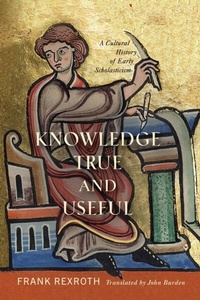
Knowledge True and Useful
Description

A radical shift took place in medieval Europe that still shapes contemporary intellectual life: freeing themselves from the fixed beliefs of the past, scholars began to determine and pursue their own avenues of academic inquiry. In Knowledge True and Useful, Frank Rexroth shows how, beginning in the 1070s, a new kind of knowledge arose in Latin Europe that for the first time could be deemed "scientific."
In the twelfth century, when Peter Abelard proclaimed the primacy of reason in all areas of inquiry (and started an affair with his pupil Heloise), it was a scandal. But he was not the only one who wanted to devote his life to this new enterprise of "scholastic" knowledge. Rexroth explores how the first students and teachers of this movement came together in new groups and schools, examining their intellectual debates and disputes as well as the lifelong connections they forged with one another through the scholastic communities to which they belonged.
Rexroth shows how the resulting transformations produced a new understanding of truth and the utility of learning, as well as a new perspective on the intellectual tradition and the division of knowledge into academic disciplines-marking a turning point in European intellectual culture that culminated in the birth of the university and, with it, traditions and forms of academic inquiry that continue to organize the pursuit of knowledge today.
All prices
More details
Other editions
Additional editions
Persons
Frank Rexroth is Professor of Medieval History at Georg-August University in Göttingen.
John Burden is Instructor in History at the Rochester Institute of Technology.
Content
- Cover
- Series Page
- Title Page
- Copyright
- Dedication
- Contents
- Note on the English Translation
- Preface
- Chapter 1. Against the Clock
- A Productive Anachronism
- Scholasticism: Learned Knowledge Begins to Reflect on Itself
- Chapter 2. Schools of Loyalty: Teaching and Learning in the Early Middle Ages
- Studying to Be a Good Christian? Early Medieval Schools
- Obliged to Love: The Norms Guiding Teacher-Student Interactions
- Social Groups and Intimacy
- Chapter 3. Groups of Enthusiasts: School as a Utopian Place in the Era of Church Reform
- A Third Way: The Free Schools
- Living in Groups: Personal Needs and Collective Solutions
- Chapter 4. The Renaissance of Scientific Thought and Knowledge (c. 1070-1115)
- Learned Knowledge Becomes Willful
- Higher Knowledge: New Understanding and New Uses
- A New Episteme in the Making
- Chapter 5. Peter Abelard and the New Science
- Accelerating Tradition
- The New Knowledge and Its Modernized Requirements
- Sic et non: Domesticating Error and Defending Doubt
- Chapter 6. Abelard's School: A Social History of Truth
- Lifelong Schooling
- Truth, Probability, Boldness: Disputing Toward the Unreachable
- The New Scholarship Under Fire
- Chapter 7. The Parisian School Environment
- Other Minds, Other Horizons
- The Most Amazing City in the Scholastic Universe
- Europe After 1150: Knowledge Becomes Usable and Interconnective
- Chapter 8. Knowledge Creates and Orders the Things of the World
- Learned and Unlearned: Scholarship and the Layman's Understanding
- School and Abbey: Reciprocal Accreditation
- Scholasticism and Humanism: Two Discourses on Knowledge and Education
- Chapter 9. Truth and Utility
- Experts of Utility: Law and Jurists
- Mutual Perceptions Shape the Habitus
- Chapter 10. "We, the University": The Scholars' Guild
- Paris Just After 1200
- The University of Contrasts
- Epilogue
- List of Abbreviations
- Notes
- Bibliography
- Index
- Acknowledgments

