

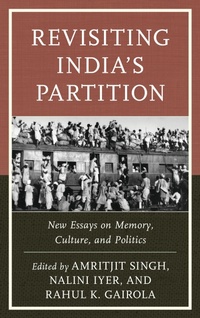
Revisiting India's Partition
New Essays on Memory, Culture, and Politics
Lexington Books (Publisher)
1st Edition
Published on 15. June 2016
400 pages
978-1-4985-3105-4 (ISBN)
Description

Revisiting India's Partition: New Essays on Memory, Culture, and Politics brings together scholars from across the globe to provide diverse perspectives on the continuing impact of the 1947 division of India on the eve of independence from the British Empire. The Partition caused a million deaths and displaced well over 10 million people. The trauma of brutal violence and displacement still haunts the survivors as well as their children and grandchildren. Nearly 70 years after this cataclysmic event, Revisiting India's Partition explores the impact of the "Long Partition," a concept developed by Vazira Zamindar to underscore the ongoing effects of the 1947 Partition upon all South Asian nations. In our collection, we extend and expand Zamindar's notion of the Long Partition to examine the cultural, political, economic, and psychological impact the Partition continues to have on communities throughout the South Asian diaspora.
The nineteen interdisciplinary essays in this book provide a multi-vocal, multi-focal, transnational commentary on the Partition in relation to motifs, communities, and regions in South Asia that have received scant attention in previous scholarship. In their individual essays, contributors offer new engagements on South Asia in relation to several topics, including decolonization and post-colony, economic development and nation-building, cross-border skirmishes and terrorism, and nationalism. This book is dedicated to covering areas beyond Punjab and Bengal and includes analyses of how Sindh and Kashmir, Hyderabad, and more broadly South India, the Northeast, and Burma call for special attention in coming to terms with memory, culture and politics surrounding the Partition.
The nineteen interdisciplinary essays in this book provide a multi-vocal, multi-focal, transnational commentary on the Partition in relation to motifs, communities, and regions in South Asia that have received scant attention in previous scholarship. In their individual essays, contributors offer new engagements on South Asia in relation to several topics, including decolonization and post-colony, economic development and nation-building, cross-border skirmishes and terrorism, and nationalism. This book is dedicated to covering areas beyond Punjab and Bengal and includes analyses of how Sindh and Kashmir, Hyderabad, and more broadly South India, the Northeast, and Burma call for special attention in coming to terms with memory, culture and politics surrounding the Partition.
More details
Edition
1. Auflage
Language
English
Place of publication
New York
United States
Publishing group
Bloomsbury Publishing Plc
Target group
Professional and scholarly
ISBN-13
978-1-4985-3105-4 (9781498531054)
Copyright in bibliographic data and cover images is held by Nielsen Book Services Limited or by the publishers or by their respective licensors: all rights reserved.
Schweitzer Classification
Other editions
Additional editions
Amritjit Singh | Nalini Iyer | Rahul K. Gairola
Revisiting India's Partition
New Essays on Memory, Culture, and Politics
Book
06/2016
Lexington Books
€155.50
Article exhausted; check different version
Persons
Amritjit Singh is Langston Hughes Professor of English & African American Studies
at Ohio University.
Nalini Iyer is professor of English at Seattle University.
Rahul K. Gairola is assistant professor of English and comparative literature at the
Indian Institute of Technology Roorkee, Uttarakhand, India.
at Ohio University.
Nalini Iyer is professor of English at Seattle University.
Rahul K. Gairola is assistant professor of English and comparative literature at the
Indian Institute of Technology Roorkee, Uttarakhand, India.
Content
Introduction
Section I: Approaches to Partition
Chapter 1. "Specters of Democracy/The Gender of Specters: Cultural Memory and the Indian Partition" - Radhika Mohanram
Chapter 2. "Lost Homes, Shifting Borders and the Search For Belonging" - Jasbir Jain
Chapter 3. "A Will to Say or Unsay: Female Silences and Discursive Interventions in Partition Narratives" - Parvinder Mehta
Chapter 4. "Migrations in Absentia: Multinational Digital Advertising and Manipulation of Partition Trauma - Rahul. K. Gairola
Section II: Nations and Narrations
Chapter 5. "Exorcizing the Ghosts of Times Past: Partition Memoirs as Testimony" - Tarun K. Saint
Chapter 6. "Difficult Choices: Work, Family, and Displaced Women in Partition Writings" - Debali Mookerjea-Leonard
Chapter 7. "Refugees as Homo Sacers: Partition and the National Imaginary in The Hungry Tide" - Amrita Ghosh
Section III. Borders and Borderlands
Chapter 8. "Property, Violence and Displacement: Partition in Sindh" - Nandita Bhavnani
Chapter 9. "The Long Shadow of 1947: Partition, Violence and Displacement in Jammu and Kashmir" - Ilyas Chattha
Chapter 10. "From Frontiers to Borders: Partition and the Production of Marginal Spaces in North East India" - Babyrani Yumnam
Chapter 11. "Looking East: Melodramatic Narrative, Ecotheater and the 'Forgotten Long March' in Jangam." - Amit R. Baishya
Section IV. From Pakistan to Bangladesh
Chapter 12. "The Never-Ending Partition: Pakistan's Self-Identification Dilemma"- Amber Fatima Riaz
Chapter 13. "Partition and the Bangladeshi Literary Response" - Kaiser Haq
Chapter 14. "Cosmopolitan Aesthetics in Shakeel Adil Zada's Baazigar"- Masood A. Raja
Chapter 15. "The Nexus of Class, Identity and Politics in the Representational Economy of Partition: The Case of Hasan Azizul Huq" - Mohd. Rezaul Haque
Chapter 16. "Partition and Beyond: Intizar Husain's Quest for Meaning and Vision" - Tasneem Shahnaaz and Amritjit Singh
Section V. Partitions Within
Chapter 17. "Buckle in the Hindu Belt: Contemporary Hindu-Muslim Violence and the Legacy of Partition in Banaras" - Jeremy A. Rinker
Chapter 18. "Hyderabad, Partition, and Hindutva: Strategic Revisitings in Neelkanth's 'Durga' (2005)" - Nazia Akhtar
Chapter 19. "Partition's Others: The View from South India" - Nalini Iyer
Section I: Approaches to Partition
Chapter 1. "Specters of Democracy/The Gender of Specters: Cultural Memory and the Indian Partition" - Radhika Mohanram
Chapter 2. "Lost Homes, Shifting Borders and the Search For Belonging" - Jasbir Jain
Chapter 3. "A Will to Say or Unsay: Female Silences and Discursive Interventions in Partition Narratives" - Parvinder Mehta
Chapter 4. "Migrations in Absentia: Multinational Digital Advertising and Manipulation of Partition Trauma - Rahul. K. Gairola
Section II: Nations and Narrations
Chapter 5. "Exorcizing the Ghosts of Times Past: Partition Memoirs as Testimony" - Tarun K. Saint
Chapter 6. "Difficult Choices: Work, Family, and Displaced Women in Partition Writings" - Debali Mookerjea-Leonard
Chapter 7. "Refugees as Homo Sacers: Partition and the National Imaginary in The Hungry Tide" - Amrita Ghosh
Section III. Borders and Borderlands
Chapter 8. "Property, Violence and Displacement: Partition in Sindh" - Nandita Bhavnani
Chapter 9. "The Long Shadow of 1947: Partition, Violence and Displacement in Jammu and Kashmir" - Ilyas Chattha
Chapter 10. "From Frontiers to Borders: Partition and the Production of Marginal Spaces in North East India" - Babyrani Yumnam
Chapter 11. "Looking East: Melodramatic Narrative, Ecotheater and the 'Forgotten Long March' in Jangam." - Amit R. Baishya
Section IV. From Pakistan to Bangladesh
Chapter 12. "The Never-Ending Partition: Pakistan's Self-Identification Dilemma"- Amber Fatima Riaz
Chapter 13. "Partition and the Bangladeshi Literary Response" - Kaiser Haq
Chapter 14. "Cosmopolitan Aesthetics in Shakeel Adil Zada's Baazigar"- Masood A. Raja
Chapter 15. "The Nexus of Class, Identity and Politics in the Representational Economy of Partition: The Case of Hasan Azizul Huq" - Mohd. Rezaul Haque
Chapter 16. "Partition and Beyond: Intizar Husain's Quest for Meaning and Vision" - Tasneem Shahnaaz and Amritjit Singh
Section V. Partitions Within
Chapter 17. "Buckle in the Hindu Belt: Contemporary Hindu-Muslim Violence and the Legacy of Partition in Banaras" - Jeremy A. Rinker
Chapter 18. "Hyderabad, Partition, and Hindutva: Strategic Revisitings in Neelkanth's 'Durga' (2005)" - Nazia Akhtar
Chapter 19. "Partition's Others: The View from South India" - Nalini Iyer
