

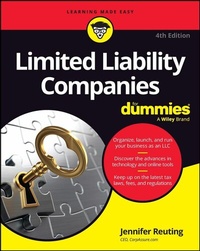
Limited Liability Companies For Dummies
Description

LLCs For Dummies is your comprehensive guide to limited liability companies. You'll explore whether an LLC is the right business structure for your business, how to set up a corporate structure and membership, and the best ways of managing an LLC. Author Jennifer Reuting explains the pros and cons of LLCs and shares insider tips on choosing members, selecting a company name, creating and filing Articles of Organization, managing day-to-day operations, and beyond. This updated edition covers all the latest tax and regulatory information, plus new laws that make it more attractive than ever to start your own business. You'll also find real-world advice on customizing your LLC for your specific business needs, creating a great operating agreement, keeping accurate records, and filing the proper paperwork with Uncle Sam.
* Learn to start a new business by founding a limited liability company (LLC)
* Get a handle on the differences between LLCs and other business structures, including state-specific tips
* Keep up on the latest information on federal taxes, regulations, and fees
* Discover online tools, new documents and forms, and helpful resources
Anyone who wants to learn the best practices of LLC formation, management, and long-term growth will love this beginner-friendly Dummies guide.
More details
Other editions
Additional editions
Person
Content
Part 1: The ABCs of LLCs 7
Chapter 1: What Is an LLC, Really? 9
Chapter 2: LLCs: Handier Than Duct Tape! 23
Chapter 3: Determining Whether an LLC Is Right for You 45
Part 2: Your First Steps: Forming Your LLC 67
Chapter 4: Making a Few Key Decisions 69
Chapter 5: Creating and Filing Your Articles of Organization 97
Chapter 6: Converting Your Current Business into an LLC 109
Part 3: Structuring Your LLC to Work For You 127
Chapter 7: Tell Uncle Sam How It Is! Choosing How You Want to Be Taxed 129
Chapter 8: Make It Official! Getting Started on Your Operating Agreement 143
Chapter 9: Structuring Your Partnership 159
Chapter 10: Using Your LLC to Attract Investors 183
Chapter 11: Membership Moves: Mastering LLC Transfers 197
Part 4: Running Your Brand-New LLC 213
Chapter 12: Maintaining Your Records (and Sanity) 215
Chapter 13: Making Cents of Taxes 229
Chapter 14: Expanding Your Empire: Going National! 243
Chapter 15: Dissolutions: Every Beginning Has an End 253
Part 5: LLCs on Steroids: Advanced Strategies 273
Chapter 16: Using LLCs to Cover Your Ass(ets) 275
Chapter 17: Protecting Real Estate with LLCs 291
Part 6: The Part of Tens 303
Chapter 18: Ten Good Reasons to Form an LLC 305
Chapter 19: Ten Ways to Keep Your Liability Protection Intact 315
Glossary 323
Index 329
Chapter 1
What Is an LLC, Really?
IN THIS CHAPTER
Getting an overview of important LLC topics
Creating your plan of attack
Knowing the essentials for operating an LLC
The Limited Liability Company (more commonly known by its acronym, LLC) is by far the most popular business structure. Only two decades ago, the LLC was the new kid on the block - untrusted and unverified. Luckily, that changed pretty rapidly - LLCs gained popularity and, within a short time, became firmly established in the business world. Since then, LLC has become a household term, and for good reason.
The LLC is a complete divergence from the predominant business structure at the time, the corporation. While corporations have a fixed management structure, LLCs offer flexibility. While corporations have strict rules regarding owners and profit distributions, LLCs are adjustable. While corporations are stuck with corporate taxation (or its limited variant, S corporation taxation), with an LLC, you can select whichever form of taxation you prefer. The added flexibility of the LLC enables you to build a solid foundation for your business that works for your exact circumstances.
Great, right? Well . yes and no. With all the hoopla and the incessant commercials from filing companies, we all know how easy it is to file an LLC. However, very few folks can really explain how an LLC works or why an LLC is right for your situation - or, even worse, how to actually structure an LLC after receiving that one-page filing back from the state. Aside from hiring a pricey attorney to do all the work (not an option for most people), most of your peers don't know how to do simple things like issue the ownership properly or formally agree on what happens if one of the partners wants to leave.
The LLC is a powerful tool, but if you don't know how to use it - how to build that crucial foundation that will support your greatest potential - then it really amounts to nothing more than the piece of paper on which your formation document is printed . and possibly a few lawsuits along the way.
I go into detail on setting up an LLC for your specific circumstances later in the book, but first, I want to give you an overview - or a refresher if you're a seasoned pro - on the meat and bones of this awesome business structure.
Understanding How LLCs Work
Think of an LLC as a partnership on steroids. If you and a buddy were to get together and start a business without registering it as any particular business structure with the state, your business would automatically be considered a general partnership. All business income and losses would be reflected on your personal tax returns. No rigid formalities would be required - you could literally draft your agreements on a napkin.
The problem is, what happens if you want to raise capital? The business is made up of only you and your partner and possibly some assets you've acquired along the way. You can't exactly sell pieces of yourself. Or what if your partner ends up being, well, a jerk? Or even worse, a jerk who runs up a lot of debts that you could be personally responsible for? Eek! As unfair as it sounds, that was the reality for most partnerships.until the LLC came along.
The LLC takes all the best features of a partnership (pass-through taxation - defined at the end of this chapter - and no hefty burdens of corporate formalities) and the best features of a corporation (personal liability protection and ownership shares) and for good measure, adds a few extra perks, like the capability to choose your form of taxation and a formal yet flexible management structure. In addition, the LLC can offer a second layer of liability protection that shields the business from any personal lawsuits that may befall you (referred to as charging order protection, which I elaborate on in Chapter 16).
If all this sounds like Martian to you, don't worry. In this chapter, I dive into some of those benefits and other LLC fundamentals while steering you toward other chapters in the book where you can read about specific topics in more detail.
Owners: You gotta have 'em
Although LLCs are separate from their owners in many ways, LLCs still require owners. An LLC without an owner is like a child without parents: It simply doesn't exist. So, even though you may have called up a filing company and filed your LLC with the state, it doesn't become its own legitimate entity until you go through the process of doling out ownership in your LLC.
The owners of an LLC are called members. They have units of ownership called membership interests that show what percentage of the company they own and how much influence they have when voting on important company matters. Membership interests in an LLC are comparable to stock in a corporation. However, unlike the S corporation, which is often compared to the LLC, an LLC can have unlimited members of any type. Members can be citizens of other countries or even entities, such as corporations, partnerships, or trusts.
Unlike corporations, LLCs offer a lot of flexibility in how you issue membership. For instance, your LLC can have many different forms of membership called classes. You can set whatever rules you like for each class. If you structure them properly, classes are a great way to entice investors or partners to join your business - some folks may want a bigger piece of the profits up front, while others may want more control. For example, one membership class can get first dibs on the profit distributions, while another class only gets paid with what's left over. Or one class can have a say in managing the company, while another class must remain silent. With an LLC, you can mirror the LLC membership classes to match your individual partners' priorities and needs.
The owners of an LLC not only own the entire business and all its assets but also generally have the final say. Although they may not all manage the business's day-to-day operations, they do elect the managers. They vote on important issues and ultimately control the company's fate. In Chapter 9, I go into more detail on membership, including how to issue it and structure it in a way that works for your business.
When it comes to reading state laws, the actual term for LLC members and their membership interests can vary from state to state. For example, in some states, the membership interest is called ownership interest or limited liability company interest. Just keep in mind that no matter what they're called, the concepts are the same.
If your LLC has only one member, it's called a single-member LLC. Unless the single-member LLC elects corporate taxation (which I'll show you how to do in Chapter 7), the IRS treats it as a sole proprietorship - or disregarded entity - for tax purposes.
All states now allow single-member LLCs. (It took a while for a few states to jump on the bandwagon - I'm looking at you, Massachusetts). However, in a few states, because of certain court rulings, single-member LLCs can be disadvantageous for certain purposes - they aren't afforded the benefit of partnership taxation and aren't guaranteed charging order protection, which protects the LLC from lawsuits that may be filed against you personally. I discuss this concept in depth in Chapter 16.
Contributions: Where the money comes from
When you buy a share of stock on the stock market, the money you pay is what you are contributing (or investing) in return for a percentage (or share) of the company's ownership. Well, purchasing ownership in an LLC is very similar: In exchange for a membership interest in the company, a person or company must contribute something of value. This contribution can be in cash, services, hard assets such as equipment, real estate, or even promissory notes (which are allowed in some states).
When a new business is formed, all the initial owners, or founding members, come together and pool the value of their contributions. Let's say Jane contributes $100,000 in cash, Chris contributes $5,000 in cash and $25,000 in services, and Joe contributes an office building worth $150,000. The combined total of their contributions is $280,000. To determine each person's percentage of ownership in the LLC, they simply divide their contributions by the total. The result: Jane gets 35.7 percent, Chris 10.7 percent, and Joe 53.6 percent.
After you figure out each owner's percentage of ownership, determining their membership interest in the company is easy. Given the previous example, if the LLC has 1,000 membership shares, then Jane's 35.7 percent ownership in the company translates to 357 membership shares, Chris's 10.7 percent results in 107 membership shares, and Joe's 53.6 percent results in 536 membership shares. I dive into more details on issuing membership in Chapter 9.
The contributions made by the founding members (those on board when the company was formed) and their corresponding membership interests are listed in the LLC's operating agreement. That way, it's documented that all the owners know what everyone else is contributing to the business and agrees on the value of those contributions.
Things get a bit more...
