

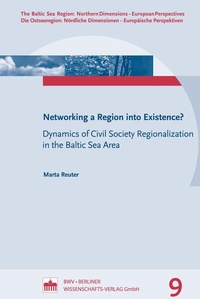
Networking a Region into Existence?
Dynamics of Civil Society Regionalization in the Baltic Sea Area
1st Edition
Published on 4. February 2010
295 pages
978-3-8305-2348-2 (ISBN)
Description

How, and why, does a cross-border regional civil society come into existence? This book sets out to explore the phenomenon of transnationalization and regionalization of civil society through a case study of cross-border NGO cooperation in the Baltic Sea region. The theoretical ambition is to contribute to a greater understanding of the processes behind the formation of a regional civil society, and to propose a conceptual model that would make such understanding easier. At the same time, at the empirical level, the study sheds light on the context-specific factors that have shaped the mode of civil society regionalization in the Baltic Sea area. In the book, the image of the developing regional civil society as seen through the eyes of the involved actors, is set against the background of the New Regionalist ideas that prevailed among observers of Baltic Sea politics in the early 1990s. The investigation shows that the regional civil society cooperation structures around the Baltic Sea are neither as 'civil' - in the sense of being autonomous from the governmental sphere - nor as 'regional' as it has often been assumed. More generally, the results of this study indicate that the process of civil society regionalization is not one that will necessarily lead to the emergence of a particularly regional civil society. Rather, it should be seen as a transition phase in a wider process of civil society transnationalization, where the emerging transnational cooperation structures assume the specifically regional shape as long as it is useful in their pursuit of other interests, the region itself being of a secondary importance.
More details
Other editions
Additional editions
Marta Reuter
Networking a Region into Existence?
Dynamics of Civil Society Regionalization in the Baltic Sea Area
Book
06/2007
Berliner Wissenschafts-Verlag
€39.00
Article exhausted; check different version
Content
- Intro
- Contents
- Abstract
- Acknowledgements
- Abbreviations
- Chapter 1: Introduction
- 1.1 Background: Regionalism and Civil Society
- 1.2 Purpose of the Study
- 1.3 The Baltic Sea Region
- 1.4 Conceptual Framework
- 1.5 Scope and Outline of the Thesis
- Chapter 2: Methods, Materials and Concepts Used
- 2.1 Question of Epistemology
- 2.2 Research Design
- 2.3 Definitions and Analytical Limitations
- 2.4 Materials and Research Techniques
- Part I: Theorizing Civil Society Regionalisation
- Chapter 3: Theory I: Civil Society and its Transnational Dimension
- 3.1 Civil Society - The Concept and its Uses
- 3.1.1 Civil Society in Normative Political Theory
- 3.1.2 Civil Society in Policy Research and Policy-Making
- 3.1.3 Theorizing Civil Society - Summary
- 3.2 Transnational Civil Society
- 3.2.1 »Global Civil Society« - Globalization From Below?
- 3.2.2 Global Civil Society - A Critique
- 3.2.3 Analysing Transnationalization of Civil Society
- 3.2.4 Transnational Civil Society - Summary
- Chapter 4: Theory II: Regionalization of Civil Society
- 4.1 »New« Regionalism and Civil Society
- 4.1.1 The New Regionalism Approach
- 4.1.2 Regionalism Seen Through the Lens of the NRA
- 4.1.3 The NRA and Regionalization of Civil Society
- 4.2 Regionalization of Civil Society - An Analytical Framework
- 4.2.1 The General Framework
- 4.2.2 Inside Regional Civil Society Structures: Three Dimensions of Cooperation
- Part II: The Baltic Sea Region Case
- Chapter 5: Case Background I: Baltic Sea Area as a New Regionalist Project
- 5.1 Constructing the Region
- 5.2 Regional Identity
- 5.3 The »Bottom-Up« Region
- 5.4 Along the East-West Frontier
- 5.5 The Region-Building Discourse - Concluding Remarks
- Chapter 6: Case Background II: Civil Society in the Baltic Sea Region
- 6.1 The Domestic Contexts of Civil Society
- 6.1.1 Norden
- 6.1.2 Germany
- 6.1.3 Poland and the Baltic States
- 6.1.4 Russia
- 6.1.5 Civil Society across the Baltic Sea Region
- 6.2 Transnational Civil Society Cooperation
- 6.2.1 Cross-border Civil Society Networking
- 6.2.2 Civil Society and Regional Integration
- 6.2.3 Regional Civil Society? The Issues at Stake
- Chapter 7: Introducing the Empirical Case: The Networks and the Cooperation
- 7.1 The Networks
- 7.2 Cooperation: The General Patterns
- 7.3 Why Network?
- 7.4 The Question of Purpose
- 7.5 The Networks: Concluding Remarks
- Chapter 8: The »Bottom-up« Dimension of NGO Cooperation
- 8.1 Networks and GOS - A Question of Distance
- 8.2 Public Visibility and Prestige
- 8.3 Expectations towards GOS
- 8.4 Bottom-Up Cooperation? Concluding Remarks
- Chapter 9: The »Regionality« Dimension of NGO Cooperation
- 9.1 The Networks and the Region
- 9.2 A Transnational Space for Civil Society?
- 9.3 The Regional Logic of Cooperation
- 9.4 Regionality: Concluding Remarks
- Chapter 10: The »Partnership« Dimension of NGO Cooperation
- 10.1 Internal Democracy and Equality
- 10.2 Aims of Networking Seen from East and West
- 10.3 The Mission
- 10.4 The Impact of Financial Arrangements
- 10.5 Equality and Partnership?
- 10.6 Partnership: Concluding Remarks
- Part III: Concluding Discussion
- Chapter 11: Regionalization of Civil Society: Theory and Reality
- 11.1 Regional Civil Society in the Baltic Sea Area?
- 11.1.1 The Three Dimensions of Baltic Sea Regional Civil Society Cooperation
- 11.1.2 A Regional Civil Society?
- 11.1.3 Beyond the Divide? Final Remarks
- 11.2 Regionalization of Civil Society - Theoretical Implications
- 11.2.1 The Three Analytical Dimensions
- 11.2.2 The General Assumptions of the Analytical Model
- 11.2.3 Final Reflections
- Bibliography
- Official Documents and Reports, Baltic Sea Region
- Interviews with Networks Participants
- Network Member Organizations Included in the Study
- Observed Network Meetings
- Cited Network/NGO Materials
- Note on the Publication Series
