

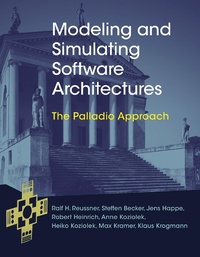
Modeling and Simulating Software Architectures
Description

Too often, software designers lack an understanding of the effect of design decisions on such quality attributes as performance and reliability. This necessitates costly trial-and-error testing cycles, delaying or complicating rollout. This book presents a new, quantitative architecture simulation approach to software design, which allows software engineers to model quality of service in early design stages. It presents the first simulator for software architectures, Palladio, and shows students and professionals how to model reusable, parametrized components and configured, deployed systems in order to analyze service attributes.
The text details the key concepts of Palladio's domain-specific modeling language for software architecture quality and presents the corresponding development stage. It describes how quality information can be used to calibrate architecture models from which detailed simulation models are automatically derived for quality predictions. Readers will learn how to approach systematically questions about scalability, hardware resources, and efficiency. The text features a running example to illustrate tasks and methods as well as three case studies from industry. Each chapter ends with exercises, suggestions for further reading, and "takeaways” that summarize the key points of the chapter. The simulator can be downloaded from a companion website, which offers additional material. The book can be used in graduate courses on software architecture, quality engineering, or performance engineering. It will also be an essential resource for software architects and software engineers and for practitioners who want to apply Palladio in industrial settings.
More details
Other editions
Additional editions
Persons
Steffen Becker is Full Professor of software engineering at Chemnitz University of Technology (TU).
Jens Happe is a Senior Researcher at SAP Research and co-founder of the software start-up avenyou.
Robert Heinrich is Head of Quality-Driven System Evolution Research Group at the Chair of Software Design and Quality, Karlsruhe Institute of Technology (KIT).
Anne Koziolek is a Junior Professor of software engineering and head of the Architecture Driven Requirements Engineering Group at the Karlsruhe Institute of Technology (KIT).
Heiko Koziolek is a Principal Scientist and Global Research Area Coordinator at ABB Corporate Research.
Max Kramer is a Scientist at the Chair of Software Design and Quality, Karlsruhe Institute of Technology (KIT).
Dr.-Ing. Klaus Krogmann is the manager quality engineering platform with Citrix, GetGo.
Content
- Intro
- Title page
- Copyright page
- Table of Contents
- Foreword
- Preface
- Acknowledgments
- About the Editors
- Part I An Engineering Approach to Software Architecture
- 1 Introduction
- 2 Palladio in a Nutshell
- Part II Architectural Modeling
- 3 Architectural Viewpoints
- 4 Architectural Reuse
- Part III Architectural Analysis
- 5 Modeling Quality
- 6 Getting the Data
- 7 Answering Design Questions
- 8 Under the Hood
- Part IV Embedding into the Software Engineering Process
- 9 Software Engineering Processes
- 10 Relation to Requirements Engineering
- 11 Relation to Implementation
- Part V Case Studies
- 12 Workload-Aware Monitoring of a 1&1 E-mail System
- 13 Design Trade-offs in IBM Storage Virtualization
- 14 Design Space Exploration for an ABB ASP.NET Server
- Future Trends
- Conclusion
- Epilogue: A Brief History of Palladio
- References
- Contributors
- Index
