

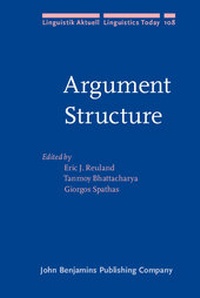
Argument Structure
1st Edition
Published on 28. November 2007
XVIII, 243 pages
978-90-272-9126-4 (ISBN)
Description

Recent developments in the generative tradition have created new interest in matters of argument structure and argument projection, giving prominence to the discussion on the role of lexical entries. Particularly, the more traditional lexicalist view that encodes argument structure information on lexical entries is now challenged by a syntactic view under which all properties of argument structure are taken up by syntactic structure. In the light of these new developments, the contributions in this volume provide detailed empirical investigations of argument structure phenomena in a wide range of languages. The contributions vary in their response to the theoretical questions and address issues that range from the role of specific functional heads and the relation of argument projection with syntactic processes, to the position of argument structure within a broader clausal architecture and the argument structure properties of less studied categories.
More details
Other editions
Additional editions
Eric J. Reuland | Tanmoy Bhattacharya | Giorgos Spathas
Argument Structure
Book
11/2007
John Benjamins Publishing Co
€116.60
Shipment within 10-15 days
Persons
Content
- Argument Structure
- Editorial page
- Title page
- LCC data
- Table of contents
- Preface
- List of contributors
- Introduction
- References
- Do verbs have argument structure?
- 1. Background and aims
- 2. Frames
- 3. Made-up verbs
- 4. The verb's flexibility
- 5. A brief note on the role of lexical semantics in syntactic theory
- References
- Projecting argument structure
- 1. Introduction
- 2. Background
- 2.1 Full Interpretation
- 3. Contact verbs
- 3.1 Contact as change
- 3.2 Contact activities
- 3.3 Alternating contact verbs
- 4. Conclusion
- References
- The argument structure of the dative construction
- 1. The dative construction and its alternates
- 2. Dravidian has no adjective
- 3. The dative construction in English
- 4. The possessive construction in English and Hungarian
- 5. A Lexical Relational Structure (LRS) for Experiencer and Possessor theta roles
- 6. The genesis of adjectives
- References
- Syntactic categories and lexical argument structure
- 1. Syntactic categories and argument structure
- 2. Case and the category P
- 3. Postpositions and adjectives in Kannada
- 4. The licensing of imperfect and perfect participles
- 5. Dative experiencer predicates as arguments of nouns
- References
- Adpositions, particles and the arguments they introduce
- 1. Introduction
- 2. P as a universal category
- 2.1 Adposition-like words crosslinguistically
- 2.2 Identifying P in different languages
- 2.2.1 English
- 2.2.2 Chinese
- 2.2.3 Northern Sámi
- 2.3 Cross-linguistic generalizations
- 3. Figure and Ground
- 3.1 Adposition and Ground
- 3.2 Particles
- 3.2.1 Particle and category
- 3.2.2 Particles and constituency
- 3.2.3 Particles and c-selection
- 3.2.4 Particles and s-selection
- 4. Non-spatial P
- 4.1 Metaphorical extensions of spatial P
- 4.2 Grammatical P
- 4.3 Case markers
- 5. Adpositions and verbs
- 5.1 Split-V and Split-P
- 5.2 Arguments of V
- 5.3 Ground in motion
- 5.4 Tense versus specifiers
- 6. Conclusion
- Abbreviations
- References
- Argument structure and aspect
- 1. Introduction
- 2. The two imperfectives
- 3. Mohanan and Mohanan's analysis of aa constructions
- 3.1 The presupposition effect
- 4. Unaccusatives and eventive v
- 4.1 The contrast between the -ukayaa and the -unnu constructions
- 5. Manner adverbs: Further evidence for a focus effect
- 5.1 The position of adverbs
- 6. Summary
- References
- Argument features, clausal structure and the computation
- 1. Introduction
- 2. Background: Case is not a driving force - Person and EPP are
- 3. The structural cases are interpretable
- 4. Grammar is event-speech matching
- 4.1 Clausal architecture I: background
- 4.2 Clausal architecture II: extensions
- 4.3 Evidence: the mysterious First Position Constraint
- 5. Logophoric matching and speech event binding: some initial observations
- 6. Conclusion
- References
- On theta role assignment by feature checking
- 1. Thematic roles in minimalist theory: a problem?
- 2. Fanselow's (2001) arguments against scrambling of argument DPs
- 2.1 Floating quantifiers
- 2.2 Parasitic gaps
- 2.3 Freezing effects
- 2.4 Wh- phrases in situ
- 2.5 Reconstruction
- 2.6 Quantifier scope
- 3. The alternative proposal: the head F that attracts an object
- 4. Scrambling and focus: Kidwai (2000)
- 5. "Theta feature" checking and Attract: Manzini and Roussou (2000)
- 6. The analysis of theta roles as feature bundles
- 7. "Theta features" and thematic roles
- 7.1 General s-selection considerations
- 7.2 Lexical selection of compounds
- 7.3 The Unaccusative Alternation
- 7.4 Motivation for chain formation
- 7.5 Causatives and theta roles
- 8. Conclusion
- References
- Argument prominence and the nature of superiority violations
- 1. Introduction
- 2. Wh patterns in Bangla/Bengali
- 3. What & who patterns and Superiority in English
- 3.1 Animacy distinctions among wh-phrases
- 3.2 Thematic relations and empathetic centre of interest
- 3.3 Prosodic factors
- 3.4 Referential familiarity of expected answers to wh-questions
- 4. Bangla sluicing revisited
- 5. The status of Superiority, and argument prominence
- References
- Look across
- 1. Introduction
- 2. Blocking and its discontents
- 3. Sarcastic causatives
- 4. Look across and sarcastic passives
- References
- Author index
- Subject index
- The series Linguistik Aktuell/Linguistics Today
