

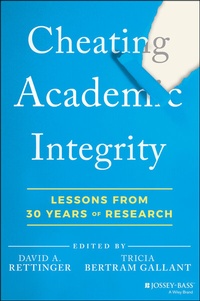
Cheating Academic Integrity
Description

In Cheating Academic Integrity: Lessons from 30 Years of Research, a team of renowned academic integrity experts delivers revealing and practicing insights into the causes of--and solutions to--academic cheating by students. This edited volume combines leading research from an interdisciplinary group of scholars, offering readers an overview of the most important topics and trends in academic integrity research.
The book focuses on teaching, classrooms, and faculty behavior and offers a glimpse into the future of this rapidly developing field. Readers will also find:
* Discussions of the newest forms of cheating, including online "contract cheating" and "paper mills" and the methods used to combat them
* Explorations of the prevalence of cheating and plagiarism between 1990 and 2020
* Psychological perspectives on the student motivations underlying academic integrity violations
* Teaching and learning approaches to reduce academic misconduct in both online and in-person courses
A must-read resource for administrators, leaders, and policymakers involved with higher education, Cheating Academic Integrity also belongs on the bookshelves of school administrators-in-training and others preparing for a career in education.
More details
Other editions
Additional editions
Persons
DAVID A. RETTINGER, PhD, is Professor of Psychological Science and Director of Academic Integrity Programs at the University of Mary Washington. He currently leads the International Center for Academic Integrity's research efforts and served as its President from 2018-20.
TRICIA BERTRAM GALLANT, PhD, is the author of Academic Integrity in the Twenty-First Century and an internationally recognized expert on integrity and ethics in education. She is the director of academic integrity at UC San Diego and has consulted on academic integrity at institutions around the world.
Content
List of Authors xi
Chapter 1 Cheating Academic Integrity: Lessons from 30 Years of Research 1
Tricia Bertram Gallant and David A. Rettinger
Chapter 2 Trends in Plagiarism and Cheating Prevalence: 1990-2020 and Beyond 11
Guy J. Curtis
Chapter 3 The Past and Future of Contract Cheating 45
Thomas Lancaster
Chapter 4 Academic Motivation and Cheating: A Psychological Perspective 65
Eric M. Anderman, Shantanu Tilak, Andrew H. Perry, Jacqueline von Spiegel, Arianna Black
Chapter 5 The Moral Puzzle of Academic Cheating: Perceptions, Evaluations, and Decisions 99
Talia Waltzer and Audun Dahl
Chapter 6 It's in the Pedagogy: Evidence-Based Practices to Promote Academic Integrity 131
Jacqueline A. Goldman, Mariko L. Carson, Jennifer Simonds
Chapter 7 Beyond Doing Integrity Online: A Research Agenda for Authentic Online Education 169
Douglas Harrison and Sharon Spencer
Chapter 8 Celebrating 30 Years of Research on Academic Integrity: A Review of the Most Influential Pieces 201
Ann M. Rogerson, Tricia Bertram Gallant, Courtney Cullen, Robert T. Ives
Chapter 9 The Next 30 Years: Lessons Learned and Predictions about the Future 233
David A. Rettinger, Tricia Bertram Gallant
Index 241
CHAPTER 1
Cheating Academic Integrity: Lessons from 30 Years of Research
Tricia Bertram Gallant1 and David A. Rettinger2
1University of California, San Diego
2University of Mary Washington
To cheat means to "act dishonestly or unfairly in order to gain an advantage" (Oxford Languages). Most readers will bristle at the thought of being lied to or being treated unfairly. This bristle instinct seems to be biological. In 2003, Brosnan and de Waal published a study in Nature showing that capuchin monkeys are exquisitely sensitive to unfairness, including the famous video of one experimental subject throwing cucumbers at the experimenter after witnessing an unfairly generous reward of grapes to another monkey. So, while it seems clear that both humans and monkeys detest unfairness, cheating in school persists. How can this be the case?
Stephens (2019) argued that cheating persists because it is natural and normal; that is, the propensity to cheat (deceive or trick), despite our instinct to avoid unfairness, was developed as a method for survival. This evolutionary development is even exemplified in our contemporary colloquial language such as in the English phrase "cheating death".
It is within this vein that this book is written. The authors in this book illustrate not only how students cheat academic integrity by their decisions, choices and behaviors but also how instructors and higher education institutions cheat academic integrity by their decisions, choices and behaviors. In other words, through this book, we will learn that cheating occurs because of them (the students) and because of us (the faculty and staff).
It is imperative that we, as educators, understand the complex relationship between forces that can serve either to cheat academic integrity or to promote and support it. While cheating may be normal and natural, it is still "unethical and evitable" (Stephens, 2019). It is unethical because left unaddressed, cheating creates tears in the fabric of higher education. Cheating undermines raison dêtre, which can be stated simply as facilitating, assessing, and certifying learning. Given the essential role that higher education plays in twenty-first century economics, democracy, health and sustainability, we cannot afford to idly watch the fabric be torn or participate in the tearing ourselves. The good news is that there is no need to do so. The last 30 years of research has taught us that cheating is evitable; we can do things to mitigate and minimize it.
This book, along with its companion piece (a special issue of the Journal of College and Character, volume 23(1), published in February 2022), illuminates a positive way forward that is not only good for our students but also for our shared goals of growing and certifying knowledge as well as developing ethical citizens and professionals. Both this volume and the special issue were created to celebrate and learn from 30 years of research on academic integrity, a research agenda that can be largely credited to the initial research agenda of Donald McCabe and the formation of the International Center for Academic Integrity (ICAI) in 1992. Together, these two volumes provide researchers, instructors, staff, and administrators with a scholarly perspective on the causes and context of cheating as well as the internal and external factors that serve to either promote and support academic integrity or to cheat academic integrity.
INTRODUCTION OF EACH CHAPTER
The last 30 years of research on academic integrity was vast, so we start at the beginning with two chapters that look at what we know about the prevalence of cheating during this time. First, in Trends in Plagiarism and Cheating Prevalence, Curtis makes an important declaration that may surprise our readers: The prevalence of cheating and plagiarism may have decreased, not increased, over the last 30 years. Curtis posits this may be a result of an increase in preventative measures taken by higher education institutions to enhance awareness of honor and integrity as well as skills in writing with integrity. Despite this good news, though, Curtis warns us that there are threats to integrity not yet realized, including rippling effects of the COVID pandemic and emerging technologies that will require substantive changes to forms of assessment less we be assessing how well machines, rather than our students, are demonstrating knowledge and abilities.
Lancaster picks up on Curtis' idea of "rippling effects" in his piece on contract cheating. Lancaster notes that while the term contract cheating was coined in 2006 and the behavior (arranging for someone else to complete your academic work) existed long before then, the explosion of research on contract cheating really did not occur until 2017. Since that time, our understanding of contract cheating has expanded exponentially. We now know, for example, that friends and families are the most likely providers of contract cheating services, and that remote instruction substantially increased the use of commercial contract cheating providers, especially amongst those that brand themselves as legitimate "homework help sites". Lancaster foreshadows the challenging road ahead for academic integrity with the emerging technologies, such as automated writing and problem solving programs achievable through artificial intelligence. Like Curtis, Lancaster suggests that we must approach education very differently now and in the future from a learning perspective, but Lancaster also adds from a cybersecurity or safety perspective.
So, why are we here, still worrying about cheating and threats to the integrity of the academic enterprise after 30 years of research and hundreds of years of practice? The next two chapters try to answer that question.
First, readers are drawn into the psychological research on cheating as explored by Anderman and colleagues, particularly the research into academic motivation and academic integrity. This chapter reminds us that cheating is rather natural, a normal and expected phenomenon brought on by individual human factors like how and to what we attribute the cause of events (attribution theory), how our goal orientations influence our behaviors (achievement goal theory), how our behaviors are also shaped by what we see happening around us in our environment and by our peers (social-cognitive theory), how our expectations for success or self-efficacy influence our choices and behaviors (Situated Expectancy-Value Theory), and finally, how our needs for autonomy, competence and belonging may dictate how we respond when these need resolution is frustrated (self-determination theory). Anderman and colleagues' review of the research educates us that while these theories explain why cheating is a normal outgrowth of education and development, the research and theories also help us identify solutions to minimize cheating and enhance integrity and learning. Readers interested in crafting their own research agendas to explore academic motivation and academic integrity are provided suggestions for moving the knowledge forward, and those interested in evolving their own teaching to enhance academic integrity may pick and choose from the nine practical suggestions offered in the chapter.
Next, Waltzer and Dahl use insights from psychological theories and research to posit a bold new hypothesis that students do perceive cheating as "wrong", and they act in concordance with this moral judgement the majority of the time. However, when students do cheat, which the authors argue is rare, it happens for one of three psychological causes: 1) students perceive the behavior incorrectly based on the facts available to them; 2) students evaluate the act as cheating but still consider it a better option than an alternative; or 3) students decide the act is cheating but yet acceptable in some circumstances. Waltzer and Dahl use the literature of the last 30 years to level out support for their hypothesis as well as to suggest the resulting implications for research and practice. For example, when do students see cheating as acceptable or not? Do notions of cheating develop or change over time? What types of interventions could be designed to simultaneously target student perceptions, evaluations, and decisions about cheating? Which interventions-in the moment of the cheating decision-might be most effective in enhancing integrity?
This last question provides the perfect segue into the next chapter by Goldman, Carson and Simonds who focus on evidence-based pedagogical practices to promote academic integrity and thus prevent cheating. Goldman and colleagues suggest that the complex interplay of forces shaping cheating can be best addressed not by surveillance or other forms of policing student conduct but by choosing and implementing high-impact pedagogical practices. Such practices like problem-based learning and service learning, not only engage and motivate students in their own learning but they help create a sense of belonging, meet students where they are at in their own lived experiences, and generate an inclusive classroom environment in which academic integrity will be more normative than cheating.
The idea that better pedagogy can address many of the causes of cheating is picked up in the next chapter by Harrison and Spencer, who focus on what we've learned about the relationship between pedagogy and cheating as a result of the pandemic and the abrupt move...
