

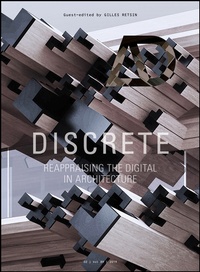
Discrete
Reappraising the Digital in Architecture
1st Edition
Published on 14. March 2019
136 pages
978-1-119-50032-2 (ISBN)
Description

After two decades of experimentation with the digital, the prevalent paradigm of formal continuity is being revised and questioned by an emerging generation of architects and theorists. While the world struggles with a global housing crisis and the impact of accelerated automation on labour, digital designers' narrow focus on mere style and continuous differentiation seems increasingly out of touch.
This issue charts an emerging body of work that is based on a computational understanding of the discrete part or building block - elements that are as scalable, accessible and versatile as digital data. The discrete proposes that a new, digital understanding of assembly, based on parts, contains the greatest promise for a complex, open-ended, adaptable architecture. This approach capitalises on the digital economy and automation, with the potential of the digital to democratise production and increase access.
The digital not only has deep implications for how we design and produce architecture; it is first and foremost a new system of production with economic, social and political consequences that need to be taken into account. This issue presents a diverse body of work focused on the notion of the discrete: from design experiments and aesthetics, to urban models, tectonics, distributed robots, new material organisations and post-capitalist scenarios engaging with automation.
Contributors: Viola Ago, Mario Carpo, Emmanuelle Chiappone-Piriou, Mollie Claypool, Manuel Jimenez García, Daniel Koehler and Rasa Navasaityte, Immanuel Koh, Neil Leach, Ryan Manning, Philippe Morel, M Casey Rehm, Jose Sanchez, Marrikka Trotter, Manja van de Worp, Maria Yablonina and Lei Zheng.
Featured Architects: Kengo Kuma, Lab-eds, Plethora Project, MadM, EZCT, Eragatory and Studio Kinch.
More details
Other editions
Additional editions

Discrete
Reappraising the Digital in Architecture
Book
03/2019
1st Edition
Wiley
Unfortunately, price unknown
Article exhausted; check different version
Person
Gilles Retsin is Tutor at The Bartlett (UCL) and a Senior Lecturer at the University of East London. Having studied in Belgium, Chile and the UK, he worked as a project architect with Christian Kerez in Switzerland and with Kokkugia in London. He now has his own London-based practice. His work has been acquired by the Centre Pompidou in Paris. He has exhibited internationally in museums, such as the Museum of Art and Design in New York, the Vitra Design Museum in Weil-am-Rhein, Design Exchange Toronto and the Zaha Hadid Gallery in London. He has been invited professor at the Texas A&M University and has lectured and taught internationally.
Content
- Cover
- Title Page
- Copyright Page
- Contents
- About the Guest-Editor
- Introduction: Discrete Architecture in the Age of Automation
- Computational Parts
- Moving On From Craft
- A Discrete Paradigm for Design and Production
- A New Platform
- Notes
- The Origins of Discretism: Thinking Unthinkable Architecture
- In Search of Foundations
- The Supremacy of Effectiveness
- Notes
- Architecture for the Commons: Participatory Systems in the Age of Platforms
- Dissolution of Tectonics
- The Discrete Proposition
- Platform Design
- Rethinking the Socio-Economic Implications of Design Frameworks
- Notes
- Mereological Thinking: Figuring Realities within Urban Form
- Beyond Quantities
- What Can Mereology Do For Architecture?
- Parts Without Wholes
- Part to Part
- Thinking Parts
- Notes
- Bits and Pieces: Digital Assemblies: From Craft to Automation
- Automation as Design Project
- Digital Syntax
- Low Resolution
- Notes
- Our Automated Future: A Discrete Framework for the Production of Housing
- Finally, We Are Digital
- Prosumerist Co-production
- Automated Redistribution
- Towards Discrete Continuity
- Notes
- Rubens Structures: A Different Lightness Through Performance Adaptability
- Difference in Degree
- Continuous Equilibrium
- Efficiency Through Redundancy
- New Models of Structural Analysis
- The Future of Structural Time-Based Variation
- Notes
- Distributed Fabrication: Cooperative Making with Larger Groups of Smaller Machines
- The Robot Arm is Not (Always) the Solution
- Co-designing the Process, the Machine and the Artefact
- Experimenting with Heterogeneous Robot Teams for Filament Materials
- A Larger Library of Robotic Tools and Processes
- Notes
- Discrete Flexibility: Computing Lightness in Architecture
- Computing Lines
- Softmodelling
- Digital Bamboo
- Discrete Lightness
- Towards Universal Flexibility
- Notes
- Et Alia: A Projective History of the Architectural Discrete
- Elements
- Standard Types
- Units and Cells
- Connected Objects
- Bits and Voxels
- Particles and Agents
- The Unassigned
- Notes
- Particlised: Computational Discretism, or The Rise of the Digital Discrete
- A New Visuality
- Material (Dis)continuity
- Excessive Resolution
- Notes
- Complicit: The Creation Of and Collaboration With Intelligent Machines
- The Pixel/Voxel as Raw Material
- Teaching Algorithms to Design
- Spaces From/For Data
- Transforming Design through Nonhuman Collaboration
- Notes
- Discrete Sampling: There Is No Object Nor Field. Just Statistical Digital Patterns
- Statistical Seeing
- Discrete Fields
- Notes
- Series and Other Unit-Based Alternatives: Notes on Contemporary Digital Operations
- Revisiting Systems Aesthetics
- Latourian Networks and Composition
- 'Poppy Red': A Series-Oriented Study
- Notes
- Soft Discrete Familiars: Animals, Blankets and Bricks, Oh My!
- Familar Bricks
- Familiarity in Architectural Form
- Notes
- The Discrete Charm of the Glitch
- Continuity in Discreteness
- Form in Four Dimensions
- Glitch Engines
- Notes
- Meta-Utopia and the Box: Two Stories about Avant-Garde Projects
- Meta-Utopia
- The Box
- Re-instrumentalising the Box?
- Notes
- Counterpoint: There Is No Such Thing as a Digital Building
- The Digital is Not a Style
- The Problem of Architecturalisation
- There is No Such Thing as a Digital Material
- Notes
- Contributors
- EULA
