

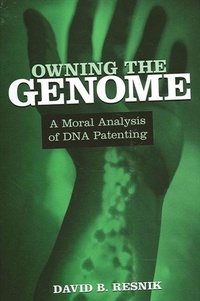
Owning the Genome
Description

DNA patenting has emerged as a hot topic in science policy and bioethics as private companies and government agencies spend billions of dollars on genetic research and development in a race to identify, sequence, and analyze DNA from human, animal, and plant species. David B. Resnik's Owning the Genome explores the ethical, social, philosophical, theological, and policy issues surrounding DNA patenting and develops a comprehensive approach to the topic. Resnik considers arguments for and against DNA patenting and concludes that only a patent on a whole human genome would be inherently immoral, while the morality of other DNA patents depends on their consequences for science, medicine, agriculture, industry, and society. He also stresses the importance of government regulations and policies in order to minimize the harmful effects of patenting while promoting the beneficial ones.
David B. Resnik is Professor of Medical Humanities at the Brody School of Medicine at East Carolina University. He is the author of The Ethics of Science: An Introduction and the coauthor (with Holly B. Steinkraus and Pamela J. Langer) of Human Germline Gene Therapy: Scientific, Moral, and Political Issues and (with Adil E. Shamoo) Responsible Conduct of Research.
More details
Other editions
Additional editions
Person
David B. Resnik is Professor of Medical Humanities at the Brody School of Medicine at East Carolina University. He is the author of The Ethics of Science: An Introduction and the coauthor (with Holly B. Steinkraus and Pamela J. Langer) of Human Germline Gene Therapy: Scientific, Moral, and Political Issues and (with Adil E. Shamoo) Responsible Conduct of Research.
Content
Acknowledgments
Legal Disclaimers
Disclosure Statement
1. Introduction and Overview
2. DNA and Biotechnology
3. DNA as Intellectual Property
4. Arguments for DNA Patenting
5. Patenting Nature?
6. DNA Patents and Human Dignity
7. DNA Patents and Scientific Progress
8. DNA Patents and Medicine
9. DNA Patents and Agriculture
10. Conclusions and Policy Recommendations
Notes
References
Index
