

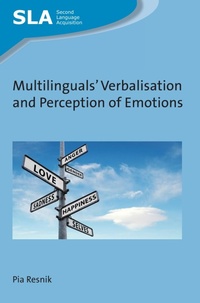
Multilinguals' Verbalisation and Perception of Emotions
Published on 18. June 2018
304 pages
978-1-78892-005-6 (ISBN)
Description

This book investigates the interplay of language, emotion and gender in a multilingual context and provides rich insights into the complexities of bilingualism and the field of emotion research, as well as the intersection of both. Combining quantitative and qualitative analyses of data, the book examines multilinguals' verbalisation and perception of emotions in their first language and English, their second language (L2). The research looks at crosslinguistic, intercultural and gender-based differences, thereby highlighting the challenges faced by multilinguals in this context and the potential risks of miscommunication and misinterpretation. Results support the call for a change of paradigm towards a holistic approach to multilingualism and emotion research and highlight the similarities and differences in L2 users of English when expressing their emotions in the different languages. The book will appeal to anyone interested in research on emotions in the context of bi-/multilingualism or second language acquisition, as well as those teaching or learning multiple languages.
Reviews / Votes
This book represents a major contribution to the research on multilingualism and emotion. Pia Resnik has managed to present an excellent overview of the research to date, to which she now adds her own original analyses and findings. A fascinating read. * Jean-Marc Dewaele, Birkbeck, University of London, UK * Pia Resnik provides a fresh, contemporary understanding of the complex and dynamic interconnections between emotions, language and gender in multilingual and multicultural contexts. It is an exciting, rich and incredibly valuable contribution, which is certain to inspire further research. It is compulsory reading for anyone interested in these areas and I will be recommending it widely. * Sarah Mercer, University of Graz, Austria * A stimulating, novel but logical marriage between emotion studies and multi-competence through well-executed studies, with conclusions for the sheer complexity of this relationship, unexpectedly involving gender and age of acquisition. * Vivian Cook, Emeritus, Newcastle University, UK * This contribution is a very skillful attempt to capture an extensive range of aspectsconcerning affectivity in multilinguals and their perception and expression of emotions in the L1 and the LX. -- Alex Panicacci, Birkbeck College, University of London, UK * International Journal of Bilingual Education and Bilingualism, 2019 * This book offers an important reference in studying language learning emotions. [It] is a recommended reading for those multilingual language teachers and learners, the researchers in the field of language learning and teaching emotions, and those interested in CDST and its wider application in applied linguistics. -- Honggang Liu and Hanxi Li, Northeast Normal University, China * System, September 2019 *
More details
Series
Language
English
Place of publication
Bristol
United Kingdom
Target group
College/higher education
Product notice
Reflowable
ISBN-13
978-1-78892-005-6 (9781788920056)
Copyright in bibliographic data and cover images is held by Nielsen Book Services Limited or by the publishers or by their respective licensors: all rights reserved.
Schweitzer Classification
Other editions
Additional editions
Book
06/2018
Multilingual Matters
€56.30
Shipment within 3-4 weeks
Person
Pia Resnik is a Senior Lecturer at the Department of English of the University of Vienna, Austria. Her research interests include all aspects surrounding multilingual users of English, with a particular focus on emotions in multilingual contexts. Recently, she has started investigating the effect of tandem language learning on students' foreign language enjoyment, foreign language anxiety and learner autonomy, a project she collaborates on with colleagues at King's College London, UK.
Content
List of Illustrations
Figures
Tables
List of Abbreviations
1. Introduction
2. Emotion
3. Language and Emotion: The Two Basic Components of Human Communication
4. Bi-/Multilingualism and Emotion
5. Research Questions, Hypotheses, Independent Variables and Research Design
6. Differences in Feeling? - Multilinguals' Own Views on Verbalising Emotions in the L1 & L2
7. Feeling the Difference? - Verbalising Emotions in ESL
8. Conclusions and Implications
References
Figures
Tables
List of Abbreviations
1. Introduction
2. Emotion
3. Language and Emotion: The Two Basic Components of Human Communication
4. Bi-/Multilingualism and Emotion
5. Research Questions, Hypotheses, Independent Variables and Research Design
6. Differences in Feeling? - Multilinguals' Own Views on Verbalising Emotions in the L1 & L2
7. Feeling the Difference? - Verbalising Emotions in ESL
8. Conclusions and Implications
References
