

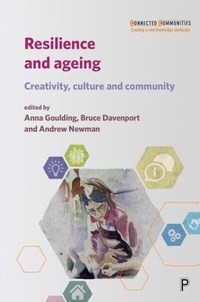
Resilience and Ageing
Creativity, Culture and Community
Policy Press
1st Edition
Published on 19. December 2018
224 pages
978-1-4473-4093-5 (ISBN)
Description

Understanding how creative interventions can help develop social connectivity and resilience for older people is vital in developing a holistic cross-sector approach towards ageing well.
Academics with a wide range of expertise critically reflect on how the built environment, community living, cultural participation, lifelong learning, and artist-led interventions encourage older people to thrive and overcome both challenging life events and the everyday changes associated with ageing.
The book uses a range of approaches, including participatory research methods, to bring the voices of older people themselves to the foreground. It looks at how taking part in creative interventions develops different types of social relationships and fosters resilience.
Academics with a wide range of expertise critically reflect on how the built environment, community living, cultural participation, lifelong learning, and artist-led interventions encourage older people to thrive and overcome both challenging life events and the everyday changes associated with ageing.
The book uses a range of approaches, including participatory research methods, to bring the voices of older people themselves to the foreground. It looks at how taking part in creative interventions develops different types of social relationships and fosters resilience.
Reviews / Votes
"Resilience is an area of growing interest within critical gerontology and policy agendas and in this book, academics with a wide range of expertise critically reflect on waysin which cultural engagement can encourage older people to thrive." Simon Evans, University of Worcester
More details
Series
Edition
First Edition
Language
English
Place of publication
Bristol
United Kingdom
Publishing group
Bristol University Press
Target group
Professional and scholarly
Illustrations
Not illustrated
ISBN-13
978-1-4473-4093-5 (9781447340935)
DOI
https://doi.org/10.51952/9781447340935
Copyright in bibliographic data and cover images is held by Nielsen Book Services Limited or by the publishers or by their respective licensors: all rights reserved.
Schweitzer Classification
Other editions
Additional editions
Anna Goulding | Bruce Davenport | Andrew Newman
Resilience and Ageing
Creativity, Culture and Community
Book
12/2018
1st Edition
Policy Press
€105.20
Shipment within 15-20 days
Anna Goulding | Bruce Davenport | Andrew Newman
Resilience and Ageing
Creativity, Culture and Community
Book
12/2018
1st Edition
Policy Press
€48.70
Shipment within 15-20 days
Resilience and Ageing
Creativity, Culture and Community
E-Book
12/2018
1st Edition
Policy Press
€60.49
Available for download
Persons
Anna Goulding is a Research Associate at the Institute of Health and Society, Newcastle University.
Andrew Newman is Professor of Cultural Gerontology at Newcastle University. His research focuses on resilience, connectivity and community participation.
Bruce Davenport is a Research Associate in Media, Culture, Heritage in the School of Arts & Cultures at Newcastle University
Andrew Newman is Professor of Cultural Gerontology at Newcastle University. His research focuses on resilience, connectivity and community participation.
Bruce Davenport is a Research Associate in Media, Culture, Heritage in the School of Arts & Cultures at Newcastle University
Content
Introduction ~ Anna Goulding;
Setting the field: older people's conceptualisation of resilience and its relationship to cultural engagement ~ Anna Goulding
Ages and Stages: creative participatory research with older people ~ Miriam Bernard, Jill Rezzano and the Ages and
Stages Theatre Company
Social connectivity and creative approaches to dementia care: the case of a poetry intervention ~ Kate de Medeiros and Aagje Swinnen
Narrative identity and resilience for people in later life with dementia living in care homes: the role of visual arts enrichment activities ~
Andrew Newman, Bruce Davenport and Teri Howson-Griffiths
After the earthquake: narratives of resilience, re-signification of fear and revitalisation of local identities in rural communities of Paredones, Chile
~ Cynthia Meersohn Schmidt, Paulina Osorio-Parraguez, Adriana Espinoza and Pamela Reyes
Integrating sense of place within new housing developments: a community-based participatory research approach ~ Mei Lan Fang, Ryan Woolrych, Judith Sixsmith, Sarah L. Canham, Lupin Battersby, Tori Hui Ren and Andrew Sixsmith
Ageing in place: creativity and resilience in neighbourhoods ~ Cathy Bailey, Rose Gilroy, Joanna Reynolds, Barbara Douglas, Claire Webster Saaremets, Mary Nicholls,Laura Warwick and Martin Gollan
Crafting resilience for later life ~ Jackie Reynolds
Oral histories and lacemaking as strategies for resilience in women's craft groups ~ Anna Sznajder and Katarzyna Kosmala
Objects of loss: resilience, continuity and learning in material culture relationships ~ Helen Manchester
Later-life gardening in a retirement community: sites of identity, resilience and creativity ~ Evonne Miller, Geraldine Donoghue, Debra Sullivan
and Laurie Buys
Setting the field: older people's conceptualisation of resilience and its relationship to cultural engagement ~ Anna Goulding
Ages and Stages: creative participatory research with older people ~ Miriam Bernard, Jill Rezzano and the Ages and
Stages Theatre Company
Social connectivity and creative approaches to dementia care: the case of a poetry intervention ~ Kate de Medeiros and Aagje Swinnen
Narrative identity and resilience for people in later life with dementia living in care homes: the role of visual arts enrichment activities ~
Andrew Newman, Bruce Davenport and Teri Howson-Griffiths
After the earthquake: narratives of resilience, re-signification of fear and revitalisation of local identities in rural communities of Paredones, Chile
~ Cynthia Meersohn Schmidt, Paulina Osorio-Parraguez, Adriana Espinoza and Pamela Reyes
Integrating sense of place within new housing developments: a community-based participatory research approach ~ Mei Lan Fang, Ryan Woolrych, Judith Sixsmith, Sarah L. Canham, Lupin Battersby, Tori Hui Ren and Andrew Sixsmith
Ageing in place: creativity and resilience in neighbourhoods ~ Cathy Bailey, Rose Gilroy, Joanna Reynolds, Barbara Douglas, Claire Webster Saaremets, Mary Nicholls,Laura Warwick and Martin Gollan
Crafting resilience for later life ~ Jackie Reynolds
Oral histories and lacemaking as strategies for resilience in women's craft groups ~ Anna Sznajder and Katarzyna Kosmala
Objects of loss: resilience, continuity and learning in material culture relationships ~ Helen Manchester
Later-life gardening in a retirement community: sites of identity, resilience and creativity ~ Evonne Miller, Geraldine Donoghue, Debra Sullivan
and Laurie Buys
