

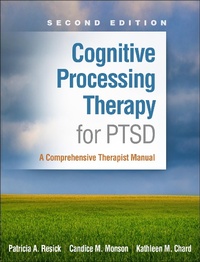
Cognitive Processing Therapy for PTSD
A Comprehensive Therapist Manual
2nd Edition
Published on 10. April 2024
328 pages
978-1-4625-5540-6 (ISBN)
Description

Clinical psychologists, psychiatrists, clinical social workers, counselors, and psychiatric nurses; graduate students and residents. May serve as a supplemental text in graduate-level courses.
More details
Other editions
Additional editions
Patricia A. Resick | Candice M. Monson | Kathleen M. Chard
Cognitive Processing Therapy for PTSD, Second Edition
A Comprehensive Therapist Manual
Book
06/2024
2nd Edition
Guilford Press
€53.50
Shipment within 15-20 days
Persons
Patricia A. Resick, PhD, ABPP, is Professor Emeritus of Psychiatry and Behavioral Sciences at Duke University School of Medicine. She developed cognitive processing therapy (CPT) in 1988 at the University of Missouri-St. Louis, where she founded the Center for Trauma Recovery and was an Endowed Professor. For a decade, she was Director of the Women's Health Sciences Division of the National Center for PTSD. She has conducted numerous randomized controlled trials of CPT with civilians and active-duty military. Dr. Resick has served as president of the International Society for Traumatic Stress Studies (ISTSS) and the Association for Behavioral and Cognitive Therapies (ABCT). She is the recipient of numerous research and mentoring awards, including Lifetime Achievement Awards from Division 56 (Trauma Psychology) of the American Psychological Association, ISTSS, and ABCT.
Candice M. Monson, PhD, is Professor of Psychology at Toronto Metropolitan University in Toronto, Ontario, Canada. A Fellow of the American and Canadian Psychological Associations and the Royal Society of Canada, she is a recipient of the Traumatic Stress Psychologist of the Year Award from the Canadian Psychological Association and the Distinguished Mentorship Award from the International Society for Traumatic Stress Studies. Dr. Monson is well known for her research on interpersonal factors in traumatization and the development, testing, and dissemination of treatments for posttraumatic stress disorder (PTSD), including cognitive processing therapy and cognitive-behavioral conjoint therapy for PTSD.
Kathleen M. Chard, PhD, is Associate Chief of Staff for Research at the Cincinnati Veterans Affairs (VA) Medical Center and Professor of Psychiatry and Behavioral Neuroscience at the University of Cincinnati. She oversees the dissemination of cognitive processing therapy (CPT) to VA clinicians across the United States and is President of the CPT Training Institute. Dr. Chard is a recipient of the Mark Wolcott Award for Excellence in Clinical Care Leadership from the VA and the Heroes of Military Medicine Award from the United Service Organization. She is known for her research on dissemination and clinical implementation of evidence-based trauma treatments for civilians, first responders, and veterans, and she is the creator of the CPT for Sexual Abuse treatment manual.
Candice M. Monson, PhD, is Professor of Psychology at Toronto Metropolitan University in Toronto, Ontario, Canada. A Fellow of the American and Canadian Psychological Associations and the Royal Society of Canada, she is a recipient of the Traumatic Stress Psychologist of the Year Award from the Canadian Psychological Association and the Distinguished Mentorship Award from the International Society for Traumatic Stress Studies. Dr. Monson is well known for her research on interpersonal factors in traumatization and the development, testing, and dissemination of treatments for posttraumatic stress disorder (PTSD), including cognitive processing therapy and cognitive-behavioral conjoint therapy for PTSD.
Kathleen M. Chard, PhD, is Associate Chief of Staff for Research at the Cincinnati Veterans Affairs (VA) Medical Center and Professor of Psychiatry and Behavioral Neuroscience at the University of Cincinnati. She oversees the dissemination of cognitive processing therapy (CPT) to VA clinicians across the United States and is President of the CPT Training Institute. Dr. Chard is a recipient of the Mark Wolcott Award for Excellence in Clinical Care Leadership from the VA and the Heroes of Military Medicine Award from the United Service Organization. She is known for her research on dissemination and clinical implementation of evidence-based trauma treatments for civilians, first responders, and veterans, and she is the creator of the CPT for Sexual Abuse treatment manual.
Content
Preface
I. Background on Posttraumatic Stress Disorder and Cognitive Processing Therapy
1. The Origins of Cognitive Processing Therapy
2. Research on CPT
3. Pretreatment Assessment
4. Cognitive Case Conceptualization
5. Preparing to Deliver CPT
II. CPT Manual
6. Session 1: Overview of PTSD and CPT
7. Session 2: Impact Statement
8. Session 3: ABC Worksheets
9. Session 4: Processing the Index Event
10. Session 5: Exploring Questions
11. Session 6: Thinking Patterns
12. Session 7: Alternative Thoughts Worksheets
13. Session 8: Trauma Themes--Safety
14. Session 9: Trauma Themes--Trust
15. Session 10: Trauma Themes--Power/Control
16. Session 11: Esteem
17. Session 12--Intimacy and Facing the Future
III. Alternatives in Delivery and Special Considerations
18. Variations in CPT
19. Group CPT
20. Individual Variation in Client Presentations
Appendix A: Materials for Therapists
Appendix B: Simplified Worksheets
References
Index
I. Background on Posttraumatic Stress Disorder and Cognitive Processing Therapy
1. The Origins of Cognitive Processing Therapy
2. Research on CPT
3. Pretreatment Assessment
4. Cognitive Case Conceptualization
5. Preparing to Deliver CPT
II. CPT Manual
6. Session 1: Overview of PTSD and CPT
7. Session 2: Impact Statement
8. Session 3: ABC Worksheets
9. Session 4: Processing the Index Event
10. Session 5: Exploring Questions
11. Session 6: Thinking Patterns
12. Session 7: Alternative Thoughts Worksheets
13. Session 8: Trauma Themes--Safety
14. Session 9: Trauma Themes--Trust
15. Session 10: Trauma Themes--Power/Control
16. Session 11: Esteem
17. Session 12--Intimacy and Facing the Future
III. Alternatives in Delivery and Special Considerations
18. Variations in CPT
19. Group CPT
20. Individual Variation in Client Presentations
Appendix A: Materials for Therapists
Appendix B: Simplified Worksheets
References
Index
