

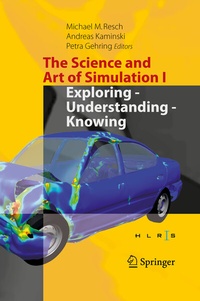
The Science and Art of Simulation I
Description

The new book series "The Science and Art of Simulation" (SAS) addresses computer simulations as a scientific activity and engineering artistry (in the sense of a techne). The first volume is devoted to three topics:
1. The Art of Exploring Computer Simulations
Philosophy began devoting attention to computer simulations at a relatively early stage. Since then, the unquestioned point of view has been that computer simulation is a new scientific method; the philosophy of simulation is therefore part of the philosophy of science. The first section of this volume discusses this implicit, unchallenged assumption by addressing, from different perspectives, the question of how to explore (and how not to explore) research on computer simulations. Scientists discuss what is still lacking or considered problematic, while philosophers draft new directions for research,and both examine the art of exploring computer simulations.
2. The Art of Understanding Computer Simulations
The results of computer simulations are integrated into both political and social decisions. It is implicitly assumed that the more detailed, and consequently more realistic, a computer simulation is, the more useful it will be in decision-making. However, this idea is by no means justified. Different types of computer simulations have to be differentiated, which in turn requires the specific skill of understanding computer simulation results. The articles in this section examine the capabilities and limits of simulation results in political and social contexts, exploring the art of understanding computer simulation results.
3. The Art of Knowing through Computer Simulations?
The advent of computer simulation in today's scientific practices challenges the order of science. What kind of knowledge is gained through computer simulations is the key question in this section. Computer simulations are often compared to experiments or to arguments, and the transformation of our traditional scientific notions might be more challenging than expected - these Ideas are put forward in the third section to conceptualize the art of knowing through computer simulations.
More details
Other editions
Additional editions
Persons
Content
2 - Introduction [Seite 7]
2.1 - 1 How to Explore Computer Simulations? [Seite 10]
2.2 - 2 How to Understand the Results of Computer Simulations? [Seite 10]
2.3 - 3 How to Gain Knowledge Through Computer Simulations? [Seite 10]
2.4 - References [Seite 10]
3 - Part I: The Art of Exploring Computer Simulations [Seite 12]
3.1 - Doing Research on Simulation Sciences? Questioning Methodologies and Disciplinarities [Seite 13]
3.1.1 - 1 Unity Does Not Follow from Novelty: On Simulation as an Object of Research [Seite 14]
3.1.2 - 2 Who Researches How Simulation Research Does Research? Interrelating and Extending the Observer Perspective [Seite 17]
3.1.2.1 - 2.1 [Seite 18]
3.1.2.2 - 2.2 [Seite 19]
3.1.2.3 - 2.3 [Seite 20]
3.1.2.4 - 2.4 [Seite 21]
3.1.3 - 3 Interdisciplinary Evaluative Research: Taking Simulation Sciences Seriously [Seite 21]
3.1.3.1 - 3.1 [Seite 22]
3.1.3.2 - 3.2 [Seite 22]
3.1.3.3 - 3.3 [Seite 23]
3.1.3.4 - 3.4 [Seite 23]
3.1.3.5 - 3.5 [Seite 23]
3.1.4 - 4 In Lieu of a Conclusion [Seite 24]
3.1.5 - References [Seite 24]
3.2 - On the Missing Coherent Theory of Simulation [Seite 26]
3.2.1 - 1 Introduction [Seite 26]
3.2.2 - 2 The Technical-Scientific Conception of Simulation [Seite 27]
3.2.3 - 3 Core Sciences of Simulation [Seite 29]
3.2.3.1 - 3.1 Mathematics [Seite 29]
3.2.3.2 - 3.2 Computer Science [Seite 30]
3.2.4 - 4 Applied Sciences of Simulation [Seite 31]
3.2.5 - 5 Science Theory of Simulation [Seite 32]
3.2.6 - 6 Socio-Scientific Theory of Simulation [Seite 33]
3.2.6.1 - 6.1 Meaning of Simulation for Political Action Processes [Seite 33]
3.2.6.2 - 6.2 Meaning of the Perception of Simulation in Society [Seite 33]
3.2.7 - 7 Questions [Seite 34]
3.2.8 - References [Seite 35]
3.3 - The Art of Staging Simulations: Mise-en-scène, Social Impact, and Simulation Literacy [Seite 36]
3.3.1 - 1 Introduction [Seite 36]
3.3.2 - 2 Poietic Simulation [Seite 37]
3.3.2.1 - 2.1 Mimesis One, Two, Three [Seite 38]
3.3.2.2 - 2.2 Composing Simulations [Seite 40]
3.3.2.2.1 - 2.2.1 Simulation and Prefiguration [Seite 41]
3.3.2.2.2 - 2.2.2 Simulation Configuration [Seite 41]
3.3.2.2.3 - 2.2.3 Refiguring Simulations [Seite 42]
3.3.3 - 3 Mise-en-scène and Presentation Impact [Seite 43]
3.3.4 - 4 Staging of Simulations and Simulation Literacy [Seite 46]
3.3.4.1 - 4.1 Refiguration Signals [Seite 47]
3.3.4.2 - 4.2 Irony or Lie? Simulation or Deceit? [Seite 48]
3.3.5 - 5 Conclusion [Seite 51]
3.3.6 - References [Seite 52]
3.4 - Myths of Simulation [Seite 54]
3.4.1 - 1 Introduction [Seite 54]
3.4.2 - 2 What Is Simulation? [Seite 56]
3.4.3 - 3 Myths of Simulation [Seite 57]
3.4.3.1 - 3.1 Myth 1: Computer Simulation Is a Virtual Experiment [Seite 57]
3.4.3.2 - 3.2 Myth 2: Computer Simulation Is Exact [Seite 59]
3.4.3.3 - 3.3 Myth 3: Computers Can Simulate Anything [Seite 61]
3.4.4 - 4 Conclusions [Seite 63]
3.4.5 - References [Seite 64]
4 - Part II: The Art of Understanding Computer Simulations [Seite 67]
4.1 - Understanding Social Science Simulations: Distinguishing Two Categories of Simulations [Seite 68]
4.1.1 - 1 Introduction [Seite 68]
4.1.2 - 2 Two Types of Social Science Simulations [Seite 70]
4.1.2.1 - 2.1 Simulations STE [Seite 71]
4.1.2.2 - 2.2 Simulations SE [Seite 71]
4.1.2.3 - 2.3 Two Model Cases [Seite 72]
4.1.3 - 3 Understanding the Results of Simulations [Seite 74]
4.1.3.1 - 3.1 What-If-Things-Had-Been-Different Questions as a Basis of Inferential Performance Constitutive of Understanding [Seite 75]
4.1.3.2 - 3.2 Understanding the Results of Simulations STE and Simulations SE [Seite 76]
4.1.3.3 - 3.3 Understanding the Results of the Model Cases [Seite 77]
4.1.4 - 4 The Challenge of Opacity [Seite 78]
4.1.4.1 - 4.1 Opacity Versus Epistemic Transparency [Seite 79]
4.1.4.2 - 4.2 Loss of Understanding [Seite 80]
4.1.4.3 - 4.3 Relevance for Social Science Simulations [Seite 81]
4.1.5 - 5 Conclusions [Seite 82]
4.1.6 - References [Seite 83]
4.2 - Seven Problems with Massive Simulation Models for Policy Decision-Making [Seite 86]
4.2.1 - 1 Introduction [Seite 86]
4.2.2 - 2 MSM vs. ASM [Seite 87]
4.2.3 - 3 The Case of Vaccination Policy Modeling [Seite 89]
4.2.4 - 4 Seven Problems with MSMs for Policy Purposes [Seite 92]
4.2.4.1 - 4.1 What Is the Target? [Seite 92]
4.2.4.2 - 4.2 How to Measure Parameters [Seite 94]
4.2.4.3 - 4.3 Number of Parameters [Seite 95]
4.2.4.4 - 4.4 Number of Mechanisms [Seite 97]
4.2.4.5 - 4.5 Counterfactual Questions [Seite 98]
4.2.4.6 - 4.6 Structural Uncertainty [Seite 99]
4.2.4.7 - 4.7 Match with Decision Tools [Seite 100]
4.2.5 - 5 Conclusions [Seite 101]
4.2.6 - References [Seite 101]
4.3 - Between Knowledge and Action: Conceptualizing Scientific Simulation and Policy-Making [Seite 103]
4.3.1 - 1 Introduction [Seite 103]
4.3.2 - 2 Scientific Simulations and Policy-Making Compatibilities [Seite 104]
4.3.3 - 3 A Systemic Perspective: Simulations Modes of Knowledge and Communication [Seite 107]
4.3.4 - 4 An Impact Perspective: Simulation Use by Policy [Seite 110]
4.3.5 - 5 An Evaluation Perspective: Quality Assessment of Simulations [Seite 113]
4.3.6 - 6 Conclusions [Seite 116]
4.3.7 - References [Seite 116]
5 - Part III: The Art of Knowing Through Computer Simulations [Seite 119]
5.1 - Outlines of a Pragmatic Theory of Truth and Error in Computer Simulation [Seite 120]
5.1.1 - 1 Models of and Models for [Seite 122]
5.1.2 - 2 The Application of Simulation [Seite 123]
5.1.3 - 3 Which Theory of Truth Is Appropriate for Computer Simulation? [Seite 124]
5.1.4 - 4 Why a Pragmatic Theory of Truth? [Seite 126]
5.1.5 - 5 Features of a Pragmatic Theory of Truth [Seite 128]
5.1.6 - 6 Balance of a Pragmatic Theory of Truth in Simulation Research [Seite 130]
5.1.7 - 7 An Amendment: The Pragmatic Theory of Error [Seite 132]
5.1.8 - References [Seite 134]
5.2 - The Demon´s Fallacy: Simulation Modeling and a New Style of Reasoning [Seite 136]
5.2.1 - 1 Introduction [Seite 136]
5.2.2 - 2 The Classic Viewpoint: Rational Mechanics [Seite 137]
5.2.3 - 3 Combination Rather than Analysis [Seite 139]
5.2.4 - 4 Schema of Simulation Modeling [Seite 140]
5.2.5 - 5 The Argument by Way of Two Examples [Seite 142]
5.2.5.1 - 5.1 Equations of State in Thermodynamics [Seite 142]
5.2.5.2 - 5.2 Quantum Chemistry [Seite 145]
5.2.6 - 6 Conclusion [Seite 149]
5.2.7 - References [Seite 149]
5.3 - Advancing Knowledge Through Computer Simulations? A Socratic Exercise [Seite 151]
5.3.1 - 1 Introduction [Seite 151]
5.3.2 - 2 Knowledge [Seite 153]
5.3.3 - 3 Propositional Content [Seite 156]
5.3.4 - 4 Justification [Seite 162]
5.3.5 - 5 Conclusions [Seite 169]
5.3.6 - References [Seite 170]
5.4 - Varieties of Simulations: From the Analogue to the Digital [Seite 173]
5.4.1 - 1 Introduction [Seite 173]
5.4.2 - 2 The Analogue-Digital Distinction [Seite 175]
5.4.3 - 3 Varieties of Simulations [Seite 178]
5.4.3.1 - 3.1 Analogue Simulations as Part of the Laboratory Instrumentaria [Seite 180]
5.4.3.2 - 3.2 The Microcosm of Computer Simulations [Seite 183]
5.4.3.3 - 3.3 Computer Simulations Meet the Laboratory Instrumentaria [Seite 185]
5.4.4 - 4 The Importance of the Analogue-Digital Distinction in the Literature on Computer Simulations [Seite 187]
5.4.5 - References [Seite 189]
