

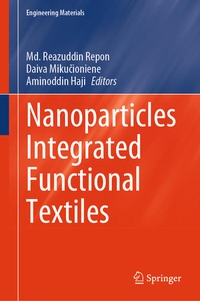
Nanoparticles Integrated Functional Textiles
Description

This book explores the cutting-edge realm of functional textiles with nanoparticle integration, describing the synthesis and fabrication processes of integrating nanoparticles into textiles. From enhanced performance and durability to novel functionalities, this book offers a detailed exploration of the intricate techniques involved. The book unravels the intricate methods that transform ordinary textiles into smart materials with applications spanning healthcare, electronics, and environmental monitoring.
More details
Other editions
Additional editions
Persons
Dr. Md. Reazuddin Repon is currently serving as a Postdoctoral Researcher in the Department of Bioproducts and Biosystems at Aalto University, Finland. Prior to this, Dr. Repon held research and academic positions at the Nature Research Centre, Lithuania; Kaunas University of Technology, Lithuania; Daffodil International University, Bangladesh, and Khwaja Yunus Ali University, Bangladesh. His research focuses on wearable and flexible electronic textiles, smart clothing systems, functional materials, fibre-reinforced composites, and eco-friendly and sustainable textile coloration.
Dr. Daiva Mikucioniene serves as a Professor in the Department of Production Engineering at the Faculty of Mechanical Engineering and Design, Kaunas University of Technology, Lithuania. Her research interests include medical and protective textiles, theoretical modeling and development of knitted structures, and electronic wearables. She has been recognized with the "Gold Spindle" award by the Lithuanian Apparel and Textile Industry Association for her contributions to the development of the Lithuanian textile industry.
Dr. Aminoddin Haji is an Associate Professor in the Department of Textile Engineering at Yazd University, Iran. His research encompasses surface modification of textiles, natural and synthetic dyeing, nanotechnology applications in textiles, and wastewater treatment. He has been recognized among the top 2% of scientists globally by Stanford University and Elsevier since 2022.
Content
Chapter 1. Introduction to nanoparticles, their synthesis, fabrication and applications.- Chapter 2. Nanoparticles integrated UV protective textiles.- Chapter 3. Nanoparticles coated flame retardant textiles.- Chapter 4. Advances in nanoparticles integrated antibacterial textiles.- Chapter 5. Nanoparticles integrated self-cleaning textiles.- Chapter 6. Nanoparticles integrated electro-conductive textiles.
