

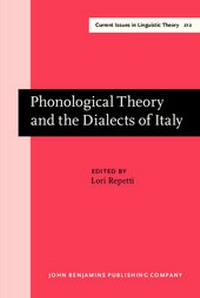
Phonological Theory and the Dialects of Italy
1st Edition
Published on 21. December 2000
X, 301 pages
978-90-272-8441-9 (ISBN)
Description

These articles provide new explorations into phonological patterns attested in the minor Romance languages ('dialects') spoken in Italy. The goal of this book is both theoretical and empirical. First, it aims to introduce non-Italianists to the phonological structures of the Italian dialects, including northern Gallo-Romance dialects, central and southern dialects, plus a Francoprovençal dialect spoken in southern Italy and a Catalan dialect spoken in Sardinia. Second, the collection provides readers with sophisticated analyses of complex and poorly understood and under-studied phonological phenomena. Over half of the articles contain data collected by the authors, and most of the data have not been available in English language publications. The richness of the empirical material and the sophistication of the theoretical analyses make this collection a particularly important contribution to both phonology and Romance language studies.
More details
Other editions
Additional editions
Lori Repetti
Phonological Theory and the Dialects of Italy
Book
12/2000
John Benjamins Publishing Co
€127.20
Shipment within 10-15 days
Person
Content
- PHONOLOGICAL THEORY AND THE DIALECTS OF ITALY
- Editorial page
- Title page
- Copyright page
- Acknowledgements
- Table of contents
- CONTRIBUTORS
- PHONOLOGICAL THEORY AND THE DIALECTS OF ITALY
- 0. Introduction
- 1. The Minor Languages of Italy
- 2. Italian Dialectology
- 3. Summary of Articles
- 4. Conclusion
- REFERENCES
- THE RELATIONSHIP BETWEEN VOWEL LENGTH AND CONSONANTAL VOICING IN FRIULIAN*
- 0. Introduction
- 1. The data
- 2. Approaches to Friulian vowel length
- 3. The Relationship Between Vowel Lengthening and Voicing in Synchronic Friulian: Empirical Evidence
- 4. Acoustic Analysis of Long Vowel + Obstruent Sequences in Friulian
- REFERENCES
- CONSONANT GEMINATION IN NEAPOLITAN
- 0. Introduction
- 1. The Basic Data and the Context for RS
- 2. The Prosodic Status of RS Triggers: Fnc/ Lex
- 3. The Phonology of RS
- 4. Conclusion
- REFERENCES
- THE FEATURE [ADVANCED TONGUE ROOT]AND VOWEL FRONTING IN ROMANCE*
- 0. Introduction
- 1. The Dialect of Altamura
- 2. Theoretical Background of Analysis
- 3. Fronting in the Dialect of Altamura
- 4. Fronting in Old French
- 5. Conclusion
- REFERENCES
- VOWEL ALTERNATION, VOWEL/CONSONANT ASSIMILATION AND OCP EFFECTS IN A BARESE DIALECT*
- 0. Introduction
- 1. Coratino Vowel System
- 2. Vowel Reduction and Retention
- 3. OCP and Tier Scanning
- 4. Labial Vowels in the Stem
- 5. Stem and Suffix
- 6. Low Vowel Reduction
- 7. Conclusion
- REFERENCES
- HOW MANY MORAS?OVERLENGTH AND MAXIMAL MORAICITY IN ITALY
- 0. Introduction
- 1. Evidence of Overlength in Romance Languages
- 2. Problems and Issues in Identifying Overlength and Three Degrees of Length in Italy
- 3. Overlength and Trimoraicity in Bolognese: A Special Case
- 4. Conclusion
- REFERENCES
- STRESS STABILITY UNDER CLITICIZATION AND THE PROSODIC STATUS OF ROMANCE CLITICS*
- 0. Introduction
- 1. Stress Stability in Standard Italian
- 2. (Allegedly) PW-Sensittve Rules in Standard Italian
- 3. PW-Sensitive Rules in Some Romance Dialects of Italy
- 4. Conclusion
- REFERENCES
- PHONOLOGICAL DISSIMILATION AND CLITIC MORPHOLOGY IN ITALO-ROMANCE
- 0. Introduction
- 1. The Nature of Dissimilation
- 2. The Absence of **[l- l-] in Italo-Romance Clitic Sequences
- 3. Typology of Italo-Romance Clitic Dissimilations
- 4. Other 'Morphological' Dissimilations in Italo-Romance
- 5. The Conditioning of Clitic Dissimilation
- REFERENCES
- OXYTONE INFINITIVES IN THE DIALECT OF PISA*
- 1. Oxytone Forms of the Infinitive
- 2. Method of Investigation
- 3. Truncated Infinitives and 'Rafforzamento Fonosintattico'
- 4. Restructuring
- 5. RF is Prosodically Constrained
- 6. Articles Beginning with /l-/
- 7. Clitics
- 8. Degenerate Feet
- 9. Catalexis
- 10. Iambic Feet?
- REFERENCES
- SONORITY AND DERIVED CLUSTERSIN RAETO-ROMANCE AND GALLO-ITALIC
- 0. Introduction
- 1. Preliminaries
- 2. Structural Analyses
- 3. The OT Perspective
- 4. Conclusion
- REFERENCES
- STRESS AND SCHWA IN FAETAR
- 0. Introduction
- 1. Background Phonological Information
- 2. Empirical Evidence of RS in Faetar
- 3. The Problem
- 4. Conclusion
- REFERENCES
- VOWEL LENGTHENING IN MILANESE*
- 0. Introduction
- 1. Vowel Length Distribution in Milanese
- 2. Previous Analyses of Milanese Vowel Lengthening: The Role of Weightand Sonority
- 3. Vowel Lengthening in Milanese: An Optimality Approach
- 4. Conclusion
- REFERENCES
- UNEVEN OR MORAIC TROCHEES?EVIDENCE FROM EMILIAN AND ROMAGNOL DIALECTS*
- 0. Introduction
- 1. Phonological Processes and the Uneven Trochee
- 2. Epenthesis and the Metrical Template
- 3. Conclusions
- REFERENCES
- INDEX OF NAMES
- INDEX OF TERMS & CONCEPTS
