

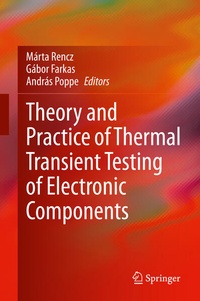
Theory and Practice of Thermal Transient Testing of Electronic Components
Description

This book discusses the significant aspects of thermal transient testing, the most important method of thermal characterization of electronics available today. The book presents the theoretical background of creating structure functions from the measured results with mathematical details. It then shows how the method can be used for thermal qualification, structure integrity testing, determining material parameters, and calibrating simulation models. General practical questions about measurements are discussed to help beginners carry out thermal transient testing. The particular problems and tricks of measuring with various electronic components, such as Si diodes, bipolar transistors, MOS transistors, IGBT devices, resistors, capacitors, wide bandgap materials, and LEDs, are covered in detail with the help of various use cases. This hands-on book will enable readers to accomplish thermal transient testing on any new type of electronics and provides the theoretical details needed tounderstand the opportunities and limitations offered by the methodology. The book will be an invaluable reference for practicing engineers, students, and researchers.
More details
Other editions
Additional editions
Persons
Gábor Farkas, Ph.D., received his MSc in electrical engineering in 1976 and his Ph.D. in 1981 at the Budapest University of Technology and Economics, Hungary, specializing in technical physics. Since then, Dr. Farkas has worked in various fields of microelectronics, from device design to circuit testing. He was visiting scholar at several European universities. His current research focus is on testing high-power devices. He has published his research results in over 100 technical papers.
András Poppe, Ph.D., received his MSc in electrical engineering in 1986 and his Ph.D. in 1996 at the Budapest University of Technology and Economics, Hungary, where he currently works as a professor. In 2019 he obtained a Doctor of the MTA degree from the Hungarian Academy of Science. Dr. Poppe's research interest is modeling and testing devices in microelectronics, focusing on LEDs. He is actively working in various standardization committees to help standardize testing devices in electronics. He has published his research results in over 200 technical papers.
