

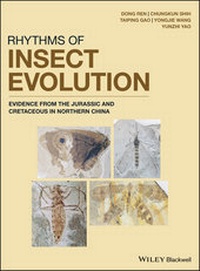
Rhythms of Insect Evolution
Description

Documents morphology, taxonomy, phylogeny, evolutionary changes, and interactions of 23 orders of insects from the Middle Jurassic and Early Cretaceous faunas in Northern China
This book showcases 23 different orders of insect fossils from the Mid Mesozoic period (165 to 125 Ma) that were discovered in Northeastern China. It covers not only their taxonomy and morphology, but also their potential implications on natural sciences, such as phylogeny, function, interaction, evolution, and ecology. It covers fossil sites; paleogeology; co-existing animals and plants in well-balanced eco-systems; insects in the spotlight; morphological evolution and functional development; and interactions of insects with co-existing plants, vertebrates, and other insects. The book also includes many elegant and beautiful photographs, line drawings, and 3-D reconstructions of fossilized and extant insects.
Rhythms of Insect Evolution: Evidence from the Jurassic and Cretaceous in Northern China features chapter coverage of such insects as the: Ephemeroptera; Odonata; Blattaria; Isoptera; Orthoptera; Notoptera; Dermaptera; Chresmodidae; Phasmatodea; Plecoptera; Psocoptera; Homoptera; Heteroptera; Megaloptera; Raphidioptera; Neuroptera; Coleoptera; Hymenoptera Diptera; Mecoptera; Siphonaptera; Trichoptera and Lepidoptera.
- Combines academic natural science, popular science, and artistic presentation to illustrate rhythms of evolution for fossil insects from the Mid Mesozoic of Northern China
- Documents morphology, taxonomy, phylogeny, and evolutionary changes of 23 orders of insects from the Middle Jurassic and Early Cretaceous faunas in Northern China
- Presents interactions of insects with plants, vertebrates, and other insects based on well-preserved fossil evidence
- Uses photos of extant insects and plants, fossil and amber specimens, line drawings, and 3-D computer-generated reconstruction artworks to give readers clear and enjoyable impressions of the scientific findings
- Introduces insect-related stories from western and Chinese culture in text or sidebars to give global readers broader exposures
Rhythms of Insect Evolution: Evidence from the Jurassic and Cretaceous in Northern China will appeal to entomologists, evolutionists, paleontologists, paleoecologists, and natural scientists.
More details
Other editions
Additional editions
Persons
DONG REN, CHUNGKUN SHIH, TAIPING GAO, YONGJIE WANG and YUNZHI YAO are all professors in the College of Life Sciences, Capital Normal University, Beijing, China. Dr. Shih is also a volunteer Research Associate in the National Museum of Natural History, Smithsonian Institution, Washington, D.C., USA.
Content
Preface xi
List of Contributors xiii
Acknowledgements xvii
1 Jurassic-Cretaceous Non-Marine Stratigraphy and Entomofaunas in Northern China 1
Dong Ren
1.1 Introduction 1
1.2 Non-marine Jurassic and Cretaceous Insect Fossil-Bearing Lithostratigraphic Division and Correlation in Northern China 1
1.2.1 Yumen-Jiuquan Basin in Gansu Province 1
1.2.2 Intermountain Volcanic Basins in Beijing-Northern Hebei-Western Liaoning-Southeastern Inner Mongolia 3
1.3 Non-marine Jurassic and Cretaceous Entomofaunas in Northern China 4
1.3.1 Yanliao Entomofauna 5
1.3.2 Jehol Entomofauna in the Yanliao Area 8
1.3.3 Fuxin Entomofauna 10
1.4 Geological Ages of Non-marine Jurassic and Cretaceous Strata and Entomofaunas in Northern China 10
References 12
2 Coexisting Animals and Plants in the Ecosystems 17
Chungkun Shih, Taiping Gao, and Dong Ren
2.1 Introduction 17
2.2 Representative Fossils of Coexisting Animals 17
2.3 Representative Fossils of Coexisting Plants 24
References 28
3 Insects - In the Spotlight 31
Taiping Gao, Chungkun Shih, and Dong Ren
3.1 Introduction to Insects 31
3.2 How to Identify an Insect 31
3.3 Origin and Evolution of Insects 35
References 38
4 A History of Paleoentomology in China 41
Dong Ren, Chungkun Shih, and Taiping Gao
4.1 Introduction 41
4.2 Early Foundational Studies (1923-1935) 41
4.3 Early Taxonomic Studies (1965-1985) 42
4.4 Major Taxonomic Studies (1985-Present) 43
4.5 Phylogenetic and Paleobiological Studies (1991-Present) 44
4.6 International Cooperative Studies (2000-Present) 45
References 48
5 Ephemeroptera - Mayflies 51
MeiWang, Qingqing Lin, Chungkun Shih, and Dong Ren
5.1 Introduction to Ephemeroptera 51
5.2 Progress in the Studies of Fossil Ephemeroptera 53
5.3 Representative Fossils of Ephemeroptera from Northern China 53
References 59
6 Odonata - Dragonflies and Damselflies 63
Qiang Yang, Dong Ren, Hong Pang, and Chungkun Shih
6.1 Introduction to Odonata 63
6.2 Progress in the Studies of Fossil Odonata 66
6.3 Representative Fossils of Odonata from Northern China 66
References 86
7 Blattaria - Cockroaches 91
Junhui Liang, Chungkun Shih, and Dong Ren
7.1 Introduction to Blattaria 91
7.2 Progress in the Studies of Fossil Blattodea 92
7.3 Representative Fossils of Blattaria from Northern China 93
References 109
8 Termitoidae - Termites 113
Zhipeng Zhao, Dong Ren, and Chungkun Shih
8.1 Introduction to Termitoidae 113
8.2 Progress in the Studies of Fossil Termites 115
8.3 Representative Fossils of Termites from Northern China 116
References 117
9 Orthoptera - Grasshoppers and Katydids 121
Jun-Jie Gu, Chungkun Shih, and Dong Ren
9.1 Introduction to Orthoptera 121
9.2 Progress in the Studies of Fossil Orthoptera 122
9.3 Representative Fossils of Orthoptera from Northern China 124
References 134
10 Notoptera - Rock Crawlers and Ice Crawlers 137
Yingying Cui, Chungkun Shih, and Dong Ren
10.1 Introduction to Notoptera (Mantophasmatodea and Grylloblattodea) 137
10.2 Progress in the Studies of Fossil Notoptera (Mantophasmatodea and Grylloblattodea) 138
10.3 Representative Fossils of Notoptera (Mantophasmatodea and Grylloblattodea) from Northern China 139
References 145
11 Dermaptera - Earwigs 149
Mingyue Ren, Chungkun Shih, Changyue Xing, and Dong Ren
11.1 Introduction to Dermaptera 149
11.2 Progress in the Studies of Fossil Dermaptera 150
11.3 Representative Fossils of Dermaptera from Northern China 150
References 155
12 Chresmodidae -Water-Walking Insects 157
Chaofan Shi, Chungkun Shih, and Dong Ren
12.1 Introduction to Chresmodidae 157
12.2 Progress in the Studies of Fossil Chresmodidae 158
12.3 Representative Fossils of Chresmodidae from Northern China 159
References 162
13 Phasmatodea - Stick Insects and Leaf Insects 165
Chaofan Shi, Chungkun Shih, Sha Chen, and Dong Ren
13.1 Introduction to Phasmatodea 165
13.2 Progress in the Studies of Fossil Phasmatodea 166
13.3 Representative Fossils of Phasmatodea from Northern China 168
References 172
14 Plecoptera - Stoneflies 175
Yingying Cui, Chungkun Shih, and Dong Ren
14.1 Introduction to Plecoptera 175
14.2 Progress in the Studies of Fossil Plecoptera 176
14.3 Representative Fossils of Plecoptera from Northern China 176
References 183
15 Psocoptera - Barklice and Booklice 185
RuiqianWang, Yunzhi Yao, Dong Ren, and Chungkun Shih
15.1 Introduction to Psocoptera 185
15.2 Progress in the Studies of Fossil Psocoptera 185
15.3 Representative Fossils of Psocoptera from Northern China 186
References 187
16 Homoptera - Cicadas and Hoppers 189
Ying Wang, Xiao Zhang, Tingying Zhang, Xue Liu, Chungkun Shih, Yunzhi Yao, and Dong Ren
16.1 Introduction to Homoptera 189
16.2 Progress in the Studies of Fossil Homoptera 190
16.3 Representative Fossils of Homoptera from Northern China 192
References 218
17 Heteroptera - True Bugs 225
Sile Du, Shan Lin, Chungkun Shih, Dong Ren, and Yunzhi Yao
17.1 Introduction to Heteroptera 225
17.2 Progress in the Studies of Fossil Heteroptera and Fossil Coleorrhyncha 227
17.3 Representative Fossils of Heteroptera from Northern China 228
References 262
18 Megaloptera - Dobsonflies, Fishflies, and Alderflies 269
Yongjie Wang, Chungkun Shih, and Dong Ren
18.1 Introduction to Megaloptera 269
18.2 Progress in the Studies of Fossil Megaloptera 269
18.3 Representative Fossils of Megaloptera from Northern China 271
References 273
19 Raphidioptera - Snakeflies 275
Hui Fang, Yongjie Wang, Dong Ren, and Chungkun Shih
19.1 Introduction to Raphidioptera 275
19.2 Progress in the Studies of Fossil Raphidioptera 275
19.3 Representative Fossils of Raphidioptera from Northern China 276
References 282
20 Neuroptera - Lacewings 285
Zhenzhen Chen, Shuo Huang, Yu Chang, Yongjie Wang, Chungkun Shih, and Dong Ren
20.1 Introduction to Neuroptera 285
20.2 Progress in the Studies of Fossil Neuroptera 287
20.3 Representative Fossils of Neuroptera from Northern China 290
References 32920.1 Introduction to Neuroptera 285
20.2 Progress in the Studies of Fossil Neuroptera 287
20.3 Representative Fossils of Neuroptera from Northern China 290
References 329
21 Coleoptera - Beetles 337
Yali Yu, Zhenhua Liu, Chungkun Shih, and Dong Ren
21.1 Introduction to Coleoptera 337
21.2 Progress in the Studies of Fossil Coleoptera 342
21.3 Representative Fossils of Coleoptera from Northern China 344
References 414
22 Hymenoptera - Sawflies and Wasps 429
Mei Wang, Longfeng Li, Chungkun Shih, Taiping Gao, and Dong Ren
22.1 Introduction to Hymenoptera 429
22.2 Progress in the Studies of Fossil Hymenoptera 435
22.3 Representative Fossils of Hymenoptera from Northern China 436
References 490
23 Diptera - True Flies with Two Wings 497
Ye Han, Xiuna Ye, Cuiping Feng, Kuiyan Zhang, Chungkun Shih, and Dong Ren
23.1 Introduction to Diptera 497
23.2 Progress in the Studies of Fossil Diptera 500
23.3 Representative Fossils of Diptera from Northern China 501
References 546
24 Mecoptera - Scorpionflies and Hangingflies 555
Xiaodan Lin, Chungkun Shih, Sheng Li, and Dong Ren
24.1 Introduction to Mecoptera 555
24.2 Progress in the Studies of Fossil Mecoptera 558
24.3 Representative Fossils of Mecoptera from Northern China 559
References 589
25 Siphonaptera - Fleas 597
Taiping Gao, Chungkun Shih, and Dong Ren
25.1 Introduction to Siphonaptera 597
25.2 Progress in the Studies of Fossil Fleas 598
25.3 Representative Fossils of Siphonaptera from Northern China 600
References 605
26 Trichoptera - Caddisflies 607
Mei Wang,Weiting Zhang, Chungkun Shih, and Dong Ren
26.1 Introduction to Trichoptera 607
26.2 Progress in the Studies of Fossil Trichoptera 607
26.3 Representative Fossils of Trichoptera from Northern China 608
References 616
27 Lepidoptera - Butterflies and Moths 619
Weiting Zhang, Chungkun Shih, and Dong Ren
27.1 Introduction to Lepidoptera 619
27.2 Progress in the Studies of Fossil Lepidoptera 620
27.3 Representative Fossils of Lepidoptera from Northern China 622
References 629
28 Insect Feeding 631
Chungkun Shih, Taiping Gao, Yunzi Yao, and Dong Ren
28.1 Introduction 631
28.2 PollinationMutualism - Feeding on Pollination Drops Before Angiosperms 631
28.2.1 Scorpionflies with Elongate Siphonate Mouthparts 631
28.2.2 Kalligrammatid Lacewings with Elongate Siphonate Mouthparts 632
28.3 Predation - Preying on Other Insects 635
28.3.1 Mantispid Lacewings with Raptorial Forelegs 635
28.3.2 Dipteromantispidae with Raptorial Forelegs 636
28.3.3 Hangingflies - Bittacidae and Cimbrophlebiidae 636
28.4 Blood Feeding by Ectoparasite Fleas 636
28.5 Blood Feeding by True Bugs 639
28.6 Herbivores: Feeding on Plant Matter as Evidenced by Insect Damage Types 643
References 646
29 Camouflage, Mimicry or Eyespot Warning 651
Chungkun Shih, YongjieWang, and Dong Ren
29.1 Introduction 651
29.2 Camouflage by Fossil Insects 651
29.2.1 Irregular Light and Dark Patches Covering the EntireWing 651
29.2.2 Irregular Dark or Light Markings on Part of the Margin and/or Center ofWing 653
29.2.3 Dispersed Dark Spots Large or Small 654
29.2.4 Dispersed Small Light Spots or Large Light Spots Surrounded by Small Dark Spots 654
29.2.5 Regular Transverse (from Anterior to Posterior Margin) Stripes of Light and Dark Bands 654
29.2.6 Regular Longitudinal (from Base to the Apex) Stripes of Light and Dark Bands 655
29.3 Mimicry by Fossil Insects 655
29.3.1 Ancient Pinnate Leaf Mimicry among Lacewings 656
29.3.2 Mimicry and Mutualism among Hangingflies and Ginkgo Plants 657
29.4 EyespotWarning for Fossil Insects 659
29.4.1 Eyespots and Spots on the Forewings of Kalligrammatids 659
29.5 Summary and Prospects 660
References 662
30 Gene Propagation - Courtship, Mating, and Next Generation 667
Chungkun Shih, Taiping Gao, and Dong Ren
30.1 Introduction 667
30.2 Extreme Sexual Display 667
30.3 Serenade with Love Songs 668
30.4 Sensing and Locating PotentialMates with Ramified Antennae 670
30.5 Forever Love -The Hitherto Earliest Record of Copulating Insects 670
30.6 Long Ovipositors Used for Laying Eggs into Hosts 673
30.7 Breeding - Oviposition, Gall and Leaf Mining 675
References 679
Index 683
1
Jurassic-Cretaceous Non-Marine Stratigraphy and Entomofaunas in Northern China
Dong Ren
Capital Normal University, Haidian District, Beijing, China
1.1 Introduction
Northern China is an administrative and geographical region referring to the area located north of the Yellow River. Since the Late Triassic, the continental area of northern China was formed, and during the Jurassic and Cretaceous, almost all of northern China had become part of the Asian continent except for the southern Tibet, west of the Tarim basin of northwest China and Heilongjiang of northeast China. Thus, the Jurassic to Cretaceous strata of northern China are dominated by terrestrial sediments, volcanic rocks and volcanic sedimentary formations and coal-bearing beds. A great deal of fossils have been found and documented in numerous localities and horizons. The Jurassic and Cretaceous insects have been reported from several localities in Xinjiang, Gansu, Shaanxi, Inner Mongolia, Hebei, Beijing, Liaoning, Jilin and Shandong. Among them, the studies of the Jurassic and Cretaceous insect fossils from the Yumen-Jiuquan Basin, Gansu; Yanliao Area (Beijing-northern Hebei-western Liaoning-southeastern Inner Mongolia) and Laiyang Basin of Shandong have been more extensive, in-depth and detailed than the sporadic reports from other localities.
Using the non-marine insect-bearing stratigraphic occurrences, together with radiometric ages and accompanying fossils, the Jurassic and Cretaceous non-marine strata of northern China can be divided and correlated as shown in Table 1.1.
Table 1.1 Jurassic-Cretaceous non-marine lithostratigraphic division and correlation at selected insect-bearing localities in the northern China. Geological time scale is based on The ICS International Chronostratigraphic Chart (version 2013) [1].
1.2 Non-marine Jurassic and Cretaceous Insect Fossil-Bearing Lithostratigraphic Division and Correlation in Northern China
Non-marine Jurassic and Cretaceous deposits are widely distributed in several basins in northern China, including variegated beds, red beds, coal-bearing horizons, evaporates and volcanics. These deposits, often of great thickness, contain a rich fossil biota and significant oil, coal and non-metallic mineral resources.
A relatively complete non-marine Jurassic and Cretaceous stratigraphic sequence and a stratigraphic correlation have been established in northern China (Table 1.1). There are two main representative stratigraphic sequences containing insect fossils; one occurs in the Yumen-Jiuquan Basin, Gansu, and the other in the Yanliao Area of Beijing-northern Hebei-western Liaoning-eastern Inner Mongolia. These deposits contain a diverse and abundant continental biota, including insects, conchostracans, ostracods, bivalves, gastropods, fish, dinosaurs, birds, reptiles, amphibians, mammals and plants. During the past decades, a number of studies have been published on the non-marine Jurassic and Cretaceous strata of this region [2-4]. Recent radiometric dating results have complemented biostratigraphic studies [5,6]. During the last 10 years, we have undertaken a reassessment of the Jurassic and Cretaceous biostratigraphy of northern China, and have improved the assemblage sequence and zonation for insects and many accompanying fossil groups (Tables 1.2 and 1.3).
In northern China, Jurassic and Cretaceous non-marine insect fossil-bearing rocks can be recognized as two different depositional types: (i) large and stable inland depositional basins without volcanic material which is distributed in northwest China, represented by the Yumen-Jiuquan Basin and (ii) intermountain basins with abundant volcanic intercalations of lavas and tuffs separated and controlled by faults which are distributed in Northeastern China represented by the Beijing-northern Hebei-western Liaoning-southeastern Inner Mongolia basins (Yanliao Area).
1.2.1 Yumen-Jiuquan Basin in Gansu Province
During the mid-Mesozoic, the Yumen-Jiuquan Basin was a representative of large and stable inland depositional basins without volcaniclastic deposits in northwestern China. The Jurassic and Cretaceous non-marine rocks in the Yumen-Jiuquan basin comprise, in ascending order: the Dashankou, Zhongjiangou, Xinhe, Boluo, Chijingqiao, Chijingpu, Xiagou and Zhonggou Formations (Table 1.1).
The Dashankou Formation (maximum thickness, 510 m) consists of a basal gray-green conglomerate and sandstones intercalated with purple-red siltstones and mudstones. It unconformably overlies the Upper Triassic Nanyinger Formation.
The Zhongjiangou Formation (maximum thickness, 174 m) rests conformably on the Dashankou Formation and mainly comprises basal gray conglomerate, middle gray-green sandstones, mudstones and intercalated coals.
The Xinhe Formation (maximum thickness, 600 m) conformably overlies the Zhongjiangou Formation and is mainly composed of yellowish-green and dark gray sandstones intercalated siltstones and mudstones.
The Boluo Formation (maximum thickness, 700 m) conformably overlies the Xinhe Formation and includes purplish-red siltstones, sandstones and conglomerate.
The Chijinqiao Formation (maximum thickness, 200 m) unconformably overlies the Upper Jurassic Boluo Formation or other older strata. It is divided into a lower purplish-red conglomerate and sandstones and upper dark gray and gray-green siltstones, thin-bedded shales and mudstones. It yields abundant Jehol Fauna fossils [7].
The Chijinpu Formation (maximum thickness, 400 m), conformably overlying on the Chijinqiao Formation, is dominated by yellowish-green thick-bedded to massive sandstone and conglomerate beds in the lower part, and gray-black mudstone, sandstone, siltstone intercalated with shale and thin coal beds in the upper part. It contains abundant fossils of the conchostracan Neodiestheria sp. and bivalves Sphaerium jeholensis, S. anderssoni, S. subphanum and abundant Jehol Entomofauna fossils listed in Table 1.2 [7].
Table 1.2 Biostratigraphic sequence of entomofaunas in Northern China during the Jurassic and Cretaceous.
The Xiagou Formation (maximum thickness, 580 m) conformably overlies the Chijinpu Formation and consists of gray-green to purple-red siltstones, interbedded with thinly-bedded mudstone and shales, with abundant insect fossils.
The Zhonggou Formation (maximum thickness, 398 m), conformably overlying on the Xiagou Formation, is unconformably overlain by the Neogene Kuquan Formation and characterized by purple-red siltstones and siltstones.
Table 1.3 Biostratigraphic sequence of entomofaunas with important accompanying fossils in northern China during the Jurassic and Cretaceous.
1.2.2 Intermountain Volcanic Basins in Beijing-Northern Hebei-Western Liaoning-Southeastern Inner Mongolia
Volcanic activities in Northeastern China caused by tectonic movements have been intense throughout the mid Mesozoic period. The Jurassic-Cretaceous strata distributed in the Yanliao Area of Beijing-northern Hebei-western Liaoning-southeastern Inner Mongolia are representative of intermountain basins with abundant volcanic intercalations of lavas and tuffs separated and controlled by faults. Both the renowned Yanliao Biota and Jehol Biota have been found and named in this area originally. The Mesozoic non-marine rocks of Northeastern China have been studied since the 1920s [8], and hundreds of academic papers, including extensive monographs with a stratigraphic context, have been published [ 1-23].
The Jurassic and Cretaceous non-marine rocks in the Yanliao Area can been divided into 10 typical Formations, in ascending order: Xinglonggou, Mentougou, Jiulongshan, Tiaojishan, Tuchengzi, Zhangjiakou, Dabeigou, Yixian, Jiufotang, Fuxin and Sunjiawan Formations (Table 1.1).
The Xinglonggou Formation (maximum thickness, 905 m), unconformably overlies the Upper Triassic Kuntouboluo Formation, is mainly composed of basalts, andesites and tuffaceous conglomerate and is widely distributed in the Yanliao Area.
The Mentougou Formation (maximum thickness, 1330 m) rests disconformably on the Xinglonggou Formation and is characterized by coal-bearing beds, mainly consisting of lacustrine siltstones, mudstones, shales and sandstones, and rich in tuffaceous materials. These coal-bearing rocks have been called as Beipiao Formation in Liaoning Province or Xiahuayuan Formation in Hebei Province. In Beijing the Mentougou Formation can be divided into Upper Longmen Formation and Lower Yaopo Formation.
The Jiulongshan Formation (maximum thickness, 680 m) unconformably overlies the Mentougou Formation. It consists of varicolored fine-grained sandstones, fine conglomerates, siltstones, mudstones and shales, rich in fossils. To date, about 837 insect species in 476 genera,...
